

Four years ago, Georgian director Elene Mikaberidze decided to make a film about her young cousins who were living in the Russian-backed region of Abkhazia. But gaining access proved very difficult as she had to acquire numerous permits and travel passes – and this was all during the early days of Covid.
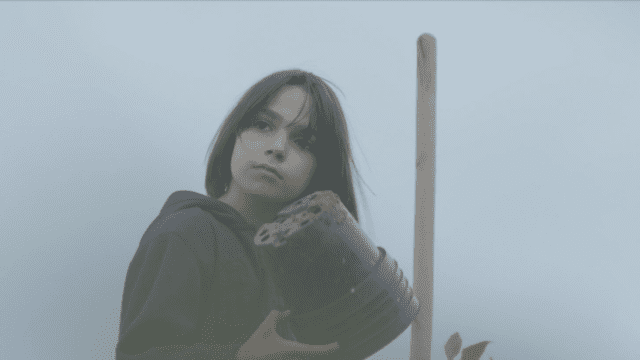
So she decided, together with producer Elene Margvelashvili, to take a temporary detour and shoot footage of the border between Georgia and Abkhazia, or the separation line, as it is officially known. They reserved accommodation 12 km away in a local farm and when they turned up they were greeted by a ten-year old kid in a tree (Lazare), and taken in by a warm and friendly woman (Nino, Lazare’s mum) as well as the thoughtful 12-year-old Giorgio. When the ebullient Soso (father to the boys and dirty from his farm labour) arrived home later that evening he immediately proceeded to tell Margvelashvili of his plans to cultivate blueberries, inspired by the government’s Plant the Future regeneration programme.
For Mikaberidze, the whole set-up seemed intriguing and so she decided to follow this family, whose boys were the same age as the cousins she had originally planned to film in Abkhazia. The young Lazare has a genuine talent for art, while older Giorgio thinks he may study psychology or become an architect. Both could be in a boy band, such are their good looks. But they were also supremely kind, and great fun.
“The parents were transmitting good values to their kids and I wanted to show this to all of Georgia, how it is possible that parents could allow kids to have such feelings even though they’re just young boys. The little one can have long hair, can wear rings, and it’s okay, nobody will judge him. And it’s okay to be an artist, not to be a man. It was a real safe place, this house, for the kids to grow how they wish.”
“The love was surprising,” director adds of what moved her most while making the film. “The love between the parents, the love toward their kids, the love of their land and their animals. It was beautiful. This is what I wanted to show, love.”
Soso, however, as determined as he is, doesn’t seem to be much of a businessman, especially in a buyer’s market like agriculture where the suppliers are continually beaten down on prices. Plus he has had recent invasive chest surgery, but continues to drink and smoke. But he is still a smart guy. “He learned everything through YouTube. And he’s very intelligent, a hard worker. And he really did good with his blueberries, because they were delicious.”
Nino is patient and loyal and no less loving, but he is more reserved, so doesn’t crave the camera, unlike her “superstar” husband. “She doesn’t speak too much, but when she says something, it’s very on point. She’s very caring,” says Mikaberidze.
The director followed the family for two years, through bad harvests and the invasion of Ukraine. She remained as the boys got older and taller, and as the business of blueberries remained a tough one to profit from.
And she came to love and appreciate them very much, as they did her. She tells how Giorgio once asked her if they were really friends, or was she just there to make a film? At which point she put her camera down and assured him that their friendship was a lot more important than the film.
Nor did she film Soso in hospital after a series of heart attacks, such was her determination not to sensationalise the situation. “I think in documentary you have to know your place and when to leave,” she says. “You have to know when to be a human and when to be a filmmaker.”
But all the time life continues in the film. The pickers get (over)paid, Giorgio and Lazare play together, put on art shows, meet up with friends or ride their bikes. The bucolic countryside works its cinematic magic and the boys go on pro-Ukrainian rallies, uniting the blue and yellow flag with the red and white flag of Georgia. Meanwhile Soso and Nino laugh throughout the day, but fret about money late at night when they are alone together.
The boys first watched the film in Brussels, at which point Giorgio saw the farm and the countryside as if through new eyes. “The first thing he said was, ‘oh my gosh, when you live there you don’t see the beauty,’” Mikaberidze remembers. “’But when I sit in the cinema and I look at this film, ‘oh my gosh, I live in a paradise,’ he said.”
But there was a rejoinder. He had just observed the scene where his parents were articulating their worries over money. “Europe is beautiful, everything is nice, but I have only one wish, to go back home and see my dad,” the boy said of Soso, who hadn’t made the trip to Belgium.
The response to the film in Ukraine (Docudays) was very emotional, Mikaberidze remembers. “They cried so much. They said ‘thank you.’ They even thanked me for the Georgian soldiers helping in Ukraine. I was, like, I’m nobody, why you are thanking me?”
The film opens in Georgia on September 23, a place where there is considerable disunity within the filmmaking community. Like many of her country’s filmmakers, Mikaberidze is boycotting the Georgian Film Centre which she believes has become an instrument of the state since the Georgian Dream party won the 2020 general election, and especially since the appointment of Thea Tsulukiani as Cultural Minister.
“Together with my 450 other colleagues who are editors, directors, cinematographers, producers…this means that we will not receive any funds, any support,” she tells BDE. “We will not apply for grants [to the Georgian Film Centre] because we don’t agree with the policy there. Because they’re for censorship, they want to have a say in every decision. We don’t agree with how it is. Our slogan is ‘cinema is independent, free and alive.’ And that’s what we are asking – to be independent.”





