Parma-based filmmaker Matteo Ferrarini explains that Spring in Mariupol (screening in Competition in AJB Doc) is intended to give a very different perspective on the Ukrainian war than that provided by most of the western mainstream media.
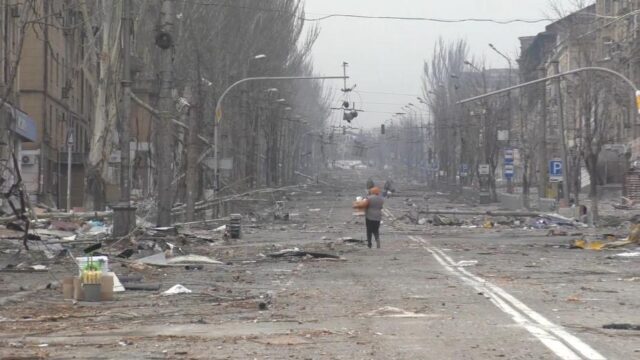
Made through Small Boss, the film was shot by the director’s long-term collaborator, Italian journalist Maurizio Vezzozi, who travelled to Mariupol in Ukraine in March last year, a few weeks after the Russian full-scale invasion of the country. Vezzozi discovered a city that had quickly been turned to rubble by the fighting and yet still had thousands of people trapped in the crossfire.
“I met Maurizio a few years ago. We started to write a movie about a Ukrainian spy,” the director remembers the documentary project the duo was originally working on, before the war began.
Many western journalists visited Mariupol during the siege but most left after a couple of days. Maurizio stayed put for the whole of the spring, trying to understand what the city’s residents were enduring. The siege lasted until late May.
“When he came back [to Italy] for the first time, he gave me all the footage into my hands,” Ferrarini remembers how he first saw the images his friend had captured of destruction on a biblical scale. This was “a mission, a passion” for Vezzozi. He was determined to bear witness to the suffering of the people trapped in the city.
“It was the first time I had made a film about the war and it was the first time I had made a film without being physically present during the shooting phase,” Ferrarini notes.
“I spent entire weeks experiencing war through Maurizio’s eyes,” the director says of the time he spent watching the deeply disturbing material his friend had shot. His first reaction had been shock at the sheer carnage. Corpses were lying on the streets. Children and pets were caught up in the mayhem. There is a chilling moment when one of the residents invites Vezzozi, into the basement where dozens of people are living in what looks like a medieval rabbit warren.
“I think Maurizio was searching for humanity in the context of the conflict,” the director suggests. “For me, it was a dance of emotions between the shock of the war, the real horror…[but] on the other side, I felt the real humanity. For me, that is a paradox, that in a conflict like this we can find the humanity. I don’t know, it’s very strange.”
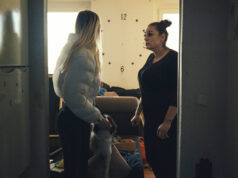
There is a heart-rending moment midway through the film when a distraught mother approaches Vezzozi and asks for his help in finding her son who had gone missing in front of the Mariupol theatre (which had been hit by an airstrike in mid-March). The Italian journalist can’t help but later in the film he discovers the fate of the son.
The director likens Vezzozi to a character in Dante’s ‘Divine Comedy’ who has somehow stumbled into the circles of hell. When the journalist first arrived in Mariupol, the local people were deeply suspicious of him. He was a western journalist after all. “He lived alone the first days in Mariupol,” the director notes. “I tried to put this loneliness in the movie…it’s like the first time in the jungle. You are very afraid and it is very dangerous for you.” As the weeks passed, though, Vezzozi was accepted. The residents were ready to open up to him and show him the extent of their suffering.
Ferrarini admits there were times when he was “very afraid” about what might have happened to Vezzozi. “You know, when you send a message and you have to wait three weeks [for an answer] and you don’t know if [he] is OK.” He was also wary about “touching” the war when it was so hard to have any critical distance on what had been happening. “I know we can interpret it really well probably in 10 or 20 years.” That’s why there is little politics or editorialising. Instead, the documentary is trying to reflect the experiences of the ordinary people caught up in the tragedy.
The director is one of the founders (alongside producer Matteo Pecorara) of Small Boss, an independent Italian production outfit set up around a decade ago. The company takes its independence very seriously. The principals always insist on creative freedom.
“We started the film without money,” Ferrarini sighs as he recalls the struggle to get Spring in Mariupol financed.
3Boxmedia is handling international sales on the documentary. The director doesn’t know yet where it will screen after AJB Docs but some deals have been closed, for example with CNN Portugal and with Spain. “We are searching for other broadcasters because for us it is very important that the message [of the film] arrives with a lot of people.”
The Italian premiere will be at Visioni Dal Mondo later this month. As yet, there aren’t plans to show the film in Mariupol. “I don’t know if it is possible,” Ferrarini says.
The documentary makes for tough viewing but its director insists that it has a hopeful conclusion. That is reflected in the title. “At the end, there is a real spring in Mariupol. I tried to use the footage as a sort of diary of Maurizio’s. I really loved at the beginning how he filmed. He’s a journalist, not a real documentarist, but his footage for me was a sort of diary…the film starts with very strong weather in the bad part of the siege but finished with flowers, spring and sun. That was the reality.”