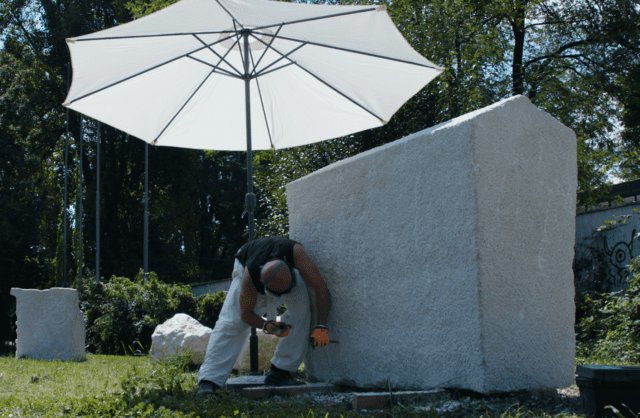
Bosnian sculptor Adis Elias Fejzić is a man rooted both in the past and the present, dedicated to reviving the Bosnian art of stećak (or tombstone) carving to create contemporary memorials dedicated to universal human values. The film’s co-director Dragan Stanimirović chisels responses to questions posed by Business Doc Europe.
The Standing Man tells two stories in parallel. Firstly there is that of the ancient tradition of tombstone (stećak) carving, a practice which which all but died out 500 years ago and deployed use of the archaic Bosnian Cyrillic alphabet. The second story tells of sculptor Adis Elias Fejzić’s revival of the stećak tradition in honouring the Bosnians who were displaced during the Balkans War and who, in turn, want to show their gratitude to the countries who opened their doors to them.
Dragan Stanimirović & Almir Berkovac’s film follows the construction and unveiling of such a modern stećak in Denmark.
In the film Addis (Fejzić’s professional name) talks of casting his net even wider than Denmark. “This should be done wherever there are Bosnians – which means all major countries in both hemispheres,” he says, before explaining his love of the stećak, made from local Bosnian hresa stone. They are, for him, the most “authentic” art within the Western Balkans, “my inspiration and diagnosis.”
He carves a plurality of texts in alternative languages onto his stones in addition to the Bosnian Cyrillic, thereby creating an “enclosed, coded content,” he explains, that acts as metaphor. “Today’s Bosnian is confined to a space and needs to ‘decode’ himself, trapped between the insufficiently familiar past and an uncertain future.”
The monument that Addis created for the Canberra Parliament in 2013 also indicated contemporary and indigenous Australian culture, while the Danish stećak references both Hans Christian Andersen (who was born in Odense where the stone stands) as well as the Bosnian poet Mak Dizdar who “turned stećak stones into words.”
Addis also takes us on an odyssey through the Balkans, ending in Sarajevo, to tell a complex history of stonecraft and cultural integration and to show how no two of the 100,000 giant stones are alike within the region’s necropoles.
Director Dragan Stanimirović became interested in the art of the stećak when living in Australia in the early part of the millennium, all the time reading voraciously about Bosnian culture back home. In 2009 the tombstones were granted Unesco Heritage status. Years later in 2013 he heard about Addis and the stećak he carved for the Canberra parliament, but despite numerous attempts he could never reach him.
Stanimirović eventually tracked down his man in 2018 when he heard about the Denmark project, deciding to go long on the project so as to tell the wider story of the stones. The director was impressed with Addis. “He’s a great guy. It means a lot when somebody says to me, ‘do what you like, do not worry, whatever you want from me, I will do it, so that was perfect,” he says. “He helped also with the script because he’s [also] really into stećak tradition. So last year, we did some key voice overs I was cutting at home, and then I would send him a text so he could [do] double checks.”
The version of the film selected for AJB DOC is 52 minutes, as that is broadcaster Al Jazeera’s standard length, but Stanimirović says that he is planning a feature-length version for 2022 that will begin with the Canberra unveiling but will also the include the stone Sarajevo keys that Addis has recently carved, one of which was presented Prince Albert of Monaco as a token of friendship between the two states in 2020.
At the end of The Standing Man, we are present at the unveiling ceremony in Denmark, the country to which 22,000 Bosnians fled in the 1990s. “The humanity of Danish people [is] a common topic of conversation,” tells one Bosnian woman now resident in Odense, and one of many who commissioned Addis to create the stećak. “This is a beautiful sign of gratitude to the state of Denmark.”