Like its main characters, Catherine Harte’s Faith and Branko is a documentary as much British as it is Serbian. It’s a film that not only fluctuates between cultures, but also between the professional and the personal through the portrait of the musician couple Faith Elliott and Branko Ristic, and also between the positions of outsider and insider for the filmmaker herself.
Faith and Branko, which opened AJB DOC 2021 on September 10, premiered at Sheffield Doc Fest 2020, received a special mention from the jury at In-Edit Barcelona and was nominated for the Golden Section/Audience Award at Dok Leipzig 2020. The film was also selected for the Hot Docs/European Promotion’s Changing Face of Europe programme.
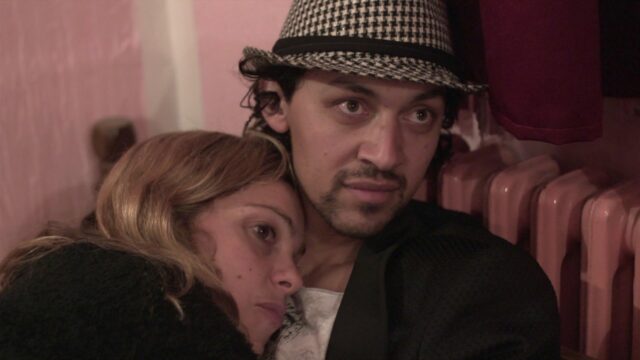
In her intimate portrayal of the challenges faced by lovers of completely opposite backgrounds, the Irish director deploys the camera as an active participant, maintaining close access to the highs and lows of a relationship, but also to Serbia’s large Roma community, which Branko belongs to.
The Irish director spent seven long years chronicling the relationship of the increasingly lauded performing couple, becoming more than their own personal filmmaker, also their friend. Harte remembers first meeting them at a school for Romani culture in 2011. Faith was a young middle-class English musician who learned Serbian and went to the Balkan country to attend a school for foreigners interested in learning Gypsy music and culture. There, she met Branko, a warm-hearted violin teacher. The two eventually decide to marry, both for love and practical reasons relating to visa issues.
Harte decided to make documenting their relationship her passion project after being invited to film their wedding. The Irish filmmaker was initially in Serbia for academic research purposes. She was doing a Master’s in Visual Anthropology, and her dissertation explored how Roma people teach music and culture to non-Roma people.
“I wanted to see if they could transmit anything that wasn’t about music, something like body language, charisma, things like that,” she said.
Being of similar age and background to Faith, the two women became friends, and Faith would recount, in the early days, her crush on Branko.
The choice to start filming everything that was happening at the school was completely intuitive on Harte’s part, who at the time had little filmmaking experience. “I learned how to make a film while making this one,” she said. “I just decided to film all of it because I was interested. I didn’t really know where the story would go. But I thought, you know, there’s something happening here, and I found it even more interesting than the academic stuff I was doing separately.”
An admirer of British documentary filmmaker Sean McAllister (A Northern Soul) and the American brothers Albert and David Maysles (Gimmer Shelter), Harte was inspired by their pioneering cinéma vérité style to create her doc: no sit-down interviews or staged situations, just constant observation through the lens of the camera.
Being close to Faith and Branko and filming them intimately was no easy task for Harte, who was embarking on this personal and long-term style of filmmaking for the first time. It was also challenging for Harte to learn about the direct cinema approach on the spot, noting moments when Branko would perform for the camera, or when she wanted to be a friend rather than a filmmaker for Faith.
“It took years for me to learn to not console my friend,” Harte says of Faith when she was upset. But in essence, it was her friendship with the two that made the filming easier, as the couple gave her complete consent and freedom to film even their moments of tension and drama.
“I remember there was a time when they argued, and I didn’t even know what they were talking about because it was early stages and I didn’t know that much Serbian,” the director recalls. “I just put the camera down and I had this weird footage of the camera facing Faith, who was just smoking and sitting there, but I never turned the camera to Branko because he was really angry. I just didn’t feel comfortable. I didn’t know what to do. And afterwards, we spoke about it. She [Faith] said, ‘if something like that happens again, you can film it, don’t feel bad. It’s happening, and we’re fine for you to portray us as we are,’ which was really amazing.”
Over the seven years, Harte went to see the couple approximately every eight months, filming for two to three weeks each time. Her project was initially self-funded, but the director eventually received funding from the Serbian Film Centre to help her continue filming in Serbia where the couple started making it big as a musical duo.
On her direct cinema approach, the filmmaker had a few tips that aspiring documentary filmmakers might find useful: “Don’t stop filming, hold the camera longer, wait for the moment to finish, and be bold.”
“If anything, what I learned is to be bolder, rather than to stop filming because of ethics,” she said. “It sounds really strange, but if you have a good relationship with the people you’re filming, if you have good intentions with the way you’re going to portray them, if you’re open about how you feel about where the film is going and how they’ll be portrayed, and there’s trust, I don’t think you should worry about filming things that are sad, or awkward, or difficult.”
As Faith and Branko continues its successful festival run, Harte notes how she is keen to continue working on similar types of long-term docs in the future. She remains friends with the two of them, who are still together as a successful world-touring Balkan gypsy music band, despite their relationship becoming vague and difficult to define, like the film’s conclusion.
“I like ambiguous endings because life isn’t happy ever after,” Harte said. “Even to this day, they don’t know what they’re doing. They still love each other. She’s confused. Should she get back with him, should she not? It felt really representative of life, and especially them, to keep it open ended.”
This article was first published in Business Doc Europe in April 2021.