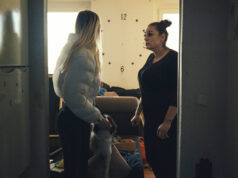
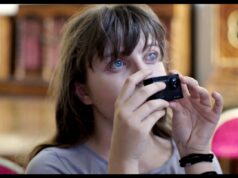
Italian master docmaker Gianfranco Rosi (Notturno) spoke to Robert Greene about his Oscar-shortlisted film Procession, about six men who suffered sexual abuse by Catholic priests but who nevertheless find empowerment together by creating fictional scenes depicting rituals of power in the church.
Click here to see the whole conversation between Robert and Gianfranco.
“Procession follows six men as they somehow re-enact their painful memory of abuse and what is strong about this film that is not a “talking heads” film. It has different layers of narrative and what really impressed me when I watched the film, I was in New York a few months ago, and is that you minimize somehow the single story of the protagonist in favour of the relationship among them,” opened Rosi. “What is impressive for me is the relationship that you were able to construct on them. Could you talk about that?”
“I think the last time we spoke, actually, I was asking you questions about Notturno which is almost wordless, and I think I expressed some anxieties about how many words were in the film that I was editing,” responded Greene. “I was literally cutting the film as we were speaking, and I was being anxious about how much is spoken out loud, actually. Because to answer your question when…you see their first meeting, when they all get in the room together for the first time […] immediately they just start talking.
“And you know, the entire point of our film really is that words are not enough, right? Like that there is a kind of talk therapy that can be useful only up to a point, but at some point doing something deeper, in this case drama therapy. In this case, making a film together, collaborating in this way, going that deeper level is something that…obviously was the sort of starting point for the project, right? But words really, really mattered because they connected these guys in a way that they had previously not been able to be connected with other people.”
Greene further comments: “I felt like I could really speak to the guys who ended up being a big part of the editing process…They would come in, they watch several cuts. In the case of Mike Foreman, the angriest of the six men, he probably watched the film 50 times or 100 times. I’m not exaggerating. He’s seen it as many times as I have, basically. And that became a really important part of our process together.
“But it actually helped me as much, as I would normally like to never look at the material kind of like you’re describing. It helped me to be able to speak to them about how we were seeing them, because what I was trying to get to was something that was taking some of the things that are already part of the documentary process. Eventually someone will see this and incorporate that into what we were doing. And that could be a language that we created. Joe, one of the guys, I remember showing him the scene in this room where he just happened to be coming through town. [I] was like, ‘you want to see something I’m working on?’ And I showed him like a rough scene, which was one of the most thrilling, scary things I’ve ever done, frankly. But it was good because he can then start to have a more advanced language about what he was doing as a collaborator in the film…”
Click here to see the whole conversation between Robert and Gianfranco