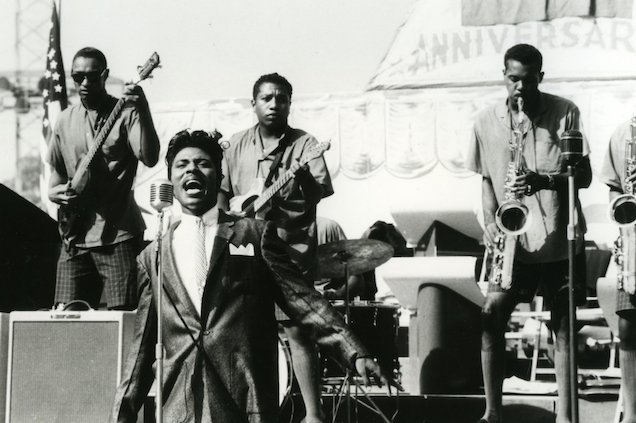
“People thought my gosh! The hair, the make-up, the pencil-drawn moustache, the playing with androgyny and male sexuality in multi dimensions – and then the costumes!” director Lisa Cortés exclaims as she contemplates the many protean qualities which made Little Richard such an explosive figure on stage.
Cortés’s Little Richard: I Am Everything has already secured a Grammy nomination for Best Music Film and is now an Oscar contender. The film, which premiered in Sundance last January, tells the story of the wildly flamboyant but still strangely neglected Black queer American singer and pianist who inspired everybody from Prince to the Beatles, from the Rolling Stones to David Bowie.
Mention Little Richard to music lovers and the image likely to come to mind is of a handsome, tousle-haired maestro performing in manic fashion at the keyboards as he yells out the words to anthems like ‘Tutti Frutti’ or ‘Lucille’.
James Brown, the Godfather of Soul, had his career kick started by Richard. “Something we don’t go into in the film which I think is so funny is that in 1955/56, Little Richard was having all this success. He was going on the road. He has performance obligations and he sends James Brown out as him! People didn’t know what he looked like,” the director notes.
Cortés had the idea for the film after Little Richard’s death aged 87 in 2020. He wasn’t exactly a forgotten figure but nor was he receiving the kudos she felt was due to him.
“In making the film, I discovered he was more than an icon. He had incredible substance that has never been really documented. His anarchic, rebellious spirit has left a musical and cultural impression on us to this day,” the director told Business Doc Europe during a whistle stop trip to London in early December to introduce a special screening of her film at the V&A Museum in South Kensington.
The documentary ends with a montage of all the artists influenced by Little Richard. We see Mick Jagger, Jimi Hendrix and Elton John among others, as producer/musician Nile Rodgers tells viewers that “he paved the way for everything that followed.”
A strong argument can be made, then, that Little Richard was the most innovative and influential figure in early rock and pop history. But he was continually denied credit. “He was the only one proclaiming how incredible he was,” the director notes of how the musician had to make all that noise on his own behalf because no-one else was paying much attention to him.
Nor was he being paid as he should have been. He had signed away the rights to his songs and received only a fraction of the money that his imitators received. Elvis Presley and Pat Boone had massive hits with Little Richard covers. Boone strained out all the wildness in ‘Tutti Frutti’ (a song about gay sex) and turned it into a middle of the road ballad. They got far richer than he did.
Some histories of pop music suggest that Welsh crooner Tom Jones (who appears in the documentary) was the first music star who so excited his female fans that they used to throw their knickers at him on stage – but it was happening to Little Richard long before Jones had his first hits.
The Rolling Stones went on tour as a supporting act to Little Richard in the early 1960s and Mick Jagger used to watch him every night, picking up tips on everything from showmanship to how to hold the microphone.
“With a lot of my films, people are impressed by how people open up and the level of emotion,” the director reflects on how she persuaded big name celebrities like Jagger and Jones to talk at such length of their admiration for her subject. “They [Jagger and Jones] were so engaged. They were happy to share. They were generous with their time.”
When Cortés went to interview Jagger at his offices, he drew her aside and took her for a chat before the cameras began to roll. “He really wanted to have a sense of what was my perspective with this story. I so appreciated his taking the time for me to share about the big vision.”
Jagger and Cortés discovered they shared the same enthusiasm for the so-called ‘godmother of rock and roll,” Sister Rosetta Tharpe, who had been a huge formative influence on Little Richard when he was growing up as Richard Penniman in Macon, Georgia.
Cortés hasn’t interviewed Paul McCartney or Ringo Starr but has archive footage of the Fab Four meeting Little Richard – and looking utterly in awe of him.
One of the paradoxes about Little Richard is that he was a pioneering figure for Black artists and yet was not heavily involved in the Civil Rights movement. Many entertainers from Marlon Brando to Josephine Baker and Harry Belafonte to Sidney Poitier, were on the front line during the Martin Luther King era but, as Cortés puts it, “you don’t ever see Richard in those images. I think there are a couple of things we can say. One is that Richard is spending a lot more time in Europe in the 1960s and so is not engaged in that way. And I don’t know if his queerness had anything to do with his not being embraced.”
Still, Richard broke down “the walls of segregation” in different ways. His music brought white and black kids together. Cortés talks of how he overcame “the psychological divisions that existed for some people” simply by making them love his songs.
The singer also had a movie career, albeit a modest one. Movies like The Girl Can’t Help It (1956), a Jayne Mansfield comedy in which he performed, brought Richard to a huge mainstream audience. He had cameos in Hollywood movies and TV series but was never given the chance to build a proper screen legacy.
As the director says of her subject, Richard was “born into contradiction.” In spite of this extravagant, hedonistic lifestyle, he was deeply religious. At the height of his fame, he went to college to study theology. He was gay but was happily married to Ernestine Harvin for several years – and remained close to her until his death. She doesn’t appear in the film but spoke to Cortés off camera. “She had tremendous tenderness for him,” the director says of Little Richard’s wife who, when she first met the star, didn’t even know his music.
“That’s what make him a beautiful human being. He can evoke in a ferocious way the spirit of rock and roll and thing home and sit with his bible,” Cortés notes of someone likened by those who saw him in his prime to a rock and roll equivalent of the atom bomb.
The passion being shown toward the documentary reveals the affection which Richard is still held.
“It has had a great journey which is a little bit atypical,” Cortés says. The original commission came from CNN. The film was produced by Bungalow Entertainment with Rolling Stones Films as a partner. Magnolia has handled US theatrical distribution as well as some of the international sales.
“Magnolia also got the film on airplanes. A lot of people have sent me pictures of the seat in front of them showing the film,” the director observes a movie which has screened everywhere from festivals to SVOD platforms, all the time to huge acclaim, and is now a front runner in the end of years awards race.