

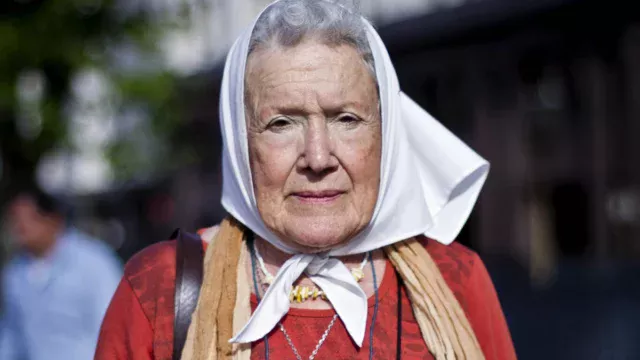
‘She’s a lioness, a beast – like one of those animals at night, even when it’s dark you can see through that light…she’s our firefly.’ So says a fellow protester of her leader and inspiration, the irrepressible Nora Morales de Cortiñas, affectionately known as Norita.
Back in the mid-1970s, Norita was a mother, wife and sister living a conventional, middle-class existence in Buenos Aires, until her son, 24-year-old Gustavo, was ‘disappeared’ along with thousands of other young activists by the country’s ruling military dictatorship.
Nora’s pleas were ignored by the government, the church and the media, and so she took to the streets with other mothers of the “disappeared” to create the Mothers of Plaza de Mayo resistance movement. Together, they embarked on a long road of struggle against the violent and authoritarian regime of General Jorge Rafael Videla, demanding the return of their daughters and sons alive. Despite the kidnap, torture and murder of three of its members, the Group survived the dictatorship and emerged during the return of democracy in the early 80s as a symbol of human rights, rebellion and protest.
Indeed, the archive images of the housewives in their sensible court shoes, and with white headscarves embroidered with the names of their lost children tied resolutely at their chins, is visually arresting as they march outside the parliament building, placards aloft. These images contrast starkly those of the regime and its sheer brutality, such as the torture chambers, and the Mothers found washed up on a beach, having been pushed from a cliff to their deaths.
The story of the Mothers is one that directors Jayson McNamara and Andrea Carbonatto Tortonese want to bring to new audiences, especially in these troubled times. Right now, McNamara asserts to Business Doc Europe, Norita’s journey is a timely reminder of the importance of democracy, tolerance, stable government, and the power within us all to protest against injustice.
“This film in particular has always felt like it was going to land at a very relevant time, because it has these really powerful references to historical human rights crimes, and the systems that have to exist for these crimes to happen,” he says. “Argentina [was] once considered the most civilized country in South America, which in the space of four or five years began torturing and disappearing its own young people and throwing their bodies into the sea… I think that’s something that we’re grappling with in our democracies as well, just how quickly things seem to be slipping out of our control.”
“It’s a film that really asks you some big questions as a viewer, like how comfortable you are with the systems around you, and with Norita and the Mothers I think there’s that added complexity of being conservative suburban housewives in that period, and being quite closed off from the outside world… I think that has a lot to do with a huge portion of the population actually stepping into politics and political issues for the first time, because it’s just so inescapable now,” McNamara adds.
Norita is the perfect person to pose those questions. She’s a luminous presence on camera; fearless, charismatic and relatable with her silver hair tucked into her trademark white headscarf. In the film, she’s already 92, but her passion and energy for her causes is palpable on screen. We watch as she continues to campaign for women’s rights in Argentina right up to her death in 2024 – an adored, battle-scarred campaigner for everything from the “disappeared,” to international solidarity and the legalisation of abortion.
It was never Norita’s intention, however to put herself front and centre, McNamara points out. “It was very difficult to follow her because she wasn’t initially receptive to the idea of being profiled individually, being from a collective political movement,” he says. “So we very much had to be sort of a fly on the wall with her out on the streets and in her house and just try and be as unnoticeable as possible.”
That said, Norita couldn’t help but be the main attraction. “She was always the little tiny figure that had to be looked after, and a seat had to be given for her, and she had to be able to see and hear. And so, everything tended to happen around her. And we wanted to reflect that she was a centre of gravity for many, many years in Argentine politics.”
“On top of that, it was just very natural because she’s a real extrovert,” McNamara adds. “You could see that she was just high on life when she was surrounded by other people, and fun, and really found somehow, despite what she went through, that she had this ability to tap into something in her personality. It’s something that she would have learned as a young woman, just how to be joyful and happy and make jokes despite everything.”
The filmmakers don’t shy away from showing the full story, however. Some family members felt neglected, side-lined by her drive to bring the government to account, to find her lost son. Indeed, her second son, Marcelo, relates how he sometimes suffered from Norita’s total abandonment to her causes. A poignant example is given when he tells us that his mother would never make a certain kind of ravioli because her lost son loved it so much. Marcelo plucked up the courage to tell his mother how much he loved it, too.
Norita’s husband is often left to hold the fort at home. He is her stalwart in his support – a position he had no choice but to assume. These domestic insights contrast with the political and social, reflecting perhaps the universal struggles, emotional conflicts and demands placed upon all mothers, wives and sisters.
As the narrative unfolds, from the brutal regime in the 1970s, through to the continuing struggles and protests women still face today in Argentina, animation is used to propel the story forward. This was created by co-director Andrea Carbonatto Tortonese.
“The animation is important because it illustrates the parts of the story that archival footage or photos never captured, which is the horrific, the emotional…if we ever did find images of it, I think it would have turned people away,” McNamara tells BDE. “So the animation has [a] really juvenile, colourful, light aspect to it. And I think that counterbalanced the dark, horrific, emotional, and violent world of the disappearances really well.”
Furthermore, the animation allows audiences to “breathe” when faced with such harrowing concepts, McNamara adds. “We’ve had a lot of feedback, especially in Argentina, thanking us for using the animation, and taking the viewer into that world so gently.”
Norita died at the age of 94, roughly six months before the film was released theatrically in Argentina. “The film, interestingly, became part of the mourning process in Argentina,” says McNamara. “And it was like going and seeing and hearing her voice again. We did about 300 grassroots screenings all over the country and it was really beautiful to see that it was received so well by Argentinians.”
Whilst Norita has been popular in Argentina, the universal themes have also resonated with audiences around the world, according to McNamara.
“You know, it is a story that once upon a time really captured the imagination and the sympathy and solidarity of a lot of people in the Northern Hemisphere. And we wanted to find a way to bring that story back. It’s just remarkable. It’s phenomenal to think that a group of housewives basically toppled a military regime and continued protesting. Fifty years later they still protest in the main square of Buenos Aires. And they’ve inspired all these movements, so it was really an attempt to pay homage to these women and bring their story back to life through cinema,” McNamara concludes.





