

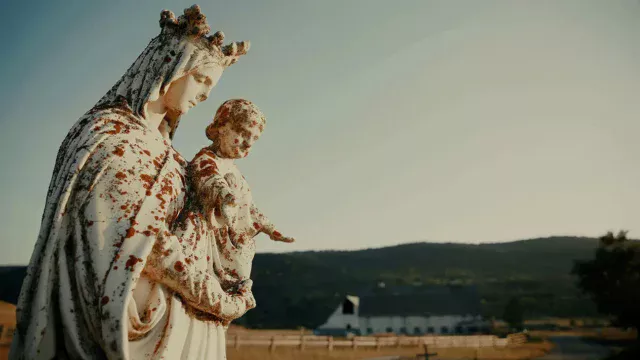
The National Geographic feature documentary Sugarcane tells a story of sexual abuse, violence and forced separation meted out by priests and staff in Catholic schools across Canada to Indigenous children over a period of 60 years.
The story came to national and global prominence in 2021 when evidence of potentially hundreds of unmarked graves was discovered on the grounds of the Kamloops Indian Residential School. Director Emily Kassie was determined to make a film on the subject and asked her colleague at Huffington Post, Julian Brave NoiseCat, to collaborate with her.
NoiseCat was initially reluctant as he and his family had painful memories of the residential schools and so he didn’t respond for a while. In the meantime, Kassie discovered a First Nation (Willie Sellars) who had just commenced a major investigation at an Indian residential school in British Columbia.
When NoiseCat eventually confirmed his interest in pursuing the project, Kassie revealed that the school under investigation was St. Joseph’s Mission, which stopped NoiseCat in his tracks. “Of the 139 Indian residential schools across Canada, Emily happened to choose the school that still looms over the life of my family, my father and myself,” he writes in his notes.
The film thereafter became a deeply moving and disturbing investigation of a subject that has continued to wreak devastation across the Indigenous community, and a core component of the story was to be the odyssey undertaken by NoiseCat and his father Ed as the older man pieces together tortuous elements of his past, not least of which was his dramatic removal from an incinerator as a baby before his life was snuffed out.
We hear and observe the pain of many survivors who were routinely subjected to physical and sexual abuse. Girls were impregnated by their rapist-abusers. One woman tells how, when she told her grandma and teachers about the abuse she suffered from a priest, nobody listened to her. When her father heard about the allegation, her “beat the shit” out of her. In later life she turned to alcohol.
Furthermore, we observe researchers as they uncover babies’ graves around the school property using radar technology. “Our film actually breaks new investigative ground on a story of a pattern of infanticide at St. Joseph’s mission,” explains NoiseCat to Business Doc Europe.
“On the one hand, this is definitely a Canadian story, and it’s obviously a particular story about a particular place in a particular school, but it’s also a story that is continental and even global,” he adds. “I think that what’s really interesting about that is the extent to which this history is not known by the world and is not known by Canadians. There has been in Canada for about 15 years a process of truth and reconciliation, and yet there’s still so much that we do not know about these schools.”
Later in Sugarcane, a delegation of Indigenous people travels to the Vatican where Rick Gilbert, former chief of the Williams Lake First Nation and still a devout Catholic, has an audience with the Pope. The pontiff’s non-committal response to Rick’s visit would be laughable if the charges being laid were not so grave. He dutifully listens, reads a prepared statement in Italian, before dispatching Rick with a cheery and efficient ‘bye bye’ to bring the encounter to an end. By this time, we have learned how, following a DNA test, that Rick’s father is likely to have been one of the priests at the school.
“What drew us to Rick in the first place was that the tension between his faith and his spirituality and what’s living in his very DNA,” says co-director Kassie. “He was this kind of extraordinary person who had been carrying this weight for so long and was…still a practising Catholic and trying to make sense or trying to find meaning in that, and also trying to understand who he was.”
“It was the most courageous thing I had ever seen someone do,’ she continues of Rick’s decision to meet the Pope. “And I think Julian feels the same way – it just took enormous courage for this 77-year-old man who had held this painful truth within him for his whole life, to muster the courage within himself after years of denial within the privacy of his own home, to be able to go all the way to the Vatican and confront the head of the Catholic order that abused him, with the truth. And what he got in response was something that was empty.”
After its world premiere at the Sundance 2024 — where it won the U.S. Documentary Competition Directing Award — the film went on to receive a raft of awards including the Center for Documentary Studies Filmmaker Award from the Full Frame Documentary Film Festival and the 2024 Filmmaker Award from the Margaret Mead Film Festival.
In addition to the publicity that the 2025 Oscar campaign is providing, how are the filmmakers looking to create greater Impact around the film as well as the terrible history it uncovers?
“We hope that it gets into [school] curriculae across the country. We’re bringing it to universities right now, and we’re very grateful that there is so much interest. And I think that here, the craft of the film itself has also really helped to maximize the impact of the film,” says co-director NoiseCat.
“There is a bill heading to the Senate right now for a truth commission in the United States. And it was only recently that the first Indigenous cabinet secretary, the US Secretary of the Interior, Deb Haaland, did an inquiry into these schools and found the official known number of federally funded schools in the US, which is 417, and at least just under a thousand children that they know of already to have perished at these schools,” adds Kassie. “And that was just a couple of months ago. And the secretary actually attended our premier at Sundance and so that in part helped launch Sugarcane as a part of an international dialogue.”
The film also screened in the Canadian senate on Parliament Hill in December 2024. “We’re working on other government screenings and, as Julian mentioned, we are working to get into classrooms. We are touring with Sugarcane on reservations and reserves all over Canada and the US to get it into native communities.”
“It’s catalysing a dialogue and helping to rewrite history and correct the record and empower communities to take hold of their own narratives and demand answers,” Kassie signs off.





