

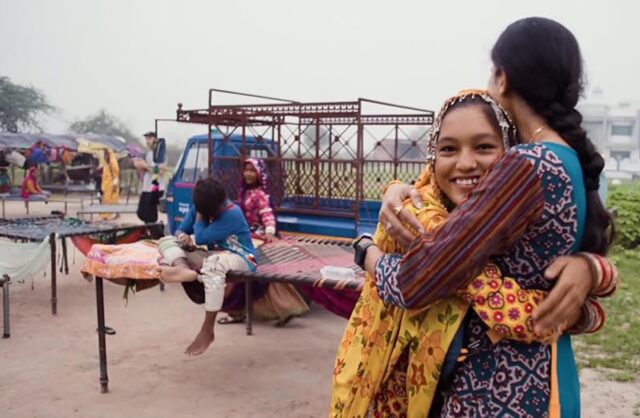
After the death of their mother in India, Aney and her two siblings moved to the US. While Aney’s sister became a lab technologist and her brother joined the armed forces, Aney herself became a medical first responder. She always felt an intense sense of guilt that she didn’t do enough to save her mother – but in essence it was the political and medical system that killed her. Each year, we are told in the short doc Where the Light Enters You, healthcare costs in India drive 55 million of the country’s inhabitants into poverty.
Teenage years are formative, and personal development can be shaped by particular likes and dislikes, obsessions and neuroses. In the film, Aney freely admits to having developed a “saviour complex” during her teens. Still driven by grief and resolve, she returned to India to set up a clinic for village outcasts, hoping to change the system, settling within the Mir community of Gujarat. There, Aney met the teenage Farida, who was wise, funny and highly intelligent, with whom she identified very closely and in whom she invested much effort.
Over the course of seven years, we see how both their lives developed, and how Aney’s hopes for Farida were dashed. Farida’s loving father was determined that she received a full education, but after his untimely death there was no money left for her to pursue her academic dreams, and Farida was thereafter a commodity that could enable the family to make ends meet financially. A hundred suitors asked for her hand in marriage, and eventually Mukesh was successful. But a condition of the marriage was that she would not be allowed to continue her education. As we see in the film, at the wedding Farida is inconsolable.
Indian co-director Hemal Trivedi describes the process that she observed. “As Farida progressed in her life, Aney found deeper meaning in her own life and she started to heal. And at one point we really thought that the ending of the film would be this happy ending of Farida going back to school, and Aney succeeding in her philanthropic mission,” she says.
“But then the marriage happened…and we’re like, okay, this is it, this is the reality. But there was also this grim understanding for Aney that it is going to take decades for any reform work to happen.”
The story of Aney and Farida was one of many that were researched and shot, points out co-director Matt Alesevich. But when Trivedi came on board, she identified this as the story to focus their main efforts on. “It was obvious that the connection that they had was the special one that we needed to follow,” Alesevich says of Aney and Farida.
“Aney was the one person that I gravitated towards, especially because I was really struck by her utopian idealism,” agrees Trivedi. “She had this wound of her mother’s death and this trauma that she was trying to heal. And that was the impetus for her to go on this journey of philanthropy.”
“In Farida, Aney saw this little girl that she had lost when she had to grow up too quickly after her mother’s death,” she adds. “There was this playfulness. There was this amazing, I would say, kinship. Farida is just so charming. She’s this charming, feisty teenager who was like an outlier in the community. We all gravitated towards her and her charisma.”
“So we just kept following the action. The story kind of just unfolded in front of us.”
That story is one with love, rawness and emotional intensity at its root. “Both Matt and I were completely aligned on the foundational mission of the film, which was that healthcare should not be a privilege. We were aligned philosophically, and we were also aligned on being very true to what the story is,” says Trivedi. “We both believe that the story is king.”
“In these years of filming, we filmed dozens of politicians and healthcare experts, and other doctors who would give you very intelligent answers on how do you bridge this gap of the rural healthcare system of India? How do you change the system? What should be done?” Trivedi further recalls. “But none of those conversations made it into the film. And the reason why [they] didn’t make it is because we were both very aligned on making sure that the emotional core of the film is not destroyed.”
That emotional core was the “amazing bond” between Aney and Farida. “Filmmaking is a visceral medium, and we wanted the audiences to understand that story viscerally, rather than intellectually. There’s so many people who can make cerebral arguments, but we very committed to making an emotional argument.”
Impact had always been a core seam with the production fabric, and the current Oscar campaign can be very valuable in raising awareness and building partnerships for long-term community impact, the filmmakers say. “The whole idea is to use this film to create a bridge between the Indian diaspora, which is spread out all over the world, and the people back home,” says Trivedi.
Short to medium-term aims of the impact campaign are to turn the local craft of beadwork, which we see much of in the film, into a proper livelihood, and to connect Mir artisans with global buyers, in the process keeping the tradition alive and putting income directly into women’s hands. Another immediate aim is to deliver water wheels and safe water access to the community.
“People say that there are three types of C that get funded, which are films about cult, crime, or celebrity. But there’s a fourth C which people don’t talk about, which is community. And our film is about building community.”
Long-term aims are to build a Common Facility Centre (CFC) to offer a clean water source; sanitation and hygiene access; electricity for light and charging; space for beadwork and skill training; childcare and study areas, medical camps and areas for wellness support.
“In the past decade, a lot of members of the Indian diaspora have kind of gone out of that survival mindset to [an] abundance mindset, where they want to now try and think about how can we give back? What can we do? How can we take accountability for our own actions? Until now, we were in this victim mentality, where we used to blame the colonisers who colonised us…but enough years have passed since colonisation – and trickle-down has not happened in Indian society,” she adds.
“And so Indian people are now taking accountability, and saying that if reform needs to happen, we need to do it. There’s no outside force that’s going to come and change India. We need to change ourselves,” Trivedi signs off.





