

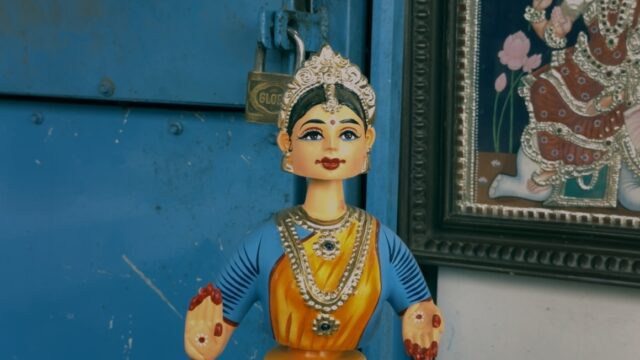
The feature documentary Dispatch immerses us into the mind of Indian director Anu Vaidyanathan following the death of her much-loved mother-in-law, a mathematician from pre-Partition Punjab.The film is a prose poem to life, a paean to grief, longing and nostalgia, and a dispatch from India in all its colours and traditions.
Dispatch opens with Vaidyanathan’s toes luxuriating in the river she grew up by. ‘Water is home to many curious creatures including rabbit fish – one feeds, while another watches for predators.’ This, she tells us, was how it was for her, her mother and the mother of her husband, who both raised her in different ways. ‘You don’t marry the man you love, you marry your mother-in-law,’ Vaidyanathan tells us in the film. Her mother-in-law loved calculus, and quietly provided the ‘essential shade of motherhood.’
Through her first-person voiceover, accompanied by a mosaic of images and music recorded during a 7000 km journey across India, we discover that the director is something of a Renaissance woman. As well as being a filmmaker, she is an engineer, stand-up comedian, athlete and author. All these influences are evident in the feature documentary.
In the film, we see a series of quotidian images from across India, accompanied by words and music, all indicative of Vaidyanathan’s unique take on life. We see rows of electricity pylons, the geometry of a flower, the ‘subjectivity and objectivity’ of old buildings, a grubby doorway surrounded by painted calligraphy, the interior of a graffitied tram, raindrops on a lorry windscreen, shambling backstreet bookstalls, unfinished statues of gods and goddesses in grey clay, sacks of roses and marigolds in the flower market and squashed behind he rubbish bins, and the matrilineal monkeys who ‘consoled me one day and suggested I write about it.’
It’s a visual feast, accompanied by Vaidyanathan’s observations on grief, longing and motherhood. ‘When I think of all the lives you nourished, you stand taller than what modern feminism, with all its punchlines and protests, might ascribe to you,’ says Vaidyanathan of her amma, her mother-in-law, in her voiceover. Later in the film, there is the revelation of a physical assault.
Produced by Ashish Ahuja and Karuna Siddharth, Dispatch has recently screened in Latin America, beginning with its world premiere at BAFICI in Buenos Aires (where Anu Vaidyanathan was also on the jury for the Vanguard and Gender competition), followed by FICG Guadalajara. Mexican reviews described Dispatch as ‘one of the most intimate and visually captivating works’ in FICG’s official selection, which led to additional screenings in Mexico City.
When BDE caught up with Anu Vaidyanathan after the world premiere in Buenos Aires, the director confided how she began filming whilst still grieving, still unsure of the direction the work might take.
“Honestly, the making of it felt a bit like a fever dream, because I think the upside of grief is you have extreme clarity about what you don’t want, and I did not want one more day, one more hour spent imagining a time when I would have a completed film…. I just felt a lot of emptiness alternating with this sense of urgency almost that, you know, this cannot wait.”
The process began with a script, but very soon, the visual landscape of the documentary began to take shape. As Vaidyanathan explains, “I definitely wrote quite a bit before I started to film. But documentary in and of itself, as we know, is a very improvisational form, there’s no controlling the frame, there’s no controlling the day, there’s no controlling the people that walk in and out, or even the people who will want to engage… you cannot go and do whatever you want. That being said, I knew it was a first-person film, and I knew it had to be visually of a certain cloth.”
Armed with these certainties, and in the spirit of her late amma, she started filming on a shoestring, using whatever she had to hand.
“Although it’s built as a co-production, we didn’t receive any funding outside of attending two workshops, but they were miniscule grants,” says Vaidyanathan. “Production, post and the festival circuit have been entirely funded on day jobs and borrowed airmiles,” she continues.
She somehow made the financial side of things work, but having confidence in herself and her story was a stumbling block as she embarked upon the project, she says.
“The biggest obstacle was probably just being self-assured that there was a story to tell, because I feel like that has been educated out of me in film school… This notion of self-reliance, I think, is not celebrated enough, especially because that is the lifeblood of an independent filmmaker… even if you don’t have the most wonderful of circumstances, you don’t have all the money you need, you will somehow get to the end,” Vaidyanathan posits.
This is manifested in Dispatch, where her amma is ever-present, following her around the market in her imagination, telling her if she doesn’t have a camera, to just film on her mobile phone.
Universal themes emerge, about motherhood, about trauma, grief, humanity, the passing of people, of a way of life, but all told through Vaidyanathan’s unique vernacular. Yet, while her storytelling skills are a huge asset, such a personal take needed a dispassionate eye in the edit, the director explains.
“I was too emotionally entangled to make sense of it. I have a very, very short-tempered, wonderful editor who could not understand why I’m weeping in the editing room. He’s like, what is wrong with this woman? I’ve worked with her for three years, now she has to show me the waterworks,” she says ruefully.
To accompany the evocative story and visuals, a third dimension of music completes the cinematic experience. “The thing about India is you cannot pin it to one thing. Is it a wealthy country? Is it a poor country? Is it the third world… the first world? We don’t know. So you can imagine, you know, just by travelling 100 kilometres, you will be almost in a different zone if you allow your senses to take it in. So from the very beginning, it was very clear to me that the overriding thing would not be just the voice or the words… the common thread would have to be musical, to be a little bit non-verbal, like my mother-in-law’s love language,” Vaidyanathan says.
The film will have a focused festival run ahead of a roll-out which will also benefit from another of Vaidyanathan’s many talents. “We are currently exploring distribution across both traditional channels — including festivals, curated theatrical screenings, and academic/institutional partners — and non-traditional channels tied to my comedy tour this fall, through venues where we already have established relationships and audiences across the UK, Europe, and India,” she says.
And what kind of impact would Vaidyanathan hope for from Dispatch?
“What would we want people to talk about? Yes, the process of grieving. Yes, the process of losing a loved one. Absolutely, the safety for women. Absolutely the things we tell our daughters of the nightmares we live with as parents also,” she responds.
“Alongside this, we are developing an intentional impact campaign focused on migration, memory, and women’s often invisible labour,” Vaidyanathan adds. “A recent workshop with Amy Shepherd at CPH:DOX was particularly valuable in helping us think expansively about the many contexts in which the film can live and connect with audiences.”
“It is very important to us that the work reaches as wide and diverse an audience as possible, because for us the political begins with the personal,” Vaidyanathan ends.





