The third edition of Doxumentale, Berlin’s multi-media celebration of all things documentary, kicks off May 27, running through to June 7. This year’s festival dates have been brought forward very much with the World Cup in mind, given how the German public’s appreciation of football may even rival its love of documentary!
Doxumentale will also see a significant change of key location in 2026, with many activities moving to Potsdamer Platz’s Atrium Tower, the same (very tall) building where every year in February we get accredited for Berlinale.
“Downstairs, we have built a cinema and have our festival centre there,” Doxumentale Artistic Director Anna Ramskogler-Witt tells BDE of her plans for the new home. The building’s 19th floor (complete with roof terrace) will also be home to readings, podcasts and the entire Industry programme.
“What triggered me to go there was that we were also offered an empty shop on the ground floor of the shopping centre adjacent to the Tower,” she continues. “We are going in there with our VR and games exhibition, and in the Manifesto Foodmarket we are going to show children’s films for free. My belief is that we’re reaching an audience that probably wouldn’t watch documentaries that much. So by going into a shopping centre, by going outside to the public, we are addressing this.”
In the main, public screenings are shown in the evenings, outside of working hours and therefore more in line with folks’ leisure time. Screenings within the festival’s outdoor venues will be presented after sundown, ie after 21.30. “As it gets darker, so the projection will be better, but it means we will often do the Q&As before the film, as people may fall asleep,” Ramskogler-Witt warns.
“We try to keep the diversity,” she adds of the 2026 programme. “We are expanding our children programme, getting to public spaces, making it available for free… to get the younger audience to us.”
“With the programme for adults, we try to be as diverse as always. We are continuing with our Club series of films because that’s working really, really well, such as in the SO36 punk club in Kreuzberg,” she adds of the legendary venue that will screen Punk Under Communist Regime by Andrej Košak (2025).
Other venues include the Archenhold Observatory, the oldest such establishment in Germany; the Freiluftkino Rosengarten (rose and beer garden), and The Galilee Church which will screen Hex, in which three women find their inner witches to transform Norway’s metal scene.
“This year, we put more capacities on reaching different groups outside of the normal documentary viewer circle,” Ramskogler-Witt adds, noting how, in the past, particular groups in the city loved what the festival organisers were doing, but much of the time got to hear about it very late.
“Jana Sepehr, our partnerships manager, really reached out to many, many civil society organisations working in Berlin, inviting them to moderate, inviting them to share information,” she adds, citing the African diaspora in Berlin as an example. The festival will screen several recent African productions, such as Enough is Enough by Elisé Sawasawa (France, Democratic Republic of Congo), Memory of Princess Mumbi by Damien Hauser (Kenya, Switzerland, Saudi Arabia), and Sorry for the Genocide by Elmarie Kapunda, Lisa Ossenbrink, Theodora Shandé, Matteo Sant’Unione (Germany, Namibia, Botswana).
The organisers’ outreach to new audiences even extended recently to leafleting supporters of Bayern Munich and VfB Stuttgart attending the German Cup Final on May 23 in Berlin’s Olympic Stadium.
Ramskogler-Witt is a self-confessed “news junkie,” and observer of the woes that are suffered across the planet, but feels that the festival should still present the broadest “range of reality.”
“Positive stories are still happening despite the despair of our world,” she says. “And I think we need them as an inspiration…I think we are trying to offer insights and spaces for conversations, and inviting exchange. And whoever wants to join is very welcome to join.”
“I am personally a very political person, coming from a strong human rights background, but in the current political [situation] I’m missing the grey zones,” she adds. “I’m missing the spaces for conversations…For me, it’s important to have different kinds of films and different kinds of perspectives that allow for conversation.”
Conversations, albeit on a more low-key level, will take place during the festival’s DX’Hub Industry programme, as delegates sit down for a series of What’s Soup lunchtime workshops and chats, covering such topics as documentary distribution (as assessed through a world sales lens, March 29), and mental health and care in documentary practice (March 30).
“The feedback from past years was that things people enjoyed most were the workshops and the intimate conversations that were truly honest, rather than the big panel discussions where you sit there and listen to something,” Ramskogler-Witt explains the rationale behind the Soup sessions. “One person gives an input talk and then everyone joins the conversation, because many people have experience and can contribute to what’s on the table and we can learn from each other.”
Ramskogler-Witt further underlines the sense of affinity that Doxumentale has with other international festivals which forefront Impact. At the heart of Doxumentale is the Good Media Pitch which “invites selected projects to forge their impact strategies and find allies for implementation in an inspiring environment.”
“We are working together with FIFDH (Impact Days) and Movies That Matter to find synergies to train our Impact projects, to make it [the campaign] more concrete. I think that’s beautiful. And we want to expand on that,” she says.
She is reluctant to compare her festival with such long-established and illustrious events as DOK Leipzig and DOK.fest Munich, and underlines how the Doxumentale audience is very much a Berlin one, hence there not so much of an onus to programme national or international premieres.
“In terms of premier status, I know that’s something that’s very important to many festivals. And yes, of course, it gives you the credibility. But speaking personally, DOK.fest Munich has a beautiful programme, and if we are in love with the same film, why not show it both to a Munich and Berlin audience?” she asks.
“I don’t believe in competing,” Ramskogler-Witt adds. “I think in particular, as festivals we need to find solutions together. That’s why I was extremely happy when Munich initiated Dok@home.”
Dok@home is a curated streaming platform joined by five major German documentary festivals (including DOK.fest München and Doxumentale Berlin) and whose task is to deliver award-winning non-fiction films directly to viewers’ living rooms.
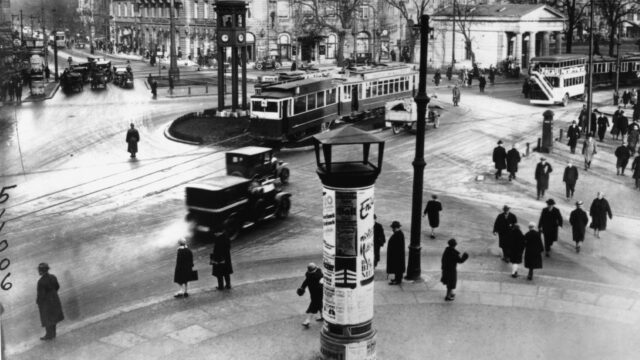
The festival will open May 27 with Homage to Berlin, during with author and actress Barbara Sotelsek takes the audience on an audiovisual journey through the city, with the spotlight trained specifically on Potsdamer Platz, focusing on its legacy as one of the most restless and historically significant locations within the city’s history.
“We will have a mixture of readings and film clips that reference Potsdamer Platz. So we are going to read from Erich Kästner, and Kafka who has written about it,” says Ramskogler-Witt. The film will also show film excerpts from the likes of Wim Wenders’ Wings of Desire; Berlin Babylon (Tom Tykwer’s crime series set in the Weimar years) and also the silent and iconic Berlin: Symphony of a Great City (Berlin: Die Sinfonie der Großstadt, 1927) by Walter Ruttmann.
Ramskogler-Witt also flags up the May 30 conversation about the highly-lauded A Fox Under a Pink Moon between protagonist/co-director Soraya Akhlaghi and Iranian director Mahnaz Mohammadi (Roya), moderated by Jana Sepehr. “I think the conversation between those two will be very interesting because Soraya was filming herself with her mobile phone, and Mahnaz used, for her latest documentary, mobile phone clips from many people from Iran in order to show what the blackout means. She has a very interesting approach also to ownership because she says they are all co-directors.”
The Doxumentale boss further invites folk to attend the presentation of, and discussion around, the Uncensored Library Project by Reporters Without Borders, in which a Minecraft server and map is used to circumvent censorship in countries that refuse to recognise freedom of the press.
“Because Minecraft is a game that’s accessible from all over the world, people who live in censored environments can read censored books through the game,” she says. “We are going to connect the presentation so people can just visit us at The Playce, the shopping centre, and try out the game themselves. But we are also going to present the game in connection with the film 80 Angry Journalists (which screens at the festival) which is another perspective on freedom of press, but from Hungary,” Ramskogler-Witt signs off.
Click to read more about the Doxumentale 2026 public programme and for information on the festival’s DX’Hub Industry programme for 2026.