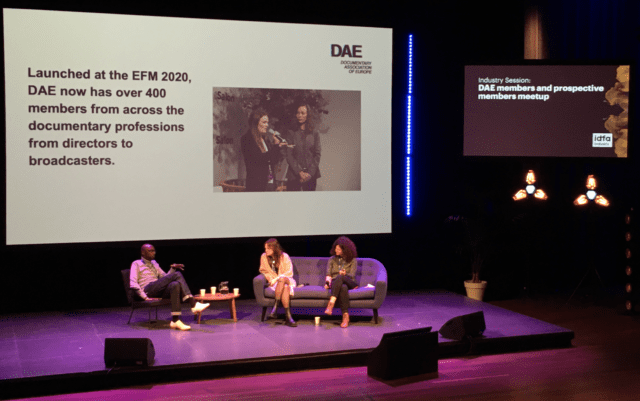
“Let’s start by focusing on the positive,” say co-directors Brigid O’Shea and Marion Schmidt of the member-led support and advocacy body now entering its third year of existence. “DAE is a thriving community of almost 500 members coming from across all fields of documentary filmmaking and the globe. We are so proud of this number and even more proud that they can find each other in our members directory.”
The association lists its duties online, which include (among many others) collecting relevant, accurate and impactful data on European documentary films and the professionals who create them to influence and drive dialogue on a political and economic level; creating spaces for community building, dialogue and networking, and negotiating and collating the best services, deals, discounts and opportunities for association members.
“We, as well as our first DAE employee (Anne Rethfeld), are motivated every day to keep going despite the global shitstorm,” they continue. “It has been the small and big successes, and the kindness of our members and supporters, that have given us the most satisfaction [such as] putting up our DAE banner in Leipzig at the Co-Production Dinner, our first onsite event since the launch.”
“Still, it is really hard as we are almost entirely financed by membership fees and we [Brigid and Marion] volunteer almost 100% of our time. We cannot always keep up with the demand of requests we receive, and more-so we’d like to have time for more long-term, big picture projects and planning,” they add.
That said, there has barely been a European doc fest or market over the past two years that hasn’t included a DAE component, whether in terms of consultancies, hook-up hubs, moderation of pitch sessions or co-pro project in-kind awards.
“We’re so proud and impressed by how well film markets and other events managed to digitise their events during the last two years. There has been so much solidarity and helpful contributions made to try to salvage what we all could during this time. We are proud to have the majority of doc-relevant festivals in Europe among our members, and continue to create meaningful collaborations and programming with them,” say O’Shea and Schmidt.
“Festivals and markets are the places where interactions take place and the industry come together. For this reason it is essential for DAE to be at film festivals and markets and make our own contributions to this ecosystem. It is essential we take care of and nourish all players in it,” they continue.
“Sometimes we also need to criticise those who aren’t pulling their weight, or who actively, or via blind spots, are creating oppressive conditions for others. Film markets and pitching events are essential places for us to collect market intelligence and learn first-hand what is happening in the industry. Neither of us are producers or active filmmakers, so we need this intelligence to reach us via the filter of events. We see it as our job to share best practices, practical information and the most-up-to-date conditions not only to members but also the greater doc community.”
They add: “There is also a lot of ‘behind the scenes’ work happening that our members don’t see: fighting for the space and financing for documentary films is thankless and unsexy but we are convinced we are making in-roads every day. We are very grateful for the many supporters and helpers who motivate us and keep us going.”
What do the O’Shea and Schmidt believe are the major issues that must be addressed within and across the documentary industry? What are the threats that docmakers must face to assure better conditions for them and a fairer share of the pie? And how does DAE advocate for this?
“It is an exciting time to be a documentary filmmaker and involved in our industry. We are growing in self-confidence and global relevance – a shout-out to FLEE, nominated for three Oscars this year [Feature Doc, International Feature, Animation Feature],” they respond.
“However, with this attention there can be a negative backlash from those who do not understand our sector’s specific needs. We need our documentary-specific programme and space, as our production chain and distribution paths are different to fiction. We need our own spaces, and cannot be absorbed into other offerings,” they continue. “We love to share the spotlight at events like When East Meets West in Trieste, network with new people and infect o
thers with our enthusiasm for documentary storytelling, but still a lot of our work is sharing our experiences and knowledge with key players to preserve our space and our workflows.”
“It is easy to point fingers at parts of our ecosystem that no longer perform or offer the resources they used to. However, to get through this current crisis we need collaboration, out of the box thinking and a willingness for flexibility, and trial and error seems important right now. We need to extend this COVID solidarity into whatever will come next. And the doc community is always a fragile place: many of us are working in crisis conditions almost constantly, so a little understanding from those who have more stability could definitely help us move into the next chapter of filmmaking and distribution.”
During Berlinale 2022 DAE is organising consultation sessions for filmmakers to discuss their new projects, get to know DAE or to receive advice on all matters documentary from a host of relevant industry experts. Each meeting is 20 minutes and the session will be held Feb 14, 10.00 – 12:00, February 15 15:00 – 17:00 and Feb 17 10:00 – 12:00 (all times CET).
The association will organise drinks on Feb 13 for the doc community who made it to Berlin. Plus they are flagging up their support for three EFM events, the Feb 15 Archive Day (for which the registration deadline has been extended to Feb 12), the Women in Film – Female Documentary Filmmakers’ Perspectives on Working in the Diaspora talk on Feb 15, and the ongoing Meet the Festivals one-on-one consultations with some of Europe and North America’s leading doc fests.
Later this year, O’Shea and Schmidt are looking forward to launching new resources for the community – next up are more mapping and data collection activities, as well as the soft-ongoing relaunch of a financing guide.
“This all takes a lot of time and planning because we are focused on sustainability and transparency. We are trying to lay those deep roots for an association with longevity,” the conclude.