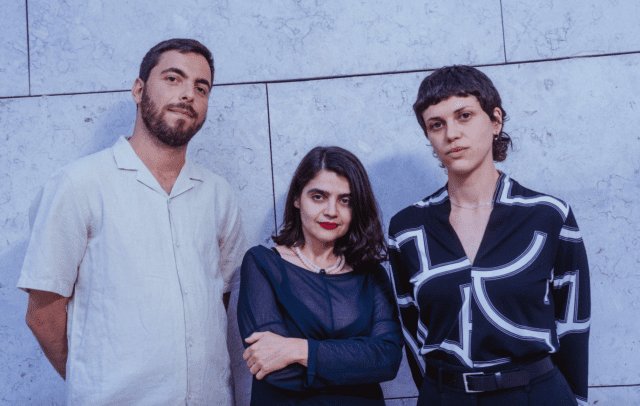
Doclisboa co-directors Miguel Ribeiro, Joana Gusmão and Joana de Sousa
“It’s a joy,” says Doclisboa co-director Miguel Ribeiro about his festival’s return to its 11-day late October slot. “A collective joy…there’s really a feeling of beautiful anticipation of a big collective celebration.” Between 21 and 31 October the festival will present 249 films, including 51 world premieres and 28 international premieres. Nebulae, Doclisboa’s industry networking “space,” is returning in a hybrid format, running October 21-25.
After its 2020/21 roll-out, which consisted of a series of themed online ‘moments’ spread over five months, Doclisboa is back in its late October slot, with a presentation of 249 films across an artistically devised and cerebrally challenging programme. Documentaries will be presented within competitive and non-competitive sections, consisting of International Competition, National Competition, New Visions, From the Earth to the Moon, Heart Beat, Ulrike Ottinger Retrospective, Cecilia Mangini Retrospective, Cinema of Urgency, Green Years and Doc Alliance.
“We learned a lot of skills,” says the festival’s co-director of the past year and the festival’s elongated presentation, but what the experience underlined to Ribeiro and his colleagues was that they truly missed the sense of group dynamic or “collective.”
“We want a rhythm, a movement between the screen and the audience,” he says of what online iterations of festivals will never deliver. “The festival happens only in these connections during the collective screening in a theatre full of people who are then talking about what they have seen…these things are what really make the festival.”
“It’s also made us think how it’s a lot about what you watch, what you don’t watch, what’s around you, what others have seen and what they tell you about,” he says of a collective gathering within a compressed timeframe. “This is also what builds the narrative of a festival.”
As ever, a core component of the Lisbon offer is the emphasis placed on Portuguese docmaking, and this is presented across all sections, not only the 11-film Portuguese Competition (which offers up films of all lengths). Each festival section, Ribeiro underlines, whether Heart Beat or From the Earth to the Moon or any of the retrospectives, offer a unique “proposition of cinema,” in which the Portuguese contribution is powerful and vital.
He underlines how the locally-produced docs are characterized by “how movement exists across time and space and territories,” especially after a past 18 months characterised by isolation and insularity. “They are not closed films,” he emphasises, pointing to two docs that reflect the vibrancy of local neighbourhoods. In Do Bairro (From the Neighbourhood), individuals from the hoods of Alfama and Mouraria ‘lay bare their story, one characterised by authenticity, roots, traditional music and cause and effect philosophy.’ José Sarmento Matos’ Jamaika, is about the eponymously named neighbourhood on the outskirts of Lisbon, inhabited by migrants from Africa or African descendants from Angola, São Tomé and Principe and Guinea Bissau. “It’s wonderful how, during this time of fragility, these neighbourhoods strived to help one another,” Ribeiro underlines.
From Heart Beat section, Ribeiro references Maria João Guardão’s Everything Must Go, about how, in a Lisbon consumed by gentrification, artist João Fiadeiro and the company he keeps ‘postpone and embrace the end’ at the house they have inhabited for the last decades. By vacating, they occupy; by disbanding, they stay together; by celebrating, they reclaim a 30-year-old project from disaffected national politics.
In New Visions Ribeiro enthuses about Edgar Pêra’s Kinorama – Beyond the Walls of the Real, described as a ‘self-reflexive film, the result of a decade of investigation in the stereoscopic format, dealing with subjects such as time and reality, manipulation and freedom, 3D cinema and beyond.’ For Ribeiro, it is “cinema as a way of spectrality and absurdness…and it’s wonderful.”
Ribeiro underlines how the Portuguese doc community is a small but dynamic one, and that the festival serves as a vital hub every year. He also stresses that Portuguese docmaking “has always been in a golden age,” and that its exponents operate within “a place where freedom for creation still exists, and you can tell that through our films.” That said, in terms of public funding, the doc industry is “coming out of one of the darkest eras, because support for the filmmaker during the pandemic was almost inexistent.”
“All films that exist in Portugal are acts of resistance and overcoming,” Ribeiro underlines. “So we keep on pushing and trying to make a force for better working conditions for artists in Portugal.”
Elsewhere in the programme, there are retrospectives of the works of visionary German filmmaker Ulrike Ottinger and the late (and very great) Cecilia Mangini. The New Visions section present a tribute to the late Colombian director Luis Ospina, during which audiences can experience his final film The Eye of the Tourist: XIII Easy Pieces. A special invitee is the “master” Austrian director Michael Pilz who dedicates his latest film With Love #3 to the late Iranian director Khosrow Sinai.
Another highlight that Ribeiro points out is the ‘Narodnaya’ triptych of films by Russian Vadim Kostrovtriptych about a group of youngsters living in a town near the Urals who have opened up a new art space based in a garage. The film “shows the urgent need for a collective action of resistance and liberation.”
In 2022, the festival will (at least for one year) change dates so as not to clash with DOK Leipzig and Ji.hlava IDFF, fellow Doc Alliance festivals. The shift is intended to allow for greater ease of attendance for industry personnel.
That said, there is a 2021 event to arrange and experience first, and as he assesses the coming weeks he articulates what would be an ideal takeaway come the end of November. “I think I will be happy if, after these 11 days, people save in their memories the films that they saw, the encounters that they made and the conversations that they had until the next edition,” he concludes.