

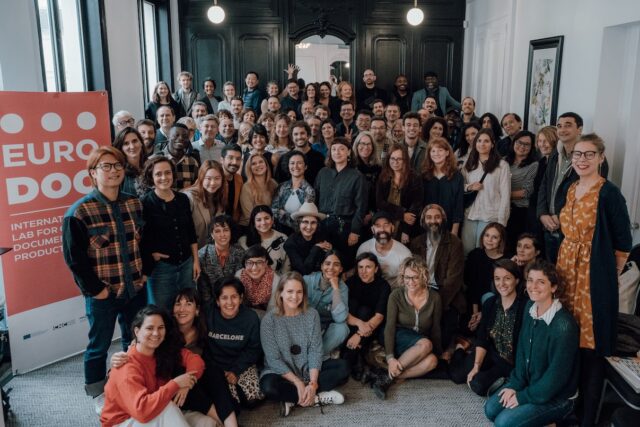
When EURODOC Program Director Nora Philippe was thinking about how to acknowledge the 25thanniversary of the esteemed training initiative, founded in 1999, she decided to create a free programme of virtual screenings to celebrate its successes. When she was going through the archive, she very soon realised that it amounted to a who’s who of docmakers over the past quarter century, representing, as she puts it, a “history of the genre, at least at European level.”
Even taking a quick glance at the last five years of projects that have gone through EURODOC mentoring, you’ll see an array of big-hitting award-winning docs, such as I-Human, This Rain Will Never Stop, Brotherhood, Young Plato, All-In, How To Save A Dead Friend, Loving Highsmith, The Mother of All Lies, Pure Unknown and We Will Not Fade Away, and many others.
Likewise, during an alphabetical scroll through alumni on the company website, you’ll be a long time scrolling even before you get past letter C.
EURODOC is aimed at producers, not at directors, although many of its alumni have taken on both producer and director responsibilities on their documentaries. Nor is it strictly European, with a gaze that extends far beyond Europe’s boundaries in enabling talented docmakers from the Global South and Latin America to ply their essential trade.
Philippe identifies a core principal in both the programme’s development and its ongoing modus operandi, that it is designed by independent producers for independent producers, all of whom espouse a “transgenerational mood or philosophy, grounded in peer to peer learning, and in solidarity.”
“When they [producer participants] start the program each year I tell them, you are here because you make prototypes,” she adds. “You are inventors. You invent a new way to produce each film because for each film there’s a different solution. And you’re here because you defend artists and you defend filmmakers, and that’s the reason you chose this job.”
She further tells how she has lost count of the conversations she has had with EURODOC alumni who only co-produce with fellow alumni, such is the strength of the bonds forged during the workshops.
The 3 x 6-day residential workshops run between March and June every year, addressing the areas of development; co-production, financing & packaging, and rounding matters off with an intensive Meet-the-experts week-long session.
The main objective of the programme is, as the organisation says on its website, “to help producers in the artistic and financial development of their project, to improve their know-how in terms of international co-production and company management – thus implementing good practices in the sector – reinforce the skills that independent production requires, and significantly expand their professional network. We believe that project development and career building go hand in hand.”
Being a producer is as much about survival, know-how and street smarts, as about having an eye for a good story or a cause to espouse, Philippe further articulates to BDE. And it’s about both possessing or understanding a raft of diverse skillsets.
“So you’re not a lawyer, but you need to be aware of how the law functions, at least in your country. You’re not an accountant, but you definitely need to supervise the accounting. You’re not a shrink, but you need to have skills in mental health and diplomacy. I could go on and on. You are not a post-production expert, but you need to be talking all the time with a post-production supervisor. You won’t [create] AI yourself, but you need to understand what it takes to be using AI right now in our industry… And you need to manage a company, you need to manage your career, you need to manage your reputation, and you need to be able to work with artists…What it also takes is courage.”
And if you’re going to operate within the world of top-level doc, then you need expert training, Philippe underlines. “You don’t survive in the business if you’re not trained. If you don’t have the necessary skills, if you don’t have a network, then you will die. It’s a very hard business. You need to have a bit of insanity to do this job, but you also need to be really rational and connected.”
But can’t all of this know-how be gained online via Zoom or webinars? No, is Philippe’s definitive answer. “Yes, we offer 300 hours of online training and consultations, but it cannot replace what happens in a residential session,” she stresses. Only through participation with a project throughout the three parts of the programme can producers develop and learn their trade. “It is through this process that, pedagogically, they will learn these hard skills.”
Philippe points to the third part of the programme, whereby seasoned industry experts are drafted in both to inspire participants and, more importantly, plug the gaps in knowledge across all areas of the production process. This is a strictly one-on-one process. “They [the experts] know it’s part of the contract. They need to share market intelligence and strategic advice to our participants. It remains confidential,” says Philippe.
“You need to know who’s producing what, at what moment, what are the amounts? What are the deals right now with that platform or with that soft money fund or with that television [company]. It’s the latest market intelligence that we share. And if you don’t know that, then you’ll get lost and you’ll lose deals, or you won’t be able to negotiate the right way.”
Philippe and her colleagues have opened the call for the 2025 EURODOC programme, running in March, June and October. The deadline for applications is November 24. The proposed cohort will comprise 40 producers.
In 2024 the programme expanded to embrace Spanish-speaking and Latin American producers, as well as docuseries, and to offer specific mentoring within its BIPOC group. “And we’ll keep offering big scholarships, and scholarships for Ukrainian participants and Global South producers,” says Philippe.
“We design the space within our sessions as safe but brave. Let’s train, let’s share in the best way we can so that we, at least in this moment, shape the documentary film industry as we would like it to be, make it the most ideal way with values of sharing and solidarity and of defending brave author-driven documentaries.”
“The producers we train at EURODOC are extremely fearless and necessary to our democracies, and our awareness as citizens,” Philippe continues, adding that without risk-taking producers, there is no meaningful creative doc industry.
“They come to EURODOC to learn how to survive, to take risks to fulfil their ambitions, which are to see films being born. We are talking about an essential trade that is sometimes invisible – [but] independent producers are key to the documentary film industry. And documentaries are key to our survival as democratic societies,” Philippe ends.





