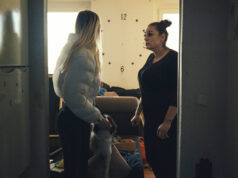
I Am Belmaya (trailer), the new film by Sue Carpenter and Belmaya Nepali, was up for two BIFAs earlier this month, for Best Doc and The Raindance Discovery award. Belmaya isn’t just the co-director of the documentary, she is its main subject too. The film tells the inspirational story of how the young Nepalese woman transforms her life through filmmaking.
London-based author and filmmaker Carpenter has known Belmaya for 15 years now. When they first met in 2006, Belmaya was a teenager living in a small village in Nepal. She was a ‘Dalit,’ from a low caste family. She had been orphaned and had endured a brutal childhood.
“The girl I first met was quite fresh from the village. She had been very scarred by all her experiences there and was very spiky as a person, which was partly what drew me to her. I saw there was somebody a bit different in there, a spirit fighting for her voice,” Carpenter recalls. “She had been beaten quite a lot in the village and she was living in survival mode.”
This was a society in which girls were (as Carpenter puts it) “taught to be quiet and submissive, and do as they were told.”
Belmaya, though, was a rebel. She also had a natural aptitude for photography. Carpenter had been leading a photography project for girls from deprived backgrounds in which she took part.
“When she picked up the camera, she really found that she loved that. She was always in there at the forefront, wanting to take pictures and to express herself. She was definitely one of my right-hand girls.”
When Carpenter left to return to the UK after 9 months, Belmaya was deeply upset by her departure. Seven years would pass before they were to meet again.
“All that sparkle I had seen before had got lost. She [Belmaya) had been living again in terrible poverty. She had been beaten by her husband and by her mother-in-law,” Carpenter says of how Belmaya had changed. “I really wondered whether this was going to work – us following her journey learning to be a filmmaker.”
Belmaya had had a daughter but her husband made it very clear he had wanted a son – and seemed to blame her for the gender of the child. This led to considerable domestic strife.
However, within days of Carpenter’s return, as Belmaya became engaged again with photography and filmmaking, her “inner fire” came back.
Carpenter has had very close ties to Nepal since first visiting in 1998. “It’s definitely a very lovely place,” “If you’ve been to India a lot, it’s the kind of place people go for their R&R. India can be seriously full on, but then Nepal is a little gentler.”
Her first visit was to write an article for You Magazine about a women’s refuge. “I think that what brought it to their attention was that Prince Charles had just visited this refuge and they thought it was a story which would resonate for people in Britain,” Carpenter says of why the magazine sent her there. “It really opened my eyes to the plight of women in Nepal and the length and depth and breadth of what they have to put up with.”
Carpenter was one of the founder trustees of charity, Asha Nepal, which helps victims of trafficking and had been established by Peter Bashford after he read one of Carpenter’s articles.
In 2002, Carpenter adopted her daughter Simi, from Nepal. Simi grew up in the UK but, in order to give her “some real memories of the country,” Carpenter would take her on visits to the country.
In order to make the film to feature Belmaya, Carpenter set up her own production company, Tideturner Films in 2015. From the outset, she was determined that Belmaya would be involved in the making of the documentary – and wouldn’t just be its subject.
“It’s to honour the fact that it is her story and she wants to tell it her way,” Carpenter says of Belmaya’s role as the co-creator of the documentary. “Most of the editing, I did back here [in the UK].The editor does have quite a lot of power of what goes in and what goes out. But I’d consult with her and show her along the way and she would say whether she was happy or not…but she as cameraperson and co-director in Nepal, when I wasn’t there, she was setting up shots.”
Christopher Hird, founder of pioneering independent UK documentary company, Dartmouth Films, was an early supporter, coming on board as executive producer.
The film has turned into a firm festival favourite, winning Best Documentary at the UK Asian Film Festival, and picking up prizes at several other events too.
“It was ready in October 2020 but then we realised there was no hope of cinema release [because of Covid] so we have been putting it out to film festivals,” Carpenter says of the revised release strategy. Even with the pandemic, the film has been widely recognised. “Whenever I show the film, there’s a real sense of people being moved very deeply in the audience,” Carpenter says.
Dartmouth released the film in the UK. One of the main screenings was at the Ritzy in Brixton, Carpenter’s local cinema. “But tragically I got Covid,” the director laments not being able to introduce the documentary in person.
As for the future, Carpenter isn’t sure whether she’ll be making further feature docs. “It was a big, big, big learning curve doing a feature doc. So far, there has been money out and not much money in. So, you know, I don’t know if I can really afford it…It [I Am Belmaya] was a story I really passionately wanted to do and I think it is going to have amazing ripple effects.”
However, Carpenter will continue to work with Belmaya on her short films, making sure she has the means co-produce them and that they have the chance to find an audience they deserve.