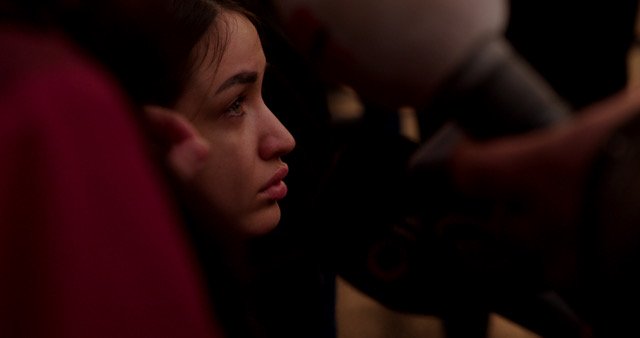
Mutlu means ‘happy’, both in Turkish and Kurdish. It is also the name of a young woman who, on the verge of stardom on Turkey’s Sesi Çok Güzel TV talent show in 2015, was shot in the head by a deranged and unwanted suitor who objected to the general public seeing the woman he purported to love.
But by the end of the film, ‘Mutlu’ has assumed quite another meaning, that of ‘mature,’ or ‘strong woman’ or ‘survivor,’ the heroine of the film suggests. Because the journey that Mutlu undertakes after her attempted murder is truly extraordinary, one in which she suffers even greater tragedy, but also one of bravery, determination and generosity.
After 58 days in intensive care following the shooting, Mutlu went to stay with her very dear (and politically outspoken) sister Dilek. In the film we see her disabled and wheelchair-bound, harbouring dreams both of being able to sing again and to eat with her own hands. The bullet remains lodged in Mutlu’s head, but she makes peace with this “alien object.” Meanwhile, her assailant is sentenced to a mere 15 years in prison.
Within the family, Mutlu’s loving father suffers a breakdown. He feels like “a dead man walking,” and can hardly bear to look at his disabled daughter, such is the pain he experiences. Meanwhile her younger brother Hakan (he has six older sisters, and is, according to Mutlu, ‘closer to Gen Z’) is a passionate supporter of full female emancipation, although the life he has hitherto experienced means that his personal “circle of trust” is one into which very few friends are admitted.
More and more as the film progresses, and as her mobility and speech return (at least in part), Mutlu is a woman on a mission. She turns to TikTok where she amasses an audience of 1.5 million followers, making 2-hour long broadcasts per day via her “window to the world.” And she vows to write and record a song, part-folk, part-rap, to help inspire women across a country whose tendency towards patriarchy shows no sign of diminishing.
But even greater tragedy is set to befall Mutlu.
Since 2015, we are told, 2500 women have been victims of femicide in Turkey. One of those is Mutlu’s sister Dilek who is murdered in 2020 by a soldier who believed that he “owned” her. It is an event that, as Mutlu says, hit her “harder than the bullet.” “Let the world stop, everyone stop…Let not just Turkey but the whole world perish…My sister is dead,” she cries.
Thereafter Mutlu uses her TikTok platform to deliver even more intense and heartfelt anti-femicide broadcasts, and she ventures beyond the realm of social media, out onto the streets, to advocate publicly and articulately for justice for all female victims of murder and violence. She also enters the studio to record her song, accompanied by her family members. The film ends outside the courtroom as she sits in her wheelchair, awaiting news of the judge’s decision on her sister’s murderer.
Director Nick Read was “shocked and appalled” by the story of the attempted murder of Mutlu and made contact with her and the family in 2016, but he realized it was “too early to really engage with them” at that point.
“It was in August 2020 when there was a spate of really appalling femicides, probably the case of Pınar Gültekin is the best known, that I got back in touch,” he says. “We learned about Dilek’s tragic death. Obviously then I realized that this was a much more urgent subject to address. And at that point I went searching for someone who I could collaborate with [on the project]. And that’s how Ayse got involved.”
“[That] was the first time that we both went together to meet them face to face,” explains co-director Ayse Toprak, who had directed the multi award-winning Mr Gay Syria in 2017. “We stayed there [with the family] for quite a while to do research…I think they very much loved the fact that their story was being told. First of all, Mutlu wanted to get the story out there as much as possible. She thought that this was a great avenue. A feature film made on her story would raise her voice even more and add to what she’s already doing.”
“And I think they made the film very much their own,” she adds of the bond that soon formed. “They very much embraced us as if we were a part of their family. We were already a very small crew. It was Nick, me, our DOP and our sound recorder. We were only four people. So it was sort of very easy to be involved in that family dynamic basically.”
Mutlu’s journey in the film from aspiring singer to survivor to articulate political advocate is absorbing, as is her ability to engage with huge audiences via the internet, or indeed with either microphone or megaphone in hand.
“When we met her, we didn’t realize that she had millions of followers on TikTok, and she was this sort of iconic figure,” admits co-director Toprak. “We were so mesmerized by her that we knew that she’s a great character… Instinctively, we guessed there would be other layers that would [emerge].”
Read adds: “We spent a long time discussing the film before we could meet the family or get on a plane. We were severely delayed by the pandemic. But it did give us a chance to try and come up with a joint vision for the film. And our vision was that it would be epic and intimate, and cinematic. I hope we went somewhere to achieve that.”
“If we succeeded, then it was largely down to the trust that particularly Ayse managed to achieve with the family. And obviously trust is reciprocal. Mutlu especially was big-hearted enough, and listened carefully, to give us her trust. And that’s not something that we ever took lightly and hopefully we respected,” he further expresses.
Mutlu has been granted a renewed passport and visa, will be able to come to the UK to attend the film’s UK premiere in February 2023 (she was unable to attend the film’s world-premiere at IDFA). The co-directors are hopeful that My Name Is Happy will feature highly at the BAFTAs in the same month.
“There will be event screenings hosted by one of our partner organizations, the Turkey Mozaic Foundation, which is a civil rights NGO based in London, so we have quite advanced plans in principle, but everything stems from Mutlu’s presence here [in the UK],” adds Read. “We will have a limited theatrical run in the first quarter of 2023. And Channel Four will transmit in the third quarter of 2023.” Many international doc fests, both in Europe and North America, are keen to screen the film in 2023, Read adds. International sales on the film are handled by Autlook.
The filmmakers further underline how they have advanced plans for an impact campaign “that takes this subject matter and the issues raised in the film outside the cinemas and into the communities internationally.” They will also set up a funding mechanism to enable a percentage of the film’s profits to go towards Mutlu’s future care needs.
Turkish Toprak underlines how femicide numbers increased in Turkey (and worldwide) during the pandemic, but that her home country is doing little to combat this. “I don’t think anything is getting better in terms of the law,” she says, citing the Istanbul Convention, a human rights treaty of the Council of Europe against violence against women and domestic violence, signed in Istanbul in 2011. “The government actually pulled out of that, which meant that the implementation of laws that are already in place were not going to be as strong as had we continued being in the Istanbul Convention. I think we’re not getting anywhere better. I would say we’re going backwards.”
Toprak also reminds how Turkish authorities commenced proceedings in April 2022 to close down the Turkish ‘We Will Stop Femicide’ platform on the grounds of “illegal and immoral activities” and “damaging the Turkish family structure,” as reported by the platform’s website earlier this year.
Read expresses particular gratitude to the London/NY/LA documentary production outfit October, which made the film. “I’d call it a fragile ecosystem in this country [UK], especially with risk capital being really hard to get to, and it requires a really brave partner on the journey that we’ve been on. And I would just love [to acknowledge] the contribution that October have made to this film because they’re the people that took all the risks. It’s not an easy subject. It’s not an self-evidently commercial subject – femicide in Turkey – to get behind, and without their support, frankly, we wouldn’t have got come this far.”