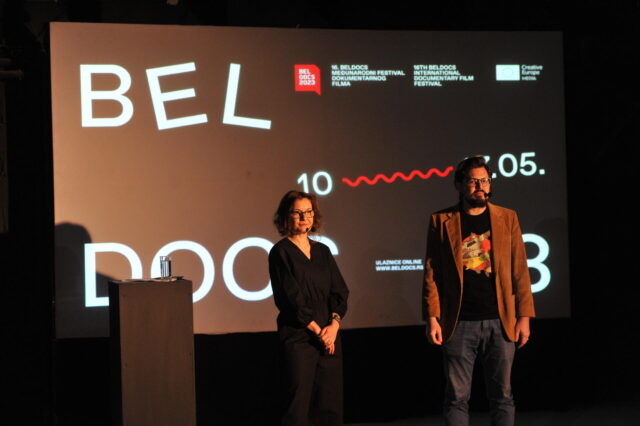
Beldocs plays out this year against a sombre backdrop as the country mourns the children and adults who were senselessly murdered in two mass shootings. “In the current deeply sensitive, complex and truly heart-breaking moment our society in Serbia is facing, we believe Beldocs curated creative documentaries can bring us very close together, guide us to face crises and overcome trauma in a creative way,” says Festival director Mara Prohaska Marković.
“It has always been our belief that by addressing current issues that we as a society and individuals are facing, we are creating a relevant place for the audience and film professionals.”
This year’s festival presents 105 films, of which nine are world premieres and four are international premieres. The Industry section will present 30 projects in different phases of production. Beldocs hosts an International Competition of 10 titles and a Serbian Competition of 12 feature-length and short films.
In 2023 Beldocs was chosen to host the Eurimages Audentia Award, valued at €30,000 and “created to encourage women in filmmaking in their ongoing careers by giving them extra financial support for their upcoming films based on the quality of the film screened at the selected festival.”
The German Arsenal – Institute for Film and Video Art will be honored with a retrospective, while a special focus section will feature the best of contemporary Greek documentaries, including Stavros Petropoulos’s Microbiome and Yorgos Goussis’ Arm Wrestler. This year’s special section will have the theme of The Future of Freedom.
Fest head Mara Prohaska Marković, Artistic Director Marko Grba Singh and Industry Head Andrijana Sofranić Šućur put aside time to answer a wide range of questions posed by BDE.
BDE: Can you explain the raison d’etre of your festival, and the uniqueness of your offer both to the Belgrade public and local/international industry?
Festival director Mara Prohaska Marković: Beldocs has always been dedicated to daring, authentic and creative films – documentaries that penetrate deep and stimulate thinking, reveal stories from the reality, bring people closer together, inspire them to reflect, create and believe in changes. Today 16 years after its inception, Beldocs is truly recognised in European context as a vibrant point of dynamic circulation of documentary films, projects, film professionals, and audience, that is, as the most important networking place for global creative documentary film making in this part of Europe.
An integral part of the festival is Beldocs Industry which is dedicated to encouraging new contacts, collaborations, and co-productions among film professionals from Western Balkan countries, Baltic States, Post-Soviet Media, South Caucasus countries, and Western Europe in order to further the distribution of European audiovisual works. Beldocs Industry Days 2023 will feature training and project development workshops for young talents, public presentations of documentary film projects at the Beldocs Pitching Forum, panels, masterclasses, and matchmaking sessions. Beldocs Market, as part of the industry, is the only documentary distribution market in the Western Balkan territory which foster circulation and distribution of documentaries from 16 countries to global market, and from the Europe to this region. Also, we are developing VR projects.
In the festival programme sense, Beldocs is considerably open and keep its horizon sufficiently distant, to cover the diversity of the world in which we live in and present the most diverse narratives about people, phenomena from the sphere of reality. In the current deeply sensitive, complex and truly heart-breaking moment our society in Serbia is facing, we believe Beldocs-curated creative documentaries can bring us very close together, guide us to face crises and overcome trauma in a creative way. It has always been our belief that by addressing current issues that we as a society and individuals are facing, we are creating a relevant place for the audience and film professionals.
BDE: Your selections look varied and eclectic across an imaginative set of programmes. Can you explain your rationale when it comes to the programming of the festival?
Artistic director Marko Grba Singh: We try to include in our programme films that come from a diverse spectrum in terms of structure and form. What all films have in common is the cinematic truth that documentary films always strive for and will continue to strive for. The International Competition programme consists mainly of debut films (or second and third films) by younger authors who are just breaking into the documentary scene. We believe that it is very important to recognize new, brave people with authentic expression and give them space. The criteria we always follow when selecting films are quality, originality, and cinematic value.
BDE Is this a strong year for Serbian documentary? Post-Covid, is the local doc industry in a robust position right now?
Marko Grba Singh: The national documentary scene has progressed in the last decade. Several factors have influenced this, primarily the emergence of digitization, which has made film production more democratic than before. Authors with very little resources can create excellent films that will be noticed and seen – the idea and its execution are of primary importance. In addition, the dissolution of the former state (Yugoslavia) led to the fragmentation of the scene, and once a large Yugoslav cinematography was divided into several small, individual independent countries. This process of transformation was very painful and traumatic, so the vacuum that followed was entirely expected. It seems to me that we have come out of this process, but there is always a question of whether everything had to happen that way. In recent years, the domestic scene has been rich in exceptional titles that have been seen around the world and screened at major international festivals. This is an irreversible process that the pandemic has partly slowed down. Some authors have used the pandemic period to work on archival documentaries because it was impossible to shoot during lockdowns, so working on archival material in editing seems like a logical solution.
BDE: Please guide readers through your special programmes and why you alighted on these particular subjects, such as Arsenal, Meteors and others?
Marko Grba Singh: Arsenal – Institute for Film and Video Art is an institution involved in the distribution and screening of independent author films. Beldocs has been working on networking with film institutions and festivals throughout Europe for several years, so this collaboration came at the right time. This year’s program, which will be presented by Angelika Ramlow, consists of five films by women authors from different periods. The accompanying program Meteors is dedicated to radical arthouse cinema and hybrid genres. It was established in 2018 in collaboration with the Museum of Contemporary Art in Belgrade. Over these six editions, films by Joao Pedro Rodrigues, Chantal Akerman, Apichaptong Weerasethakul, Lav Diaz, Deborah Stratman, Miguel Gomes, and many others have been shown in Meteors. This year, we are proud to collaborate with the festivals FID Marseille and Underdox from Munich. The result of this collaboration is the Connecting Futures project, which connects young people from Belgrade, Marseille, and Munich.
BDE: How do you describe your festival audience? Is it particularly receptive to documentary these days?
Mara Prohaska Marković: Our audience knows that by careful selection of films in the framework of Beldocs, we want to open space for public dialogue, exchange that sometimes surpasses artistic, informative and intellectual frameworks and enter the sphere of personality development, somatic effects, re-examination and facing current challenges of the world we live in. Documentary film has the power to divert the audience from the regular state of mind into the state of turbulence. These are situations in which our emotions, our bodies act through our mind, but which transform the latent into the manifested, and enable us to wake up the unconscious. This special feature of the documentary film makes the audience especially receptive to creative documentaries today.
BDE: Are there any films in the festival programme that were pitched or developed at Beldocs Industry over past years?
Head of Industry Andrijana Sofranić Šućur: Yes! We are pleased to say that this year’s program includes several projects from Beldocs that have been transformed into outstanding films, including Flotacija by Eluned Zoe Aiano, Alesandra Tatić, Boogie & Demons by Ivan Šijak, End of the Road by Ivana Todorović.
BDE: When it comes to new projects, what are your selection criteria?
Andrijana Sofranić Šućur: Beldocs Pitching Forum is focused on discovering projects from Western Balkan countries, Baltic States and Post-Soviet and South Caucasus countries. We are gaining an increasing number of applications from these regions every year and have the opportunity to contribute to creating new contacts, collaborations and co-productions between selected projects and professionals from the rest of Europe. We always have projects from Serbia and the Balkans since the documentaries are thriving. Beldocs is proud to be recognized as a safe space for filmmakers to refine their ideas and launch their projects.
BDE: What are the documentary topics that are more prominent?
Andrijana Sofranić Šućur: There is a great diversity of topics – from politics, social issues, migrations, the war in Ukraine, ecology to history and more. Beldocs Industry is always focused on inclusion, diversity and representativeness.
BDE: What differentiates your market offer from other Industry forums across Europe, or the Balkans? What are your unique elements?
Andrijana Sofranić Šućur: Besides Beldocs Pitching Forum which is concentrated on projects from Western Balkan countries, Baltic States and Post-Soviet Media and South Caucasus countries, Beldocs Market is the only documentary distribution market in the Western Balkan territory. It has a 10-year tradition, and in previous editions it has already contributed to the structuring effect on the European audiovisual industry. It opened the whole new territory for European documentary films distribution, and it continuously works on developing market opportunities, on increasing the slots for documentaries (feature, shorts, docu series), establishing new programs and channels dedicated to documentaries, and enhancing the circulation of European films.
BDE: Is the business of doc thriving from your perspective? There are so many new docs within the system, whether at project or finished stage. Is this sustainable?
Andrijana Sofranić Šućur: Sustainability is a critical issue in today’s world, but it’s important to acknowledge that the business of documentary making is strong and dynamic. As trends and technologies continue to evolve, we see it as our responsibility to provide resources and support to filmmakers navigating these changes. By empowering filmmakers to adapt and innovate, we can help ensure the future of documentary filmmaking.