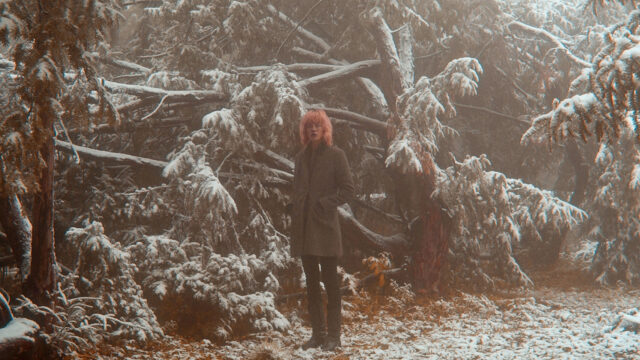
Serbian street photographer Boogie (aka Vladimir Milivojevich) goes where other artists fear to tread. He’ll take images of skinheads and Russian football hooligans. He will ask gang members to pose for him, to show him their tattoos or to flash their gold teeth. He’ll turn his lens on those on the margins of society. He also has a lyrical eye. Some of his best pictures are of streetscapes and decaying buildings.
Boogie is the subject of Ivan Šijak’s new feature documentary Boogie & Demons, a world premiere in Serbian Competition at Beldocs this week. Šijak pays full tribute to Boogie’s street photography while also focusing on another of his obsessions – the portraits he makes using the early Collodion wet plate process. This is a technique that was used in the 19th Century. It’s time consuming, involving many hours in the dark room and the use of toxic chemicals, but the images that finally emerge have a strangely blurry and ghostly quality. It’s as if they uncover the dark spirit of their subjects. He calls the series of images his “demons.”
“Something similar can be achieved with a long exposure and a regular camera but there is something beautiful in the way he is really pouring and mixing his chemicals…he is just very artistic about it,” the director says of the “dirty, blurry, spontaneous and surprising” Collodion images which take a small eternity to create.
“We’re buddies, we’re pals,” Šijak (a well-known cinematographer and teacher as well as documentary maker) says of Boogie. They’re from the same neighbourhood in Belgrade and first met after high school. “He’s a punk rocker,” the director describes his first (and still enduring) impression of his street photographer subject. “By looking at him, you can say this guy listens to this kind of music. He’s not a violent guy…he is just committed to music. He hasn’t changed much.”
And, yes, Šijak has posed for him.
Boogie is continually experimenting. “Every day, there is something different in his pocket,” the director says of him. When he is doing street photography, he moves very fast. He’ll never ask anyone to pose for more than a moment or two. He’ll walk around for up to 15 hours a day, hunting for the subjects for his pictures. Sometimes he uses colour and sometimes black and white. People feel comfortable in his presence. A drug addict might invite him to photograph her shooting up. An impoverished old lady preparing food on a park bench will let him snap away.
In the documentary, we hear Boogie on the soundtrack, explaining his aesthetic philosophy: “You just need to relax and go with the flow…you can never plan images,” he says. Šijak comments how he wanted the voice-over to sound as if Boogie was talking to a friend on the phone.
Reflecting the subject’s personality, the film has a deliberately haphazard structure. “It’s not so linear. It goes forwards and backwards [in time]. He [Boogie] is also moving around…”
One paradox about Boogie is that while he is utterly spontaneous as a photographer, he remains deeply reserved as a personality. “If you ask him to do something, he doesn’t feel comfortable in front of the camera,” Šijak says of him. “He is always embarrassed when he sees himself and hears his own voice. When he tries to put something into words, he isn’t comfortable either.”
The documentary shows Boogie at work. He’ll accost strangers in the street and take their pictures. In his own blunt way, he is articulate about his photography. “I’m just showing the world the way it is,” he says at one stage. “What I want to see is how regular people live…for most people, life is sheer hell.” He doesn’t moralise. He is just there, pressing the shutter.
What are Šijak’s favourites among the thousands of images captured by Boogie? “I am not sure if I could tell you one. Probably, there are around ten. He has an enormous amount of good pictures. He is probably best at getting involved when things are going wrong. He’s not like Weegee [the American photojournalist known for his pictures of crime scenes], but living with these guys in Brooklyn in the 90s, they are probably the most valuable things he has done,” Šijak says of the series of very intimate photographs of gang members.
The director believes that Boogie does have compassion and “strong emotions” but when he is photographing on the streets, he is utterly absorbed in his work, “not feeling much at that moment.”
When Boogie comes back to Belgrade from a trip abroad, for example after embedding himself with Russian football hooligans, he is like a war photographer still suffering from the stresses of the front line. “He is really not feeling good for some time…it really hits him hard.” The director confides that when Boogie was shooting images in the run-down apartments of the junkies and gang members, he was “buying food and bringing toys to the kids…he has a really human, great side. He is pretending that he is tough but he’s like a really nice guy.”
Šijak qualifies the compliment. “He’s [also] crazy. He has three cameras that he shoots all the time. He is like some grown-up kid. He still has this energy of a teenager. It is a really nice thing about him.”
Alongside his filmmaking, Šijak works as a professor at the University of Arts in Belgrade, teaching cinematography and visual effects. “This is my first documentary so it is something new for my experience,” he says of Boogie & Demons. He has a distinguished career in music video, advertising and digital arts – and has worked with some very big name figures among them Nikita Miklhalkov and Emir Kusturica.
Boogie & Demons was supported by the Serbian Film Center. Šijak is already at work on a new documentary. This is about his close friend, the artist Predrag Nešković, who is now in his 80s. “I started this production on my own, without any funds, but I have my equipment – two cameras and friends who come to help,” he says of his Boogie-like approach to the new venture. “It’s on its way for next year, probably.”