The concentration camp inmates are milling around. The Nazi guard is in his watch tower with a rifle. Someone is dragging a corpse across the mud. Jewish prisoners have yellow stars stitched onto their threadbare clothing. Amid the chaos and misery, we suddenly see camera technicians and boom operators in contemporary clothing.
These are the opening scenes of Slovakian director Paula Maľárová’s feature documentary Territory Of Imagination, a world premiere in Bel Docs. There is a sense of Chinese boxes about these scenes in which she is filming a movie crew as they shoot their own new Holocaust drama.
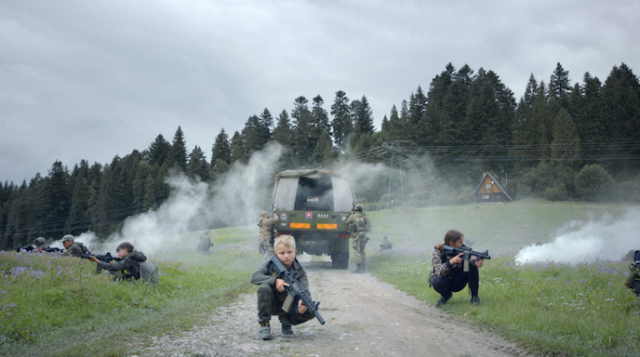
Slovakia has been at peace for many years but, as the documentary shows, war permeates every part of Slovakian society. There are big military parades. The army likes to stage military exercises. Films and TV dramas often use war as a subject – but almost everyone treats these activities as if they are games. No-one believes that real battles are going to be fought on Slovakian soil any time soon.
Maľárová doesn’t share their complacency. As a kid, she used to look out of the window “to see if the tanks were coming because I believed they would come eventually.” Even then, she felt the Slovakian attitude toward its military conflict was “too romanticised…as something so much in the past that it will never happen again, so we can just play and pretend.”
Slovakians like to tell themselves they will not “repeat the mistakes” of previous generations, but Maľárová couldn’t help but notice that the military fairs and parades always tended to glorify war rather than to dwell on the suffering and horror it brings.
Territory Of Imagination, made through Tereza Tokárová’s CinePunkt, started life around five years ago as the director’s student film at the Academy of Performing Arts in Bratislava. Producer Tokárová was a fellow student. “We were classmates, me and Teresa and the DOP (Andrej Dlabáč).” The sound engineer and the editor were also classmates.
The idea early on was to make a 15-minute film. “But the topic I chose was very complex. It was very hard to tell it in a short period of time,” the director remembers how her documentary mushroomed in size. “First, it was a small school project but then we decided we wanted it to take it further to make it our debut [feature].”
This is observational filmmaking, without interviews. There is plenty of humour in the scenes the director captures of children playing on tanks or soldiers earnestly crawling through the undergrowth.
“When we started the research, we were talking to a lot of ex-soldiers and people from the Ministry of Defence. They were telling me there will be no more war. We don’t have to be scared,” the director stresses.
Maľárová wanted to show the misleading and distorted way in which children were being taught “what war is.” She recently discovered an old family photograph of herself as a little girl standing on top of a tank, smiling and waving at the camera. “I remember this feeling that I was standing on something that was supposed to kill but I didn’t feel the fear. It’s just like this big, fascinating machine where you can pose for pictures.”
As for the scenes shot during the making of the Auschwitz movie, these were from a feature called The Auschwitz Reportdirected by leading Slovak filmmaker Peter Bebjak, also one of the professors at the Academy Of Performing Arts.
“There was no problem to get onto the production…this was a really big production where they built the concentration camp near Bratislava. They were very open. They let us go very near everything in the production.”
Maľárová also includes footage of the movie’s premiere. This allows for some jarring juxtapositions. Bebjak’s drama is about genocide and yet, outside the IMAX cinema on the night of the screening, the guests are drinking champagne and snacking on canapés.
The filmmakers are working with Slovak distribution company Film Expanded who will oversee the release of Territory Of Imagination in the summer. (The company is run by fellow former students from the Academy in Bratislava).
Although the documentary takes a satirical and critical view of the Slovakian attitude toward war and history, the military authorities have already given it their blessing.
“In our contract with them, we decided we would have to show them the film before we go public. They’ve already seen it because they had to give us approval for it. But we were shooting in the military camp in 2019. It was a different management back then. They [the new management] said we were OK to go out with this film. They didn’t have any problem with what we were saying…they just wanted us to put it in the end credits that it was the Ministry of Defence in 2019 [who gave the approval for shooting].”
The director was also recently a screenwriter on Romanian-Slovakian project Turnaj Snow, a documentary “tragicomedy” about a Transylvanian football team from a remote rural community that hasn’t won a match in years. The team is invited to Slovakia where they have a chance to redeem themselves…or, at least, to score a goal.
Now, Maľárová is contemplating making a new documentary about the “special relationship between mothers and daughters.” She hopes to shoot it in a small spa town which women visit in big numbers. The project is at early stage. “There is a special water for healing…there are a lot of women who have been coming to this spa for generations. They meet there every year and exchange stories. There is a very feminine energy and also they are talking about problems they don’t normally share with the world. Some of these issues are still taboo…I would like explore what it means to be a woman, what it means to be a mother,” she ends