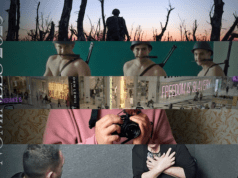
Two tragic stories are at the heart of What Will I Become? the new feature documentary from Lexie Bean and Logan Rozos (premiering in Generation 14plus and sold by Taskovski Films). Blake Brockington and Kyler Prescott were both young trans men. They were very different personalities. Blake was extrovert and charismatic, the “homecoming king” at his high school in North Carolina. Kyler was a quieter, more reflective personality, a poet and a musician. Both were to end up committing suicide.
As the documentary states, according to the American Academy of Paediatrics, more than 50% of trans boys attempt suicide.
Rozos and Bean have known each other since around 2018. They are both trans artists. “We were both actors and artists of other disciplines in New York; both in trans circles. We were in a lot of the same rooms and classes and spaces – but this is the first time actually collaborating on a project,” says Rozos.
“Logan and I both came out as trans around 2016 which was a tough year for a lot of trans people in the United States and elsewhere,” Bean refers to the start of the first Trump presidency. That was also the year of the Pulse nightclub shooting.
After coming out as trans, Bean attempted suicide. “I knew that I was probably not alone in what I was felling even though ‘suicide alley’ has a way of making someone feel so alone. I had a seed planted then of wanting to do a film, but kept talking myself out of it. I am really thankful that Logan was ready to step in a few years later and carry it with me and that we had a shared vision together,” the director (they/he) states.
Ask the filmmakers why they chose Brockington and Prescott as the anchors of the film and both acknowledge there were many other trans boys who could have been featured.
“The true thing is so many people could fall into this number specifically about trans boys [and suicide]. Blake and Kyler were people I had been focusing on in the time before bringing Logan onto the project. They both died in quite public ways around the time of both of our coming outs. It definitely shook me in the sense of considering the future,” Bean says.
Kyler had very publicly supportive and relatively affluent parents. He grew up in California, a relatively liberal state but, as Bean puts it, “that wasn’t enough.” Blake was celebrated and very popular in his life. “His story offers a push against the ways in which visibility isn’t the answer necessarily.”
Bean had also followed the story of Andrew Martinez, another trans boy who had spent time in foster care and had committed suicide, but decided eventually to concentrate on Blake and Kyler.
“They had such contrasting experiences in so many ways and yet had the same ending and had a lot of the same pressures exerted on them in life,” Rozos agrees about the film’s subjects. “I remember hearing about Blake at the time of his death and his presence before that, his force of personality and his seeming happiness in life. Kyler, on the other hand, was a lot more shy and interior. Blake was Black and had been in foster care and was from the southern United States versus Kyler being from a city on the west coast and being White.”
Blake left behind him huge amounts of footage. He was a big personality with a strong social media presence. There was far less archive material available for Kyler but the filmmakers used animation to represent his life. They also credit editor, Miles Hill, also trans, for finding ways of enriching the and amplifying storytelling.
“In some ways, Kyler represents the story of most trans people. Most trans people don’t like to be on camera. Most would have been completely unknown in their deaths. The only reason we even knew about Kyler’s death, and his life ultimately, was because of the activism of his parents,” Bean adds. “Even though Kyler rarely speaks for himself, his lack of footprint is something I think a lot of trans people will connect to.”
Bean was at college in Ohio with Drew Dickler, the producer of the documentary through Deep Dive Films. “I was making a lot of phone calls to people who know more than me, and Drew was one of those who answered her phone and offered early encouragement although we barely knew each other in college,” Bean remembers of how Dickler gave crucial support to the project at an early stage.
Bean and Rozos both emphasise the importance of “being able to be honest to what happened to these two subjects.” They felt that making a feature gave them the best chance of “conveying the truth and the totality” of their subjects’ experiences.
Bean’s degree is in anthropology – and that helped with the documentary. “I think it’s a very particular kind of listening that I feel invested in,” the director reflects. “A lot of my background, while it feels not related to documentary but for me it really is…I have put together several anthologies, collections of stories that are intersecting with each other. I have also done a lot of work with trauma survivors for over 15 years.” These experiences helped Bean with “establishing trust” with subjects.
The filmmakers hope the documentary will have a universality of appeal. “We definitely hope it will ring true to people who are from the trans community. Trans people are everywhere and most people know a trans person whether they know it or not. We wanted people to feel care when they watch it,” says Rozos.
The film opens and closes with title cards that welcome the audience. “It was also to say that yes, it [the film] is about these boys, yes, it’s about me and Logan in a way – but it also about ‘you,’” says Bean. “Anyone is the ‘you’ here, anyone who has experienced grief; parents of LGBT people in general; people navigating masculinity; people who have experienced ‘suicide alley’ themselves – there are so many ‘you’s’ there.”
Emmy-winning comedy writer [and trans woman] Harper Steele, whose own transition story was told in the Netflix doc Will & Harper (also featuring Will Ferrell), is exec producer.
“One of the best things she has brought to the process is just that she is a wonderful person and offers a sense of connection and levity,” Bean says of Steele. “It feels so good just to have a good person in general looking out for us.”
Steele advised on the project’s potential festival journey. She watched different cuts and gave her responses to the two directors.
Now, the film is being unveiled. This may be an American story but the filmmakers are glad to premiere it at the Berlinale. “It’s an unexpected and almost unhoped-for level of prestige for our world premiere. It’s a huge, huge honour and we’re very excited,” Rozos notes.
What Will I Become was made through Deep Dive Films, StoryLens Pictures, and ITVS with support from Independent Lens, Sundance Institute, and Firelight Media. An impact campaign is already underway. The aim is to “get it in front of people who can benefit from it and its lessons about suicide prevention.”
“I am obsessed with impact. That’s the reason I wanted to do this to begin with,” Bean adds. “I really believe this film can be a meaningful resource to people.”