In his restrained yet devastating documentary, Belgian-Syrian filmmaker Tawfik Sabouni visits the prison where he was held under the Assad regime. Accompanied on his journey by four other survivors, this painful confrontation with personal and political history at the same time honours the ghosts of the past.
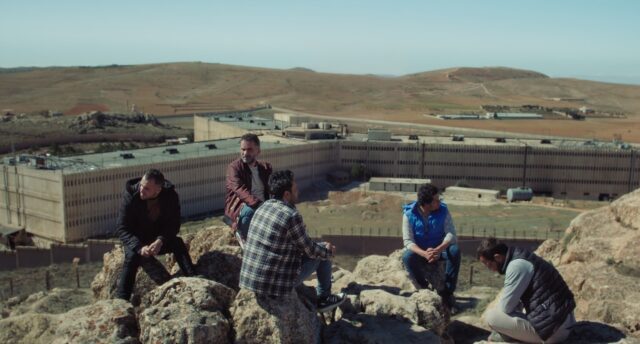
‘The other side of the sun’ was a name given to Syria’s notorious Sednaya Prison. Director Sabouni was imprisoned there during Assad’s regime, having been arrested for filming the 2011 revolution. But with dictator Bashar al-Assad now gone, Sabouni, having returned from Belgium, can now revisit the abandoned building. He asked four other survivors to join him. “We don’t know each other. But we know each other,” he calmly states in his voice-over.
As they approach the huge structure some 30 kilometres north of Damascus, they look up and recall how special it was, during those days of imprisonment, to see the sky at all. How wonderful it was to have seen a bird.
You can hear the mounting trepidation in their voices as they once again prepare to enter the complex, pass through the gates and go behind the building’s walls, which for 53 years had been impenetrable. Some of them hesitate, tremble and cry, even though there are no guards, no military, no police – there is no one at all. It’s just them, the building and their memories. And the ghosts of those who never made it out.
This restrained, yet devastating documentary partly relies on re-enactments. As they walk through the corridors, cross the main halls, enter dark cellars and look inside abandoned cells, they not only share their stories, but also re-enact certain events. Sometimes this is, perhaps, automatic, as when someone lies down to demonstrate what happened; at other times probably instigated by Sabouni, such as when they all crouch down and form a line, holding each other and walking quickly, while looking to the ground and trying not to stumble down some steps. It almost looks like a children’s game, but at that time these prisoners were in constant fear of death. Looking up even once, and catching a guard’s eye, meant certain execution.
This deeply ingrained avoidance of eye contact is one of the most sickening experiences they recollect. I thought the guards were huge monsters, one says, and describes the shock when once, by accident, he caught a glimpse of what turned out to be just a small man. One might see this as a metaphor for Assad’s dictatorship – indeed, any dictatorship: it’s the sustained fear that makes them seem huge, strong, invincible. Except here, it wasn’t just a metaphor. It was everyday existence.
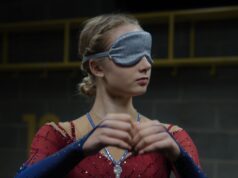
They also reminisce about how their physical appearance suffered under the mistreatment, to the extent that mothers, when they were allowed a short visit, sometimes even didn’t recognise their sons. And Sabouni’s voice-over wonders about the other survivors: “If we had met in this place, would we recognise each other today?” In his most surprising intervention, Sabouni illustrates this by using a life-sized, emaciated puppet. Its horror-like beauty visibly shocks his companions, one of whom remarks: “The people who died with us, all looked like him.”
Sabouni’s voice-over has a pensive, almost ghostly quality, and begins with the recognition of his own “fear, and the desire to forget; fear, and the desire to remember.” Alongside a mournful score, it raises the documentary from its specifics to a broader reflection on the nature of imprisonment and the reclamation of history. Which is reinforced by the documentary starting almost immediately at Sednaya Prison, with only a brief introduction of the other survivors and the explanation that they were imprisoned at different times.
While this is an understandable approach, I would have liked to know a little more about these five individuals. Maybe their reactions when they were asked if they would be willing to participate. Maybe their doubts: reliving an experience can be healing, especially when it’s shared with others with similar backgrounds, but it also risks re-traumatising. Maybe the jobs, families, houses within their current lives.
It’s precisely because the prison system attempted to crush their humanity, that I feel a need to learn more about their individuality. However, even without this extra information, the individuality is there, of course. It’s evident in a hand on a shoulder, a tear in the eye, a moment of silence, a fierceness in the voice, a fist against a door. The fact that they agreed to accompany Sabouni at all proves that, although they may be damaged, they have not been defeated. Which makes it not just informative and important, but an intense privilege to be allowed to witness their historic journey. At the same time, I can’t help wonder for how long such visits will remain possible, before the building gets closed off again and possibly returns to its former use?
Belgium/France/Saudi Arabia, 2026, 88 minutes
Director Tawfik Sabouni
Production Dérives, Habilis Productions
Producers Julie Freres, Jean-Baptiste Bonnet
Co-producer: Hanne Phlypo, Clin d’Oeil Films
International sales Andana Films
Script Tawfik Sabouni, Laurine Estrade
Cinematography Sameer Orabi
Editing Dani Abo Louh
Sound design Lucas Lauwers
Music Sami Abou Louh
With Tawfik Sabouni, Mahmoud Alqadah, Abdelkafi Alhaj, Mohammad Hamki, Abdelhamid Jadoue