Around Paradise is a film of opposites and extremes, of myths, legends and beliefs. It’s also a film about neo-colonialism, as practised by “settlers” from around the world [many of whom are German] who are attracted by the low cost of living, and a naturalization process that is very easy and very fast. The place they have settled in is Caazapá, which is to be found in one of the poorest regions of Paraguay.
In her notes for the film, director Yulia Lokshina paints an intriguing backdrop. “While a new wave of Europeans is coming with their beliefs and capital to join a newly formed gated community, the locals on the other side are trying to make ends meet and often seek their fortune elsewhere.”
The leader of the latest cohort of European settlers is German Erwin and his wife Sylvia, who enjoy a “chronic, incurable love” and who are determined to double occupancy numbers of their gated and patrolled settlement to 500 people. At the time of shooting there were approximately 250 settlers. Lokshina believes the number to be a lot less now.
Elsewhere in the city, Will and Yoha are two local students who are trying to eke out a living as tourist guides. The problem is that not so many folk see Caazapá as a prime holiday destination, and so the pair are asked by their employer to peddle the mythology of secret tunnels under the town, and that the place was visited 6000 years previously by an alien Bill Gates. The students remain incredulous.
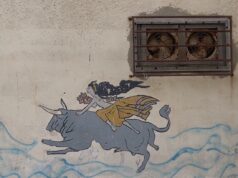
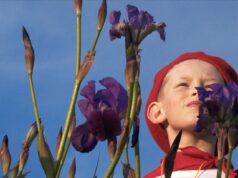
Another more lyrical, if somewhat sinister, local myth is that of the blond-haired, blue-eyed Jasy Jatere creature who lures youths into the forest only to bewitch them with kisses that burn, and all the time singing like a bird.
No less fanciful are the beliefs of some of the settlers, such as Kai, also blond-haired and blue-eyed and whom Yoha dates at beginning of the film. Kai and his mother are creators of the Messengers of Light YouTube project (as was Kai’s stepfather at the time of his untimely death), who claim to have psychic vision and can see into the realm of black magic, and whose job it is to safeguard against demon attack.
And then there is Erwin who, while seeking Nirvana in Paraguay, remains anti-vax, anti-LGBTQ and anti-promiscuity. “You need to stand for something in life, he says in the film. “He further believes that life in the gated community offers “more freedom, less control.”
“Obviously there is a great power imbalance between the settlers and the locals, which is grounded in economics,” director Yulia Lokshina tells BDE. “The locals barely have any capital to operate with, and they don’t have many possibilities to leave the place either. So this settlement also for some time became a very attractive place of work in this region with its very high unemployment, and which is statistically one of the poorest in the country.”
All of which must be to the benefit of the settlers? “It seemed to be an attractive offer to the people who came, but at the same time, the project is also highly selective, and there are certain rules, such as how to behave, what to do, who is accepted, and who is not accepted, and there is also a strong hierarchy, among the settlers, and within the governing structure of the place.” Erwin and Sylvia sit at the top of the pyramid.
Lokshina returns to the subject of myth-making, this time within the context of the region’s economy.
“One of the local people is saying at some point in the film that Caazapá is cursed with poverty. The only thing they can get out of it is to sell the image of the tunnels, ‘like we need to sell it.’ And so he comes up with this story,” she says. “It’s also a lot about which tools you have at hand, and also how legends and myths are created, and what can they be used for? And how they’re used to sell a place and attract people.”
“But the settlement itself was also lacking people, craving for more settlers,” Lokshina adds. “So they all needed to come up with a communication strategy that made this place seem attractive.”
It took a long time fully to gain trust of the settlers during the research and shooting periods, Lokshina tells BDE. “In these research trips, we were speaking a lot and spending a lot of time explaining what we’re doing, how we work, that we don’t come to point and shoot with pre-formed ideas. And how what we are doing is very different from reportage.”
“We wanted to understand what drives the people, what are their motivations to do what they do, and also why they sacrifice so much, because they did sacrifice a lot in their lives,” Lokshina adds. “Some of them left their loved ones, some of them really burned some bridges back home – not all, but some – in taking the decision to come to Paraguay. Some were highly judged.”
On the flip-side, the Caazapá locals didn’t quite understand why the filmmakers were prepared to invest such a lot of time and energy in their region. “It was quite surprising for some people that we come to this very far away territory that doesn’t seem to have so much to offer, barely any tourist attractions.”
While Erwin may not be everybody’s cup of tea, Lokshina was keen to communicate “openly” with him. “He wants people to see what he’s doing,” she says of the settlement he has built. “Also, he’s an artistic character, a musician. He loves the stage. He loves to perform, and to be seen and listened to.”
And for her documentary, Lokshina was prepared to put in the hours and hear what he had to say. “We were actually there to listen and to explore. This is how we work in general, you know, we are genuinely interested in understanding the dynamics of the places we are spending time in, getting an idea of what’s driving the people who we interact with.”
The film world-premiered February 18 (to much audience acclaim) ahead of what will certainly be a busy festival schedule over the coming year. All of which Lokshina hopes will enable her to close a local distribution deal, and lead her to “passionate and courageous partners for a strong theatrical release in Germany,” she signs off.
International sales for Around Paradise are handled by Filmotor.