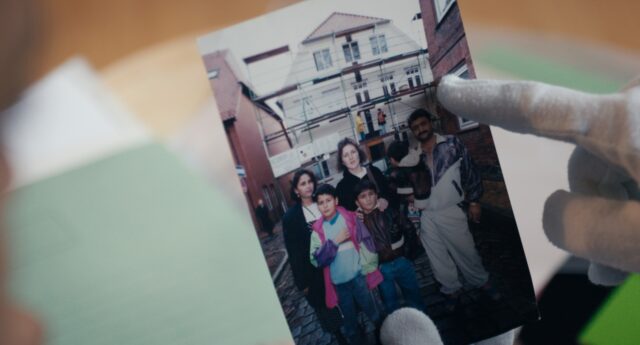
The moving and prescient The Moelln Letters (Die Möllner Briefe) shines a light on a dark episode from Germany’s past when, in November 1992, the city of Moelln witnessed the first racist attack within a reunified Germany, with three people killed by arsonists, devastating the lives of İbrahim Arslan and his family.
Years later, İbrahim and his siblings still try to deal with the lasting trauma that continues to shape their lives, with Martina Priessner’s film (screening in the Panorama section of the Berlin Film Festival) focussing on Ibrahim’s campaign to bring attention to the hundreds of letters of solidarity sent to affected families, care of the city, but which were never shared by city officials.
In the attack ten-year-old Yeliz Arslan and 14-year-old Ayşe Yılmaz died, along with 51-year-old Bahide Arslan, who was trying to save the two girls. Bahide managed to save her seven-year-old grandson İbrahim from the flames by wrapping him in wet cloths. The film follows İbrahim and his siblings as they continue to deal with the events of that fateful day, and as they struggle to keep the spotlight trained on it.
İbrahim had previously met with city archivist Christian Lopau, who has been in the post since 1990, and while he thanks him for his work in conserving the letters, he also expresses his bemusement that for 27 years he and his family didn’t even know the letters existed. In a follow-up meeting – with cameras there – he questions why letters addressed to the families involved in the attack never reached them.
The film astutely interweaves İbrahim’s poignant journey of rediscovery and his campaign to have the letters accessible as part of a more permanent form of remembrance. We also see a series of encounters with three of the letter writers, whose previously-forgotten messages create a powerful reminder of what happened.
The protagonist and his young son meet with Sonja Jansen, who wrote expressing her sorrow as a 12 year-old, also sending gifts for the children impacted; with Jessica Wappler, who expresses how it could have happened to her family, and with Michaela Rychla, then in her thirties, who was so upset by what had happened in the attack that she wrote a narrative piece titled ‘The Tears of Mölln.”
The film also strikes the ominous note, as expressed by İbrahim that this might easily happen again within a Germany that is lurching tom the right.
At one point the father stresses how “gruesome” he find some of the replies the then-Mayor wrote to letter-writers, and that he never replied to his own calls for assistance. So while there is a niggling undercurrent of anger from Ibrahim, there is also a sense of pragmatism as he sets about enlisting help and support to open up the archive of correspondence. He has found his own way to cope by fighting against racism and advocating for a remembrance culture focussed on the victims’ perspectives, and while his brother Namik is still at the beginning of his journey to come to terms with the traumatic experiences, as the film progresses he finds a way towards peace.
The film comes to a gentle – if rather damp – conclusion as family members, friends and even some letter writers, gather together in the rain in 2023 for the 31st memorial day, which sees representatives of the city alongside those who still carry the incident with them. The letters are being digitised and made available, and indications seem to be that the families’ concerns are finally being taken seriously.
Martina Priessner’s film gently observes İbrahim’s journey, never displaying any ostentatious cinematic techniques, instead allowing the emotions to surface as the survivors and their families find a sense of solidarity in their community and shared grief as they focus on remembrance rather than anger.
Germany, 2025, 96mins
Dir/scr: Martina Priessner
Production: inselfilm produktion
International sales: New Docs
Producers: Friedemann Hottenbacher, Gregor Streiber
Cinematography: Ayşe Alacakaptan, Julia Geiß, Ute Freund, Anne Misselwitz
Editor: Maja Tennstedt
Music: Derya Yildirim
With: Hava Arslan, İbrahim Arslan, Namık Arslan, Yeliz Burhan