

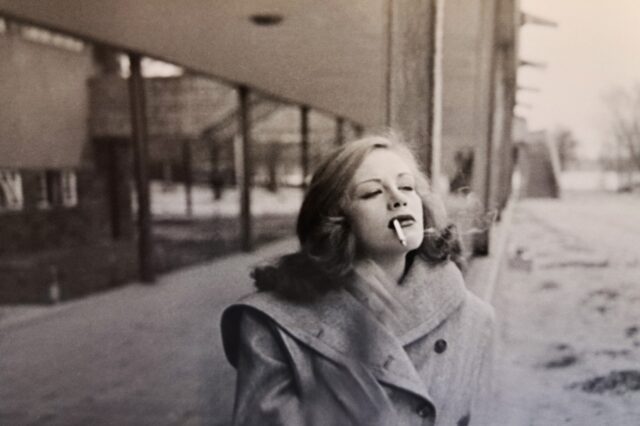
Hildegard Knef (1925-2002) is hard to sum up. You could liken the actress/singer/author/femme fatale with the husky voice to a German Marianne Faithful, or a star in the mould of Marlene Dietrich. She was a woman of immense contradictions – a performer who held audiences in the palm of her hand and yet would feel so nervous she would be sick before going on stage.
She was a strong willed and powerful personality who invariably ended up in relationships with men who manipulated her. She was a scandalous figure who provoked outrage by appearing nude in an early movie, but in her autobiography she was honest and insightful about everything from the Nazi era to post war morality in Germany. She worked with some of the greatest movie directors of the era, everyone from Billy Wilder to Carol Reed, and yet she made few truly memorable films.
Knef’s remarkable story is told in Luzia Schmid’s new feature I Want It All (a world premiere in Panorama Documentary).
As Schmid acknowledges, she didn’t start the project as any particular admirer of Knef. “Actually, quite the opposite. I knew of her. You can’t have grown up [Germany] without knowing her. But I wasn’t a fan.”
When the subject was proposed to Schmid by a producer, her reaction was “oh, really, another film about Hildegard Knef,” as if the world had enough of those already. “But then I started to get into it and I realised there was much more in it than I had expected. It didn’t take me long.”
Knef soon won her over. She is still not sure she is a fan as such, but she is convinced that Knef is “a remarkable woman and artist.”
Schmid was most enchanted by her subject’s honesty. In interviews, Knef would admit that she had made many films with big name directors who you would never expect to make a bad film – but then they would make the bad film with her.
“This really hit me. I instantly fell in love with her because I felt that nobody in Germany would talk so freely and so charmingly about things not working out well.”
The director realised there was a pattern to Knef’s life that kept repeating itself. She would have huge success but it would inevitably lead to failure and anti-climax. “She would have the steepest downfalls, ones you can never recover from, and yet there she was again…”
Schmid talks about her subject’s “tremendous ability of getting up again.” Knef survived extremely tough circumstances during the Second World War – and perhaps that is what gave her the resilience that sustained throughout the rest of her life.
“It was her childhood and she was traumatised, surely, like her whole generation. Right after the war, she did what she was best at, she lived on furiously. But health-wise, she was malnourished, she wasn’t well treated.”
Whatever challenged her after the Nazi era, whether it was professional setbacks, hostile media or the scourge of cancer, she found a way of dealing with it.
“This is what I admire. It surprised me to what extent she was a survivor. I knew she had brilliant lyrics in her songs but in her book and in her in interviews, she was very smart and witty in her self-reflections…she just had this ability to analyse herself.”
Over the years, Knef made her name different times as a movie star, a singer and an author. She was an international celebrity. The tabloid press was fascinated by her every move.
The star’s daughter Christina Knef features prominently in the documentary. She is very affectionate about her mother but also very frank. “From the first day she came home from the hospital, the daughter was a public figure. What interested me was how does she deal with that, and how does a mother-daughter relationship develop in such circumstances.”
Schmid’s main focus was on Knef herself, not the daughter. Christina, though, emerges as an intriguing character in her own right. Unlike many other sons and daughters of big name celebrities, she doesn’t bear a grudge against her mother.
“This is not all the case with Christina. She is very much aware of what she wants to share about her mother. She is very much interested in her mother – but she is not a fan.”
Paul von Schell, Knef’s final husband, is another insightful voice in the documentary.
Huge amounts of old clips are included in I Want It All. “Archive is always costly and you always need help because you can’t do that on your own,” Schmid says of the painstaking work that went into licensing this material. “I had a great research team and what really helped me was that because Hildegard was a great public person in Germany but in other parts of Europe and even America, you knew there was a fair chance you could get international footage as well.”
Schmid was also pleasantly surprised by how well some of the old interviews had been shot. These excerpts gave the film its backbone.
A few years ago, the director made the well-received documentary Three Women and The War (2022) profiling Lee Miller, Martha Gellhorn und Margret Bourke-White, pioneering female journalists who reported on the Second World War. She sees Knef as being in a very similar mould to these trailblazers. “She really had to fight and struggle for her artistic freedom and to be recognised. This she shares…and with her artistic side and vulnerable side, I very much do see connections to Lee Miller who I felt was a very vulnerable person as well as being a gifted and strong woman. And this wittiness in observing – Martha Gellhorn had the same kind of knife-sharp intelligence.”
Piffl is handling the German release of the movie which is set for early April. Whatever else, the documentary its bound to re-awaken interest in a cultural figure who, the director believes, warrants far more recognition. “She deserves to be rediscovered and I think there is a good chance for her, because she is fascinating!”





