Some perspectives can only be revealed by insiders. That can provide unexpected insights, present unknowable facts and deliver very uncomfortable truths, as in this unvarnished portrait of a gold mining village in Burkina Fasso, in which the prospect of redemptive wealth holds the inhabitants in an iron stranglehold.
Filmmaker Boubacar Sangaré briefly appears at the end of the documentary to talk casually about his own childhood in a gold mining village, where he sold water as a thirteen-year-old to support himself. The boys with whom he plays a game of table football agree: thirteen is definitely too young an age to descend into the mines.
But the boys that Sangaré follows in his film, sometimes tens of metres below ground, are not much older than he was then. And the chance that they will ever escape these often harrowing circumstances seems very small, as you gradually start to realise how much time, effort, money and health-destroying energy it takes to find even a scrap of the desired commodity.
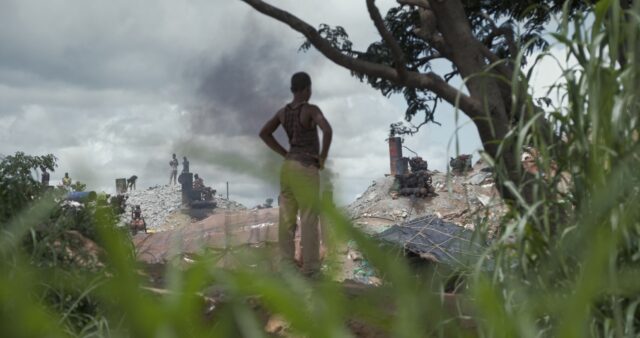
The perspective starts small, with young Bolo chopping wood, cooking beans and hanging out with friends. You don’t know where you are yet – and it is never mentioned – this dusty, sandy place, with huts made of wood, reed and tarpaulin, inhabited by boys and men. There are beautifully composed images that exude tranquility and even a kind of cosiness, until the perspective widens. Then you hear the hectic heartbeat of the diesel generator, a sound that will remain under your skin as it continues interminably throughout the documentary.
Then you see an improvised hoist above a shaft, where a man is lowered down on a rope without any form of protection. And then suddenly you’re underground, with no footing, no sense of direction, where the flashlight exposes the all-too-unreliable wooden struts in the narrow tunnel.
The conversations between the workers, some of whom are merely on the brink of adulthood, are about parents who would not have wanted this for their offspring. About what they would do if they would actually strike gold. About how, in another village, hundreds of people have lost their lives looking for gold: “if there are no catastrophies, then there is no gold,” we are told. And about how, on a piece of nearby land, white people are exploring the prospect of gold, and what that would mean for them. The pronouncement that the villagers would be chased away is delivered with depressing realism.
The perspective opens up a bit more: the huts appear to be part of a complete village, which from above looks like an abstract painting, with lines and squares in harmonic play. At night it looks like a magical anthill, with lights that form a continuous corridor over the hills created by excavated sand. When a fire threatens to get out of hand somewhere and an explosion sounds, it exposes the vast numbers of people living their lives here. Not just boys and men, but also women and children, who casually leave their tents to calculate the danger. Apparently these explosions are the order of the day.
The special thing about this documentary is the total lack of any sense of voyeurism. The camera seems to be completely absorbed within the society. It observes without judgment and pursues no effect.
A Golden Life presents a complete and commentary-free account of a life which, it transpires, has been lived this way for generations. The village forms an entire, almost circular society, in which all activities and sectors are focused on gold mining: one specialises in grinding the raw fragments extracted from the mine, another sells water, the young boys transport the ground sand. At the top of the pyramid is the boss, who weighs and assesses the gold collected through the blood, sweat and tears, and hands over the money that is eventually spent on food, cigarettes, women, drugs and drink.
No one complains. They don’t even seem to complain to one another. Life rolls on quietly to the rhythm of the generator that continues to belch out black smoke incessantly. The poetry of existence is very occasionally captured in picturesque images, of the moon, or of the emotions on the face of the young men. Those are the only moments when ominous or melancholic music sounds, moments of reflection in lives that go on and on, the same way most of our lives are just a repetition of actions while trying to get somewhere beyond our reach.
Although the circumstances of the goldminers and their families are in no way comparable to us and our comfortable lives, the film seems not to seek our pity. The miners carry, and even give you the impression that they determine, their fate with enviable grace.
Burkina Faso/Benin/France, 2023, 85 mins
Director: Boubacar Sangaré
Screenplay: Boubacar Sangaré
Cinematography: Isso Emmanuel Bationo
Editing: Gladys Joujou
Sound Design: Rémi Durel
Sound: Seydou Porgo
Assistant Director: Thomas Henoc Ouedraogo
Producers: Fernand Ernest Kaboré, Faissol Gnonlonfin, Madeline Robert
Produced by: Imedia, Burkina Faso; Merveilles Productions, Benin; Les Films de la caravane, France