I can sympathise with director Costanza Quatriglio’s need to document the dismantling of her father’s archives. The dismantling is being carried out, with great care and the best of intentions, by archivists of the Central Library of the Sicilian Region, who are interested in the materials of her father, Giuseppe Quatriglio. He was a famous journalist who, for eighty years, reported on national and international issues for the Giornale di Sicilia newspaper, starting on 18 January 1944, shortly after the Allied Forces liberated Sicily from the Fascist regime.
But to see the shelves emptied, the books, photos and 8mm reels catalogued and stored one by one, is to see the man himself dismantled, boxed up and organised in a way that is alien to how she knew him when he was still alive.
There is, as Costanza says, a sense of ‘chaos’ which disappears from the archive after it has been systematically reorganised by the librarians. The chaos of life. Or, as Giuseppe himself says in an old home video, pointing to the cluttered shelves: it’s not very organised, but I know where everything is.
I can sympathise because my own parents are in their eighties and we have recently begun going through their shelves to see which child or grandchild would like to have this or that book, and which other books will be donated to charity or thrown in the paper bin. It’s a beautiful thing to be able to do this with my parents, going through their memories one book at a time, but at the same time it has the unmistakable aura of a pre-mortem funeral rite. As if saying goodbye to their possessions is a kind of practice run for when we inevitably have to say goodbye to themselves.
For me, just as for Costanza and her father, books and photographs form the most substantial part of this heritage. Old B-novels just as much as serious reference works (perhaps more so, as they seem more personal) which have been guarded and dusted off for decades but, by now, are probably outdated.
I understand why Costanza’s camera keeps filming the shelves and books, the boxes and papers, the notebooks and more than 60,000 photographic negatives, while nerdy archivists and muscular movers catalogue, pack and remove her father’s materials from his study. That said, if you don’t share this feeling of a book collection as an imprint of a person’s personality and its dismantling as a funerary rite, then I’m afraid these scenes, with all their repetitions, will mostly just seem very long. At 132 minutes, the documentary is generously proportioned.
It raises the question of for whom The Secret Drawer is intended. Often, filmmakers, especially documentary filmmakers, follow their own curiosity, trusting the result will also be of interest to others. But when the subject matter is as personal as a parent’s inheritance, there is an obvious risk that the film becomes too private and lacks universality.
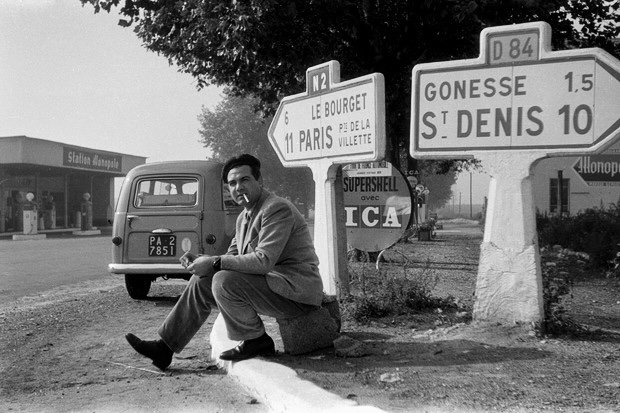
This, to be honest, is what the documentary feels like for me. Obviously, Costanza’s globetrotting father had a remarkable career as a journalist, but although his photos and films bear witness to an impressive amount of travel (from touring the US in the 1950s to documenting the Berlin Wall in 1963) and many famous people (from Winston Churchill to a long list of movie stars, including Cardinale, Dietrich, Hepburn, Heston, Peck and Grant), most of these documents feel rather generic. Giuseppe was a decent but by no means exceptional photographer and most of the selected film fragments feel more touristy than newsworthy.
Meanwhile, Costanza’s almost continuous voiceover enumerates the events of her father’s life in a mainly factual manner – and that includes the emotions involved. What I miss above all is a stronger sense of who her father was as a journalist: what were his drives, ethics and complexities? “My father never told me much, almost nothing, I’d say,” laments Costanza. Only rarely does she use her father’s own written words to accompany the images, giving us some sense of the kind of journalist he was.
It may be that for an Italian audience more of the documentary’s content will ring a bell. I do not recognise all the Italian dignitaries and celebrities who appear, and for Italian viewers the national news events mentioned might function more as a reminder of lives lived through a shared period of history. Topics such as the great Belice earthquake and the mesmerising land art project that Alberto Burri later created for the area, the Cretto di Burri. Or the graffiti Giuseppe Quatriglio discovered on the walls of the prisons of Palazzo Chiaromonte in Palermo by those condemned by the Spanish Inquisition.
But perhaps it’s even more specific, and a regional audience will most appreciate this meandering journey through time. Because Giuseppe Quatriglio was first and foremost a Sicilian journalist. In this sense, Costanza’s personal musings on heritage and loss will likely resonate more with a local audience. For sure, the fact that the Central Library is preserving some 25 metres of books and other archival papers (a figure which does not even include the photographic material, which is also being digitised and preserved) proves how highly her father’s life’s work is regarded on the island. And no doubt the librarians themselves will be more than pleased with this filmed reflection on their inventory.
In the end, it’s a question that everyone who has lost a parent will recognise: to whom does that life still matter, to whom does this legacy still speak? Am I alone in my grief or can I share it, personally and publicly? At least in raising this question, the documentary can be said to be universal after all.
Italy / Switzerland 2024, 132 minutes
Director Costanza Quatriglio
Production Indyca
Producers Simone Catania, Costanza Quatriglio, Antonietta Bruni, Francesca Portalupi, Michele Fornasero
International sales Film Harbour
Script Costanza Quatriglio
Cinematography Sabrina Varani
Editing Letizia Caudullo
Sound design Marco Furlani
Music Giovanni Di Giandomenico
With Giuseppe Quatriglio, Costanza Quatriglio