Filmmaker Abel Ferrara takes a personal journey into the heart of Ukraine as he attempts to deal with own confusion about what is happening in the country. Blending interviews with those who have experienced the conflict close up, archival footage and material of Patti Smith recording songs and poetry, Ferrara’s Turn in the Wound is a meanderingly personal examination into the nature of war and oppression.
Ferrara’s reputation as an edgy filmmaker of both fictional and documentary material to some extent helps his access within the country. It also allows him the artistic flexibility to craft a project that also, at times, puts him centre-stage as an artist, both as an interviewer out on the streets (he is often shown listening and contributing to conversations), but also in a scene in which he is interviewed for a Ukrainian television news programme.
Sitting in the television studio, he is asked why he has come to make a film about the Russian invasion of Ukraine. “When we make documentaries we don’t really think about what we are filming…what the end game is going to be,” he says. “I have friends in the Ukraine and as an event, as something that is happening, it compels me. I’m an instinctual filmmaker – so I just felt like I had to be here with my camera in a humble way.”
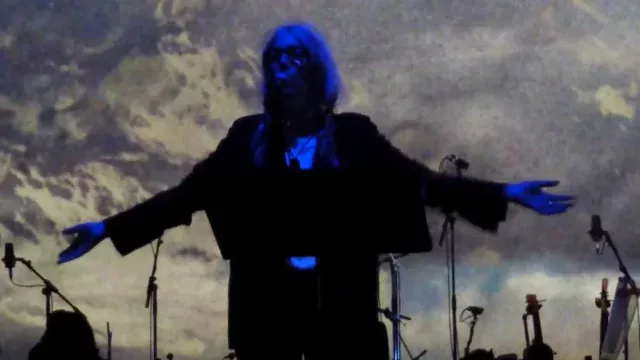
This lack of conventionality means that the film is very much a reflection of Ferrara himself, who bolsters his on-the-ground Ukrainian interviews with footage of Patti Smith both recording material and at the Centre Pompidou where she has created a world of drawings and music. She also sings and delivers intimate readings of the works of Antonin Artaud, René Daumal and Arthur Rimbaud.
Poetry and music make for an at times challenging counterbalance to stories of real-life brutality people have seen and experienced in Ukraine, but as the film’s synopsis states, Ferrara attempts a “search for meaning in the never-ending suffering and conflicts that echo the past”.
The film opens with footage of Smith at work and then talking about the phases of being an artist, before it swiftly cuts to Ukraine and a series of interviews with men, women and children who have endured terrifying and violent moments over recent years. Ferrara also manages to bag some time with Ukrainian president Volodymyr Zelensky, but never seeks to let this dominate the film, instead heading quickly back onto the streets to meet more real people with moving stories.
Screening as a Berlinale Special, Ferrara’s Turn in the Wound is a natural fit for film festivals given its blend of art and real-life trauma. Ferrara writes in his director’s statement, “When I see Patti Smith in her work, her life, the poet the singer the mother, or President Zelensky humbly governing, I become inspired. I want what they have. I want to be near them, learn from them, film them. War is far from my immediate reality but it is the reality for too many people who are just like me. Death and destruction can only be battled with contrary action, love, compassion, empathy, poetry, movies. Righteous intent.”
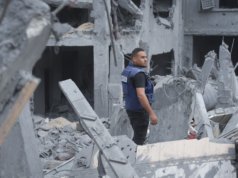
In the film when questioned about what he feels when he sees the bombed-out buildings, he answers simply “why, why, why…how does it get to this?…what is bringing us to killing each other – I have no answers, I’m 71 and more confused than ever.”
UK-Germany-Italy-US, 2024, 77mins
Dir: Abel Ferrara
Production: Rimsky Productions, Maze Pictures, Ventana, Interlinea SRL
Producers: Diana Phillips, Philipp Kreuzer
Cinematography: Emmanuel Gras, Sean Price Williams
Editor: Leonardo Daniel Bianchi
Music: Patti Smith
With: Volodymyr Zelensky, Andrei Yermak, Patti Smith