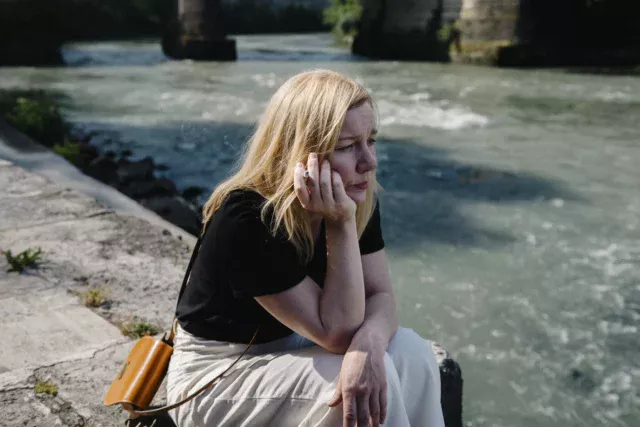
A hybrid documentary that astutely blends archival video, pictures and audio with re-enactments, Regina Schilling’s absorbing DOK.fest Munich opener Ingeborg Bachmann – Someone Who Was Once Me (Ingeborg Bachmann – Jemand, der einmal Ich war) is made all the more accessible and intriguing with acclaimed German actress Sandra Hüller on board to portray the eponymous heroine on an imaginary day in Rome.
A hybrid documentary that astutely blends archival video, pictures and audio with re-enactments, Regina Schilling’s absorbing DOK.fest Munich opener Ingeborg Bachmann – Someone Who Was Once Me (Ingeborg Bachmann – Jemand, der einmal Ich war) is made all the more accessible and intriguing with acclaimed German actress Sandra Hüller on board to portray the eponymous heroine on an imaginary day in Rome.
The film not only plays in Munich’s International Competition, it is also part of the festival’s ‘HerStory – Films About Fearless Women’ section and, given Austrian poet and author Bachmann’s striking and challenging life, this seems like a perfect fit. It weaves together stylistic elements with Bachmann’s own writings to offer a refreshing new perspective on the author, and aims to position her writings as a reference point in current debates on gender relations and power.
Bachmann is regarded as one of the major voices of German-language literature in the 20th century, with an output that included poetry, short stories, radio plays, novels, translation and even opera liberetti. In 1963, she was nominated for the Nobel Prize in Literature by German philologist Harald Patzer.
The film opens almost playfully with actress Hüller being fitted for her ‘Bachmann’ wig, commenting how, “suddenly it is exciting.’ Director Schilling has rented the flat in Rome where Bachmann lived in her later years, and she and Hüller are filmed wandering the space, looking at walls, tables and ornaments.
Schilling says: ”We’ll imagine a day in her life in her last days in Rome…with panic attacks and drugs and alcohol. Alone and reclusive.” For Hüller the fact that the manual typewriter in the flat works well is good, and while sections of the film present her as Bachmann watering her plants, typing, and sitting in the flat, there are also sections where she drives, visits parts of the city and expresses herself with a sense of abandon that counterbalances the stillness of life in the flat.
Though interspersed with scenes of Hüller and the re-enactments, the film essentially takes a chronological journey through Bachmann’s life, using photographs, archival video and audio recordings of her readings to detail her early years in Austria and education in Vienna, before moving to Rome in 1953 where she spent much of the following years writing poems, essays and short stories, which in turn brought her fame and literary awards.
During her later years she suffered both from alcoholism and addiction to drugs prescribed by her doctor. She begins to be obsessed with death. She recalls a trip to Auschwitz, adding that she developed a fear of being murdered, and is seen drinking and starting to pen articles about death and murder. The last book she was working on was titled ‘Death Styles’, a compendium of all possible ways to die. When she died in 1973 she had written 5,000 pages.
The performance by Hüller (whose already high profile has increased even more so following her role in the recent box office success Project Hail Mary) helps give the film a focal point and bursts of energy, which director Regina Schilling impressively weaves into the archival material to help present a striking, evocative and impressive portrait of a singular talent.
Germany-Austria, 2026, 95mins
Dir: Regina Schilling
Production: Zero One Film, Navigator Film
Producer: Thomas Kufus
Cinematography: Johann Feindt
Editor: Carina Mergens
Music: Anja Plaschg
With: Sandra Hüller