

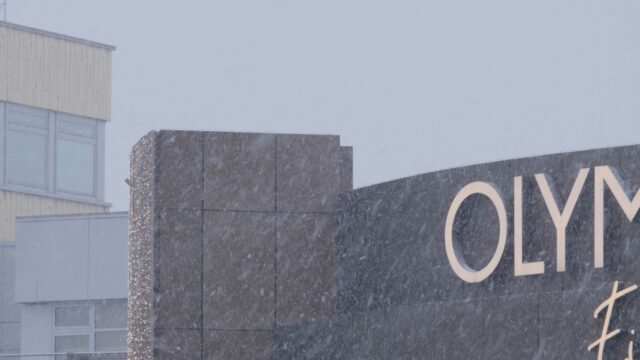
In Retrospect, directed by Daniel Asadi Faezi and Mila Zhluktenko and world-premiering in Berlinale Shorts Competition, was developed from an installation that the pair worked on for Munich’s NS Documentation Centre, that deals with racist and right-wing terror attacks in the city since 1945.
In their short film they seek to link a series of threads, starting with the construction of the shopping mall at the same time the Munich Olympic Stadium was built for the 1972 games. The mall was built by mainly foreign labour, comprising Italian, Yugoslavian and Turkish workers. The film also presents the fascinating history of the site, with details plans and models, and remarkable footage of post-war Munich which was a mass of rubble.
Another segment tells of Semra Ertan, a Turkish migrant, poet and political satirist who burnt herself to death in protest at the German treatment of fellow migrants in 1982. This inspired Sohrab Shahid Saless, Iranian by birth but considered part of the German New Wave of the 1970s and 80s, to make a film titled Addressee Unknown, about a German woman who falls in love with a Turkish migrant and which plays like a lament to the experience of those who helped (re)construct much of Germany in the second half of the 20th Century.
“We thought we had been invited. We thought we were guests. It took a while until we understood that…there is no host that would care for us,” the main character intones.
“We wanted to respond to Addressee Unknown and ask if this film is still relevant for us today. The things that he [Shahid Saless] was talking about in the eighties, does it resonate with us as filmmakers nowadays?” co-director Asadi Faezi explains to BDE. “For example, the economic depression that we’re living through now and how it’s connected to the rise of racism and the overly painful attention to migrants as if they were the problem.”
The film further cites the murderous right-wing racially-motivated attack perpetrated by an 18-year-old German/Iranian man (who claimed to be an Aryan) who killed nine people of mostly migrant background, before turning the gun on himself. The attack was planned for the 5th anniversary of the Utøya shootings (Norway).
“There are things that we were seeing in Addressee Unknown that were painfully reminding us of what is happening now,” agrees co-director Zhluktenko, who goes on to stress the film’s jigsaw-type aesthetic. “It’s more an essayistic approach where we found many different things that speak to each other.”
The film is largely moulded out of archive, whether that of the architectural practice that was responsible for the mall’s construction in the early 1970s or Bavarian broadcast archives. “And there are also the shots that you see at the very beginning of the film, the demolishing of the ruins of the Second World War in Munich and the rubble being carried outside of the city…The Olympia Park is basically built on the ruins of the Second World War,” says Zhluktenko. The resulting pile of stones became known by locals as Rubble Mountain, although it is latterly referred to as Olympic Hill, the filmmakers point out.
Zhluktenko describes herself as a first-generation migrant (of Ukrainian heritage) while Asadi Faezi is second generation, with Iranian roots.
“In January last year, we were at a big rally against the AfD (Alternative for Germany). It was quite a few days after the secret meetings were made public in Germany,” says Asadi Faezi, referring to the negotiations that politicians from the AfD had with neo-Nazis over “master plan” for the mass deportation of asylum seekers and German citizens of foreign origin.
“So suddenly also for us, the question arose, what should we do in this case and how might we be affected by the rise in power of a right-wing party in Germany? So this film was also kind of a reaction to that. And in this sense, I think we share a similar background just by being people with migrant backgrounds living in Germany right now,” he adds.
“And some of the questions that arose in the film of Shahid Saless also resonated with us,” Zhluktenko continues. “Where should we live or how should we fight? Or what is our position and stance right now as migrants here in Germany? What can we do if it really gets so bad that we have to leave?”
“One fourth of German society have a migrant background,” Asadi Faezi asserts. “So I think also this film talks to a lot of people even if they might have a different migrant background, who may ask themselves this question. In the next years, what do we do within the society that we shaped and that we are an integral part of?”





