Accompanied by a literary, autobiographical voice-over, Berlin-based Lesotho filmmaker Lemohang Mosese blends observational documentary and mythical re-enactments to create a highly poetic, highly personal film that transcends the boundaries between reality and dream, showing how, instead of concrete memories, it’s the dream of a mythicised home that sustains the emigrant.
The very title is layered with meaning. The words ‘ancestral visions of the future’ combine past and future, memory and imagination, seen and unseen.
That is, if we want to treat these elements as separate, or even opposites. Which, I feel, is exactly what Berlin-based Lesotho filmmaker Lemohang Mosese (This Is Not a Burial, It’s a Resurrection, 2019) is trying to overcome. Merging these concepts in the title can therefore be seen as a declaration of intent. A key to his film.
In the press notes, Mosese speaks of “home as I remember it, home as it is, home as it never was” as the three versions of the Lesotho of his youth that shape his dreams as an émigré. Clearly these three Lesothos are too intimately intertwined to be disentangled. Yet they all do refer to something real.
It is tempting, as a Western European critic, to point to Mosese’s time in Europe as an explanation for the clarity I experience in his storytelling, even though an important role is played by mystical concepts of ancestry which are essentially foreign to me – as an immigrant he will have had to learn how to bridge this cultural divide. But then I would be introducing another dichotomy, between Europe and Africa. And fall into the same trap of trying to separate the inseparable.
It might be better to see Mosese’s approach to recounting his personal history as a tapestry, with different elements woven into patterns that cannot be reduced to a single one, although if you look closely, the various threads are still there. This impression of a tapestry also fits with the film’s dreamlike attention to textures, both in the sound design (hail hitting a metal roof; the creaking of a tree) and the imagery (ploughed earth, tensed muscles, a tired old face).
At the same time, Ancestral Visions’ style is deceptively simple: for the entire duration of the film, Mosese’s calm, literary voice-over (similar to someone reading a novel aloud) recounts autobiographical facts, actual or imagined, about his upbringing in Lesotho, while we watch images which, more or less directly, illustrate his words. Such as the young boy filmed in present-day Lesotho while Mosese talks about his own youth there.
That said, ‘illustrating’ again creates a false separation of categories, because in Ancestral Visions, the visual and the spoken word are inextricably intertwined as well, reinforcing and deepening each other. Layers of time collapse – using the documentary present as a re-enactment of his past, this child we see automatically becomes two: a modern Lesotho child and young Mosese himself. Similarly, a registration of street life, infused with Mosese’s recollections and musings, automatically doubles as a representation of earlier times, like a psycho-archaeology of Lesotho. And conversely, the correspondences of today’s streets and anonymous passers-by with Mosese’s words elevate his autobiography to something more timeless and universal.
Did I say ‘anonymous passers-by’? Some characters are interpreted by people who are named in the credits, like actors. Are they actors? People playing themselves? Documentary subjects Mosese decided to name? Perhaps all three?
Mosese does not so much break categories or blur boundaries, as dissolve them – without losing their essence.
A somewhat lazy label for the film would be ‘hybrid documentary’. It isn’t wrong, but it obscures other ways of looking at the film. In the way Mosese talks about migration, dislocation and imagination, Ancestral Visions has an essayistic quality. Some scenes can simply be enjoyed as observational documentary. There are also philosophical, magical and even confessional aspects to the film, which all the while remains deeply personal and autobiographical.
And all these aspects diffuse into something which – and this is the most amazing aspect – is very easy to follow, with a consistent tone of voice and a compelling, slow-building message.
This message, as I understand it (but I’m sure Mosese’s tapestry is rich enough to allow for other interpretations), is that the longing for the places left behind, the longing for belonging, is what sustains the emigrant and shapes their memories in such a way as to fulfil that role. For the object of yearning, the ‘home’ of the mind, is not a physical place, but a state of mind.
One way Mosese describes this is in terms of the ‘faces’ one wears as an immigrant – not one, but many: “In exile, we wear thousands of masks, each crafted to blend into ever-shifting mosaics of places and faces. Over time, these masks melt into one another, forging a monstrous patchwork of a face that can no longer recall its true form.” Rejoining the lineage and soil of the ancestors is a way of rediscovering the beauty of the original face.
“While living in Europe, I held on to the image of home, perfect in its beauty. I told myself that one day I will return, and in that return, the face I had let fade would find its form again.” It is a simple, but evocative metaphor – which in a way isn’t a metaphor at all.
So again: a diffusion of categories. It is metaphorical and yet it isn’t; it’s acted and yet it isn’t; it’s imagined and yet it is real. But, as Mosese reminds us several times in the film, things don’t have to be just one thing: “Our shack house stood as both a sanctuary and a prison.”
It might simply be because of the way the artist Mosese sees the world that his work, while clear, consistent and inviting, resists traditional categorisation. Yet it also happens to be a particularly good fit for this specific subject. For what does the uprooted migrant want more than to dissolve borders? Towards the end of the film, Mosese even imagines that “[h]ome and exile blend into one face that wears the ones who left, and the ones who stayed.”
I would like to finish now, where I perhaps should have started – but a) I needed to lay some groundwork and b) the beginning and the end, like the past and the future, are not as different as they seem.
Mosese combines, as mentioned earlier, real recollections and imagined ones. But this is only a true opposition if you don’t consider imagination to be real. Just as there is only an opposition between actors and real people if you don’t see actors as real – or real people as acting. And there is only a real opposition between past and future if you see time as linear and not, as one person in Ancestral Visions affirms, as circular.
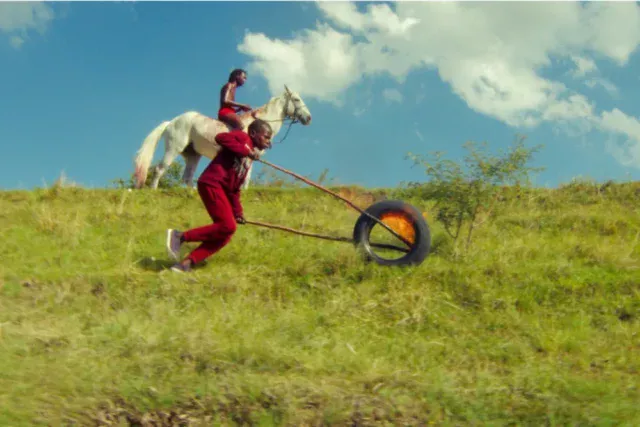
Which is not to say that there aren’t clear scenes of imagination in the film. There is an endless piece of red cloth rolled out across the landscape, like a border created by a stream of blood. There is a man walking across the savannah at sunset, large knives stuck in his back. There is a vision of ancestors, enacted against black backgrounds, with painted faces and blood-soaked hands full of flies. But when one accepts imagination, magic, dreams, ghosts and ancestors as just as real as everything else, the only real difference you are left with is that some things in our world are seen and others unseen – or seen only by individuals.
That Mosese also makes the unseen elements of his autobiography visible for us requires imagination, on the part of the filmmaker as well as the audience. But that doesn’t mean they’re any less true. Or that they cannot be considered documentary.
There is a reason why the city in Lesotho is never named: this documentary transcends the concrete and touches on the mystical. This city isn’t just as it is, a very violent city (which Mosese relates to the lasting effects of Dutch and British colonisation), but also Mosese’s dream of a city, “a city imagined so that exile could be endured”, “a mirage built out of longing”.
If we arrive at this point of transcending boundaries without forgetting the essence, the soil, we may have understood the cryptic introduction of Ancestral Visions of the Future: ‘What I am showing you is not for watching, but for becoming.’
Ancestral Visions of the Future started as an installation, which also premiered in Berlin, at the Berliner Festspiele in 2023.
France/Lesotho/Germany/Qatar/Saudi Arabia, 2025, 88 minutes
Director Lemohang Mosese
Production Agat Films
Producer Marie Balducchi
International sales Memento International, Artscope Label
Script Lemohang Mosese
Cinematography Lemohang Mosese, Philip Leteka
Editing Lemohang Mosese, Andrés Hilarión
Sound design Diego Noguera
Music Diego Noguera
With Siphiwe Nzima, Sobo Bernard, Mochesane Edwin Kotsoane, Rehauhetsoe Ernest Kotsoane