

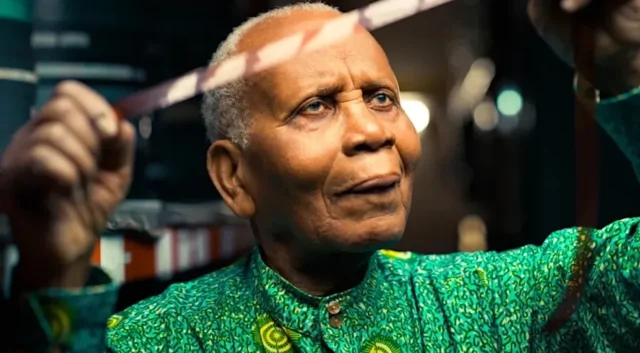
Two-time Oscar-winner Ben Proudfoot makes his feature debut with The Eyes of Ghana, produced by Oscar-nominated filmmaker Moses Bwayo (Bobi Wine: The People’s President) and exec-produced by Barack and Michelle Obama.
The film tells multiple stories, but focusses mainly on Ghanaian filmmaker Chris Hesse, now over 90 and with failing eyesight, who was the personal chronicler of Ghana’s revolutionary leader Kwame Nkrumah in the 1950s and 60s.
In his notes for the film, Proudfoot is effusive about Nkrumah and his legacy. Not only was he Ghana’s first prime minister, “he was a visionary, a scholar of pan-Africanism, an icon who had walked with Du Bois and Garvey, who dreamed of a United States of Africa, who ignited the liberation of the African continent from colonial rule,” the director writes. “He was embraced by JFK, graced the cover of TIME magazine, a symbol of African unity and global historical revolutionary for all time.”
He was also prophetic in understanding the power of the moving image to record history. A brilliant scholar who went to the US to study, Nkrumah saw the influence of movies on the American public. After he won power from the colonial government in 1951, a full six years before full independence, he turned to Chris Hesse therefore to document the momentous times they were living through, charging the filmmaker always to remains at his side in doing so.
After the CIA-backed coup of 1966, Nkrumah was deposed, but much of what Hesse had shot while Nkrumah was in power – more than 1000 reels of film – was deemed unpalatable to subsequent regimes within Ghana, and was subsequently burned.
But not the negatives, which had been sent to London for processing, and which remained safe and intact, away from political upheaval. And the custodian of these remained Chris Hesse, whose mission, even in the Autumn of his life, is to have the archive digitised and shown once more on his home soil of Ghana.
“What began as a COVID documentary assignment became something else entirely: a cinematic resurrection of the buried films of African independence, a meditation on memory and erasure, and a call to reckon with the stories we’ve lost — and why we lost them,” Proudfoot underlines.
And what was originally intended as a short film – Proudfoot has won two Short Documentary Oscars in recent years, for The Queen of Basketball and The Last Repair Shop, co-directed with Kris Bowers – became something altogether more substantial as the story got bigger.
“The challenge of this movie was there were a lot of things to explain in terms of who Kwame Nkrumah was, what Ghana’s position was in the world, and the history of colonialism. There was a lot of things to pack in there for someone who is maybe at zero, and needs to get to one,” Proudfoot further explains to BDE. “In addition to that, probably most importantly, in terms of the runtime in particular, is that this is a movie about a lost archive. This is a movie about images that have never been seen before, never been transmitted since they were shot in the 1950s and 60s.”
“So we knew that we had to show unedited sections of that restored film in the movie. And once you start doing that, in order to satisfy the audience’s curiosity [about] what is in this archive, that in and of itself takes up time. So it just grew to a feature-length documentary…I remain an extreme advocate for the short documentary. But I will also say, even more, that I admire brevity and elegance. And at 89 minutes, I’m very happy with the shape of this film.”
The feature documentary presents two other core characters. Anita Afonu is a Ghanaian documentary maker and student of Hesse’s who is determined to show some of his long-unseen footage to local audiences. Edmund Addo is the projectionist and custodian of the beautiful and elegiac, but run-down, Rex Cinema in Accra, the Ghana capital, which is destined to be location of the films’ rediscovery by new generations of viewers and cinephiles.
In this sense, The Eyes of Ghana will remind audiences of Cinema Paradiso in terms of its inherent sense of romance, the passion for movies that it evokes, and the thrill of watching films as part of a collective. It also resembles Johan Gimonprez’s Soundtrack to a Coup d’Etat in telling the story of African independence from the colonial yoke, and the role of the CIA in thwarting attempts at economic autonomy across the continent. “I mean, two great movies, and I’m honoured to be [mentioned] in the same breath as either of those fantastic films,” Proudfoot acknowledges.
The original plan was for Ugandan producer Moses Bwayo to co-direct The Eyes of Ghana, but after directing Bobi Wine: The People’s President (about a musician turned politician who risked everything to bring democracy to Uganda and end the oppressive reign of the country’s President Museveni) he had to leave the country and claim asylum in the States, where he remains. “I fled for my life,” he tells BDE, before further articulating his admiration for Nkrumah.
“He inspired the liberation of the continent. He mentored all the independence leaders of all these other countries. The message that he preached was the same message that Bobby Wine preaches – liberation of Africa, freedom and self-determination.”
Still, the film is less about the Nkrumah’s rise and fall, and more about how he sought to embrace cinema in his quest to liberate the African continent. “As soon as we figured that out…that our story was a subjective, emotional story [as seen] through the eyes of Chris and Anita and Mr. Otto, everything became clear and the movie really came together,” Proudfoot adds.
While shooting The Eyes of Ghana, an unbreakable accord developed between Hesse and the filmmakers. “I’ve never made a movie like this about another filmmaker,” says Proudfoot. “You know, I’m from Nova Scotia in Canada. The likelihood that I would end up making a film in Ghana, and with a story about Ghana, is a distant chance. And that’s what it was. It was a chance meeting with Chris Hesse. I was 30 years old, and he was 90 years old. And, you know, I think it’s something beautiful about humanity that we were there in the same room and locked eyes. Our devotion and love of cinema, and our love of the craft of documentary filmmaking – that became our bond.”
“And it was clear that I had time on my side. And he didn’t,” Proudfoot adds. “And the deal that we made, you know, whether we said it or not, was that from filmmaker to filmmaker, I will do whatever I can to help you in your mission to digitise this footage.”
Producer Bwayo articulates his own particular sense of identification with Chris. “We describe [the film] as a love letter to cinema. We all know how this craft is, and there has to be some kind of madness to continue making films. And we all share in that sickness or madness,” he says. “[Chris] says at the top of the film, ‘I was a producer, a director, a cameraman. I was everything.’ And I know what it means to be everything. I filmed Bobby Wine for five years and I was the only person, the only crew there all the time.”
Barack and Michelle Obama, who run Higher Ground Productions, came on board early in the production as executive producers. “This is the first independent film that they have done. And that, you know, was both kind of thrilling, and also daunting,” says Proudfoot.
He underlines how the Obamas’ involvement significantly ups the ante in terms of the film’s appeal both to US and global audiences, but he also suggests another, more personal, reason for their involvement.
“There’s a moment in the film at the All-African People’s Conference (in 1958) where Kwame Nkrumah comes up and speaks. It’s black and white footage and I think there’s eight free African states at the time, and the man next to him is a man named Tom Mboya, who’s a liberation leader in Kenya,” Proudfoot explains.
“Tom Mboya mentored a young man around that time by the name of Barack Obama Senior, and encouraged and supported him in getting a scholarship to go to the US to study, which obviously led to him having a son who then became the first African American President of the United States.”





