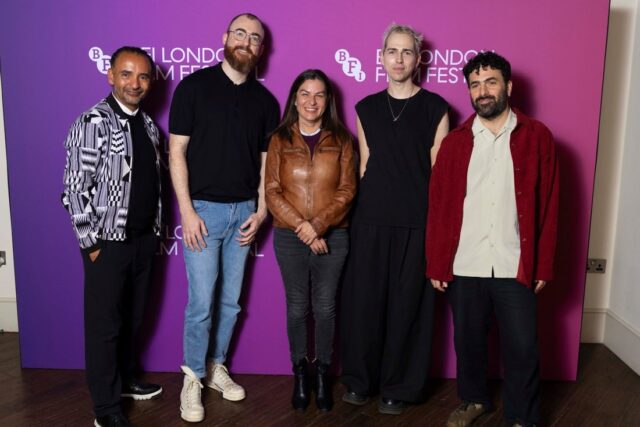
“Don’t leave it too late,” was one of the key messages from documentary filmmakers and experts at this week’s BFI London Film Festival industry discussion, Frame by Frame: Navigating Archives and Storytelling in Documentary Cinema.
“It takes a long time and a lot of back and forth. Rights are very, very complex. Don’t leave the archive until the very last minute. That is my very basic top tip,” Simon McCallum, Producer (Archive and Industry), BFI National Archive, told an audience that included several filmmakers with new archive-based projects on the boil.
US director Nanette Burstein whose new feature doc, Carl Sagan: We Are Made of Star Stuff, premieres this week at the festival, had multiple obstacles to overcome in sourcing footage for her documentary.
Her film looks at both the professional and private life of astronomer and Pulitzer Prize winning author Sagan, who became a global TV celebrity in the early 1980s. “The thing about this story is that it is a science story and it is a personal story. I always knew the personal story would be part of the film,” she said.
“We needed all of the footage from NASA, which is a bureaucracy,” noted Burstein. She was also using Sagan’s private materials as well as clips from Sagan’s TV shows.
Burstein was collaborating with Sagan’s widow, Ann Druyan. “These are people’s personal lives and there has to be a level of trust and understanding,” she observed of the sensitivity required when working on deeply personal stories.
Burstein explained how US documentary makers rely on “fair use” to access archival material in an affordable way. “You can use footage that, if it is in the context of what is being talked about [in the film], you don’t have to get the rights to use it. I don’t know how I would make films without that frankly,” the director (whose other credits include On the Ropes, The Kid Stays in The Picture and Elizabeth Taylor: The Lost Tapes) acknowledged.
Fair use, though, poses its own challenges. Lawyers are needed – and that can be an expense in itself.
New technology is also posing tricky ethical questions for directors. There has been heated debate this week about how Ava DuVernay’s Netflix documentary 14th (exploring the Trump-era erosion of many human rights enshrined in the Fourteenth amendment of the US constitution) uses AI to bring old Civil war era photographs to life. She has been criticised in certain quarters for altering images of long deceased subjects who obviously can no longer consent to how their likenesses are used. 14th wasn’t specifically addressed by the panelists but several had opinions about how AI affects the use of archive.
“There are lots of viewpoints even within the BFI. There are parts of the archive community that are very anti any manipulation at all but I personally feel we do need to be flexible to a degree in allowing stories to be told,” the BFI’s McCallum stated. “I really like this idea of re-activating archive footage to tell new stories.”
One example he cited was with Elsewhere in India, a trans media project the BFI Archive worked on with Indian artists, Murthovic and Thiruda (aka music composer and DJ Sri Rama Murthy and media artist Avinash Kumar). The BFI gave the artists full access to its ‘India On Film’ collection, allowing them to deconstruct and play with footage shot in the colonial era.
“It’s part of that process, if you like, of decolonizing the archive and returning those films to the places where they were shot,” McCallum said.
The BFI showed similar flexibility when working with Nat Geo on the feature documentary, Endurance (2024), for which they allowed the filmmakers to colour-tint footage from the 1914-1917 Shackleton Antarctic expedition. “That was a couple years of conversation, negotiation and collaboration with the production team, but we really felt in that instance it was important for us to be part of that definitive story.”
BFI National Archive has set itself a strategic target of being “the most open archive in the world” by 2033. To achieve this, McCallum argued, “there needs to be some give and take with filmmakers and artists.”
Also on the panel, Theo Rollason shared the story of how the long-forgotten footage used in the award-winning documentary Queer Edward II (largely shot by Seamus McGarvey behind the scenes as Derek Jarman was making his 1991 feature Edward II) was re-discovered.
For more than 30 years, the footage had been in the possession of Ahmad Ahmadzadeh, who ran the camera company which rented equipment to McGarvey. Rollason was invited by Ahmadzadeh to have a look at it.
The camera company boss had thought there “might be enough for a BFI DVD special feature” but Rollason quickly realised it was a treasure trove which could easily yield a feature.
Queer Edward II is “100% archival.” Alongside the McGarvey footage, it also includes material from commercial archives, from the BFI, home movies, “obscure TV interviews” with Jarman, and videos shot in the early 90s by gay rights activists.
Rollason described familiar challenges: rights holders charging “absurdly high rates” for just a few seconds of footage, material whose chain of title had become obscured over time and participants who, more than three decades later, were either deceased or very hard to find.
McCallum pointed out that while commercial libraries are “very rigid on their rates,” the BFI (which collaborated on Queer Edward II) will try to be flexible. “In terms of fees, we will do our best to negotiate based on the budget and the situation that the team are in.”
But he also pointed out that archival work doesn’t come cheap. “Preserving, digitising, researching and curating this material is extremely expensive. Anyone who has had to have a film scanned knows how expensive that is,” he cautioned.
Nonetheless, he cited another new project on which the BFI has “really done its best” to help filmmakers on a tight budget – a new Brazilian-made documentary about Brazilian-born Alberto Cavalcanti, a filmmaker whose career runs the gamut from surrealism to GPO documentaries in the John Grierson era, and Ealing dramas. “That’s an example of something we are collaborating on now where we have really done our best to give them the minimum rate we can to enable them to get the film out to festivals.”
Chilean director Rafael Guendelman, director of Az Zeeb, an intimate documentary exploring his own family’s political history, emphasised the creative possibilities of archive. “That’s the main thing. You can use one image that used to be a desert from Palestine to show something from Chile. You are lying – but in a good way. I feel there is a whole creative aspect to archive.”
Chairing the event, Raul Niño Zambrano, Creative Director, Sheffield DocFest, noted that all three directors on the panel were using archival material to tell “stories that are from the past, but are really speaking very loudly about the present.”