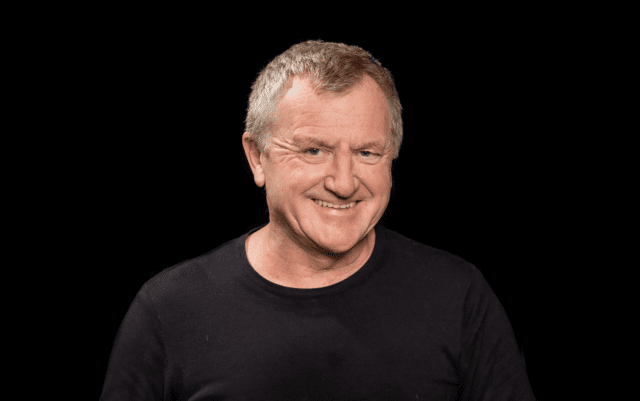
“If one believes, as I do, and as many have before me believed, that if cinema is our most powerful art form, then it naturally follows, in my book, that the art of the documentary is both the beating heart of cinema and, indeed, its conscience,” European Film Academy Chair Mike Downey told BDE a few days before the 34th European Film Awards ceremony which presents online December 11.
“A good documentary, whether European or not, will hold a mirror to our society and a great one will hold our conscience to account,” he added. “It is more important than ever that ceremonies such as the European Film Awards and organisations like the European Film Academy galvanise and speak up for and support those filmmakers – here and around the world – who bring us these essential stories in documentary form.”
The feature-length and short docs vying for awards this year (see below) are brilliant, entertaining, challenging and diverse, agrees Downey, whether they be archive-based, presented as animations or using personally derived footage, and telling stories of kindness, personal tragedy, hubris or megalomania.
“Documentaries have become far more palatable in form and content in recent times. The fact is that it [the doc form] has much more in common with Lucretius’ Epicurean philosophy than many other kinds of entertainment in which his poetry is, in the modern cliché, merely the sugar coating on the bitter pill of his science,” Downey contends.
“Documentaries are no longer perceived as bitter pills, or something that must be endured because they are ‘good for you,’” he adds. “We have moved from the popularity of bigger studio docs á la Michael Moore and March of the Penguins to the much more down-to-earth scale of streamers providing a wide range of quality documentaries on almost any subject imaginable.”
“The onset of meaningful streaming has brought about a game-changing mood in which it is possible to consider that the distribution cards are no longer stacked against the documentarian. More buyers are in the game earlier and there is a more consistent support to the art of documentary-making than there has been in the past,” he continues.
“For the first time there is some scale in the marketing and distribution and this is helpful to the overall perception. Indeed, the sense that stories are stories, whether documentary or fiction, are helping to blur the lines. Plus their ubiquity on the streamers are helping the audience familiarise themselves and get to grips with the form. The word ‘documentary’ has held in the past many negative connotations – in the times in which we currently live it no longer has that reputation.”
This year the European Film Academy Prize for Innovative Storytelling will be awarded to Steve McQueen for his Small Axe anthology series of five films telling the story of West Indian immigrants to London from the 1960s through to the 1990s. McQueen directed, co-wrote and exec-produced the series. Two episodes of the series were selected for official Cannes competition in 2020.
Complementing Small Axe is a series of documentary projects; Black Power: A British Story of Resistance, Subnormal and the 3-part Uprising. “It follows that the true stories behind his fictional versions of real events are also played out in full. The [doc] series not only provides viewers of Caribbean descent with the rare opportunity to see their histories on screen and part of the national narrative, but it also demonstrates that these histories are national histories – they are for everyone in that United Kingdom,” says Downey.
A very specific area for EFA concern, and which has come to, in part, define its remit, is its advocacy and support for global creatives under threat via the International Coalition for Filmmakers at Risk (ICFR), which was launched in 2020 together with Dutch festivals IDFA and IFFR. The organisation has played a key role within the campaigns which led to the release of makers such as Oleg Sentsov and Tatsiana Hatsura-Yavorska. The ICFR has also had significant “real-world impact” in bringing to attention the plight of filmmakers such as Mohammad Rassoulof (Iran), Moataz Abdelwahab (Egypt), Kirill Serebrennikov (Russia), Hajooj Kooka (Sudan) and Ma Aient in Myanmar.
“Documentary film is essential to a healthy and democratic society – there is a reason why it is feared by those in power. Documentary film is a form that allows us to walk miles in another person’s shoes, and to create a sense of a humanity in common. The form, for sure, has the power to give voice to the marginalized and the deprived, and equally one of its greatest superpowers is to strive to hold those in power to account,” says Downey.
“In these challenging times, when journalism, for example, is held in such contempt, and truth is even more derided and despised as an idea by the equivocators of the wrong kind of media, it is all the more important to support the ever-risky endeavour that documentary filmmaking is becoming,” he continues. “In these times of fake news and alternative facts, we need the voices of documentarians more than ever to hold the powerful to account and explore the nuance of the world that cable news squawkers deny. And, just perhaps, to help us make our world a little more compassionate. To that end as an industry organisation, and as human beings, we have a duty to support and defend colleagues who courageously put themselves in the firing line and find themselves persecuted for following their democratic right to self-expression.”
“Activism is a crucial part of what we do,” underlines Downey of his and colleagues’ activities within both ICFR and at the European Film Academy. “And personally, as chairman, I tend to follow Alice Walker’s maxim that activism is the rent that we pay for living on the planet.”
EUROPEAN DOCUMENTARY NOMINATIONS 2021
Babi Yar. Context. Netherlands, Ukraine
Written and directed by Sergei Loznitsa
Produced by Maria Choustova & Ilya Khrzhanovskiy
On September 29-30, 1941, Sonderkommando 4a of the Einsatzgruppe C, assisted by two battalions of the Police Regiment South and Ukrainian Auxiliary Police, and without any resistance from the local population, shot dead in the Babi Yar ravine in the north-west of Kiev 33 771 Jews. The film reconstructs the historical context of this tragedy through archive footage documenting the German occupation of Ukraine and the subsequent decade. When memory turns into oblivion, when the past overshadows the future, it is the voice of cinema that articulates the truth.
Flee. Denmark, France, Sweden, Norway
Directed by Jonas Poher Rasmussen
Written by Jonas Poher Rasmussen & Amin Nawabi
Produced by Monica Hellström, Signe Byrge Sørensen, Charlotte De La Gournerie, Jean-François Le Corre, Mathieu Courtois, Charlotte Most & Maria Ekerhovd
Amin Nawabi (a pseudonym), a 36-year-old high-achieving academic, grapples with a painful secret he has kept hidden for 20 years, one that threatens to derail the life he has built for himself and his soon to be husband. Recounted mostly through animation to director Jonas Poher Rasmussen — his close friend and high-school classmate, he tells for the first time the story of his extraordinary journey as a child refugee from Afghanistan. Through heartfelt interviews between Jonas and Amin, FLEE tells an unforgettable story of self-discovery. Showing how only by confronting the past it is possible to carve out a future, and the universal truth that only when you stop fleeing from who you are you can find the true meaning of home.
Mr Bachmann and his Class. Germany
Directed & produced by Maria Speth
An intimate documentary portraying the bond between an elementary school teacher and his students. His unconventional methods clash with the complex social and cultural realities of the provincial German industrial town they live in.
Taming the Garden. Switzerland, Germany, Georgia
Written and directed by Salomé Jashi
Produced by Vadim Jendreyko, Erik Winker, Martin Roelly & Salomé Jashi
An ode to the rivalry between men and nature, Taming the Garden is the story of how a powerful man indulges in an unusual hobby by having century-old trees uprooted in communities along the Georgian coast and transplanted to his private garden.
The Most Beautiful Boy in the World. Sweden
Directed by Kristina Lindström & Kristian Petri
Produced by Stina Gardell
In 1970, filmmaker Luchino Visconti travelled throughout Europe looking for the perfect boy to personify absolute beauty in his adaptation for the screen of Thomas Mann’s “Death in Venice”. In Stockholm, he discovered Björn Andrésen, a shy 15-year-old teenager, who he brought to international fame overnight and led to spend a short but intense part of his turbulent youth between the Lido in Venice, London, the Cannes Film Festival and the so distant Japan. Fifty years after the premiere of DEATH IN VENICE, Björn takes us on a remarkable journey made of personal memories, cinematographic history, stardust and tragic events in what could be the last attempt for him to finally get his life back on track.
EUROPEAN ANIMATED FILM 2021 (Documentary nomination)
Flee. Denmark, France, Sweden, Norway
Directed by Jonas Poher Rasmussen
Written by Jonas Poher Rasmussen & Amin Nawabi
Produced by Monica Hellström, Signe Byrge Sørensen, Charlotte De La Gournerie, Jean-François Le Corre, Mathieu Courtois, Charlotte Most & Maria Ekerhovd
EUROPEAN SHORT FILM 2021 (Documentary nomination)
My Uncle Tudor. Belgium, Portugal, Hungary, Moldova
Written, directed and produced by Olga Lucovnicova
After 20 years of silence, the filmmaker travels back to the house of her great-grandparents, where she passed through harmful events that left a deep imprint on her memory forever. The long-awaited family gathering runs counter to her attempts to overcome the past.
In Flow of Words. The Netherlands
Written and directed by Eliane Esther Bots
Produced by Manon Bovenkerk
In Flow of Words follows the narratives of three interpreters of the International Criminal Tribunal for the former Yugoslavia. They interpreted shocking testimonies from witnesses, victims and perpetrators, without ever allowing their own emotions, feelings and personal histories to be present. Contrary to their position at the tribunal, this film places their voices and experiences centre stage.