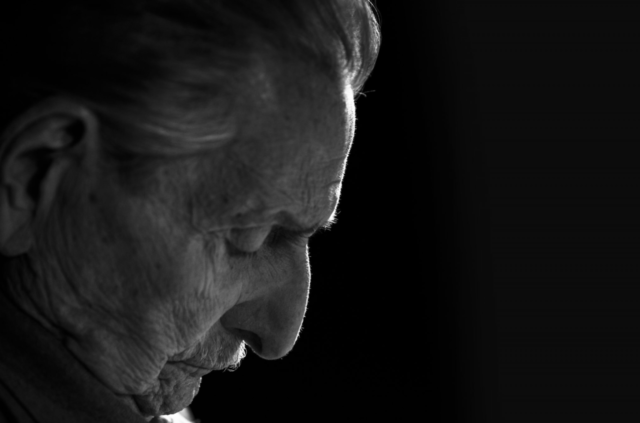
A Jewish Life by Christian Krönes, Florian Weigensamer, Christian Kermer, Roland Schrotthofer
Philippa Kowarsky’s sales outfit Cinephil will hit the Cannes market this week with several new docs on its slate, among them the multi-director A Jewish Life and Adi Arbel’s Grossman, a TV doc about the revered Israeli writer David Grossman.
Directed by Christian Krönes, Florian Weigensamer, Christian Kermer, Roland Schrotthofer. A Jewish Life is intended as a companion piece to the award-winning A German Life (2016), Cinephil’s 2016 documentary about Brunhilde Pomsel, personal secretary and stenographer to Nazi propaganda chief, Joseph Goebbels, and who worked in his office throughout the war. The film was a big seller and was later turned into a play in London starring Maggie Smith.
Pomsel was already over 100 years old when the filmmakers interviewed her. The subject of A Jewish Life, Marko Feingold, is even more venerable. He lived through two World Wars and survived the concentration camps of Auschwitz, Dachau and Buchenwald. The film’s notes stress how ‘Feingold (who became President of the Jewish Community in Salzburg) has no qualms about connecting past and present as he reflects on morality, humanity, cruelty, and compassion.’
“He’s vivid and funky, funny and smart and courageous,” Kowarsky says of Feingold. “He is not asking for pity…it’s an account of the time that everyone should listen to.”
Also fresh to the market is Adi Arbel’s Grossman, a TV doc about the revered Israeli writer David Grossman (‘See Under: Love’, ‘The Zig-Zag Kid’) which had its world premiere to huge acclaim at Doc Aviv a few days ago.
Another title which Cinephil is currently pushing is Ted Braun’s Viva Maestro, about the Venezuelan-born conductor Gustavo Dudamel. This was made through Participant Media and sold for the US recently to Greenwich Media.
Kowarsky and her team recently hit the road for one of the first times since the pandemic, travelling to Copenhagen for the Danish premiere of their Sundance winner Flee, the animated doc directed by Jonas Poher Rasmussen. This is the latest of several collaborations between the the Tel Aviv-based sales agent and Danish production outfit, Final Cut For Real (among them The Act Of Killing and The Look Of Silence).
Cinephil wasn’t just selling Flee but was heavily involved in its financing and marketing. Kowarsky and her team brought aboard the project’s US partners Vice Studios and RYOT Films. After years of hard work on the film, Kowarsky was delighted finally to be able to see it with an audience. “We were very lucky. The day before we came to Copenhagen, masks were made no longer obligatory,” Kowarsky says of the premiere.
Cinephil enjoyed spectacular success in early 2020, just before the pandemic hit, with Victor Kossakovsky’s Berlinale entry Gunda, a lyrical black and white film about a sow and her piglets which was picked up for US distribution by Neon and sold all around the world.
“The market went crazy over this film,” Kowarsky remembers of the unlikely crowd pleaser. The distributors who bought Gunda liked the film so much that they were all prepared to wait out lockdowns in order to give it a proper theatrical release. Its roll-out is still continuing, a year and a half after the Berlin premiere.
Now, with cinemas finally re-opening in many territories, distributors have been showing a similar enthusiasm for Flee, which was likewise sold to Neon. Release plans for the film are currently being “fine-tuned.”
Flee wasn’t Cinephil’s only prize winner in Sundance, where it won the World Cinema Grand Jury Prize: Documentary. Camilla Nielsson’s President, about the Zimbabwe elections, won a World Cinema Documentary Special Jury Award. (This was also made through Final Cut For Real).
Meanwhile, continuing Cinephil’s impressive early 2021 awards run, another of the company’s titles, Gorki Glaser-Müller’s Children Of The Enemy, won the Fipresci Award at Krakow Film Festival. (The film tells the story of how musician Patricio Galvez leaves Sweden to travel to Syria in search of his missing grandchildren who had been orphaned after his Jihadist granddaughter was killed).
Closer to home, Michal Weits’ Blue Box, had its Israeli premiere at Doc Aviv this week. It’s about Joseph Weits, the director’s great-grandfather, who was head of the Jewish National Fund’s Lands Department, which procured Palestinian land for the new Israeli state. He was also behind the Blue Box campaign which raised money for planting trees. The director was shocked to discover that her much loved relative had been heavily involved in moving Palestinians off their land.
“History needs to be acknowledged. This is a narrative that [they, in Israel] don’t discuss at school. Until we discuss it and understand it, it is going to be very hard to move on,” Kowarsky says of the issues raised by Blue Box. “The fact that the land is now in the hands of the Jews, how did that happen?”
Kowarsky and her team are doggedly loyal to the filmmakers they represent. “We walk with films all the way to the end,” she says of how Cinephil will often spend years making sure its docs they have the best possible chance of reaching an audience.
Now, fast fluctuating Covid regulations permitting, the Cinephil team is heading to Cannes – and looking forward to engaging with buyers face to face.
“Zoom is terribly efficient, really. You can do a lot of things on Zoom but there two things that can’t happen on Zoom in my mind. One is serendipity and the other is fun!” Kowarsky declares.