There was a time when Tom Fentenille’s father was a very angry man. After his beloved wife Yoyo died of cancer, he went into a shell, impervious to the needs of his grown-up children Tom and Manon, as well as their desires to communicate with him. All he needed was his garden and his bicycle, and to be left alone to potter around the house doing DIY.
When Tom started filming his father in 2021, his cross-dressing was non-existent, or to be more accurate, it was a secret that he had successfully kept to himself. At first, Tom’s motivations to shoot his dad were altogether different. “My desire to film was born from a need for confrontation – to make him hear my sorrow, my incomprehension, or my anger, to shake up our relationship, and hopefully revive it,” the director writes in his film notes.
But following their father’s hospitalisation after an accident, Tom and Manon discovered women’s clothes among his personal effects. It was to be a discovery was life-changing for everybody.
When Tom showed his father a short edit of what he had so far filmed, he was mesmerised. So much so, that he made a special request to his son, to thereafter film him as a woman. “It was on that day that the film was born and the shooting truly began,” Tom underlines.
The change in the father was immediate. We see a profound softening. Now he is funny, reflective and communicative, and he begins to smile. “As the barriers fade, our father-son relationship reinvents itself outside traditional patterns, and little by little, the expression of an intimate dialogue, made of shared pains, is reborn between us,” says Tom.
What’s more, his father begins the process of transitioning into a woman. ‘He’ becomes ‘she,’ and he assumes a new name, that of Lilou.
But there is a considerable hurdle yet to overcome, namely daughter Manon and the deep sense of bitterness that she feels towards him. For Manon, Lilou’s transition is more unsettling than life-affirming, and it only serves to reawaken other wounds, such as the grief she still endures after the death of her mother. During one dynamic scene, she mercilessly upbraids Lilou for her inability to fulfil her parental duties, and for what she sees as Lilou’s totally self-centred view of life.
But if Lilou had shortcomings as a parent, she takes on the role of grandparent with gusto, and little by little, the three family members resolve to set aside their enmity and differences, and to embark on this new road with a positive outlook. Because as they are all too aware, given the sad passing of Yoyo years, surely life is too short to approach the situation otherwise…
In the film, sold by Lightdox and world-premiering May 20 in Cannes ACID, it seems obvious that the camera is a catalyst, the mechanism which enables Tom’s father to make his transition both into a woman and into a more caring and reflective person. It also provides the means for wider contemplation. “Sometimes it’s magical when the camera is there,” director Tom tells BDE. “It’s like we are all together here for the movie. And the movie – it’s about our family, and how we can communicate and repair. The camera creates a space for that, it’s a good object for that.”
The sense of gravity the project represented was felt equally by everybody, Tom adds. “In the process of making the film. I think the importance was the same for everyone, but just different for each of us.”
It is a very courageous film, (for reasons I won’t divulge, and I would encourage readers to watch it to see exactly why). But how does Tom respond to this assessment?
“Having a lot of friends, people tell me that I’m brave to do that, but actually I don’t feel like that, because I don’t feel like I made a decision to make it – it’s more like I had to do it,” he responds. “My sister used to say this story would have existed regardless, in any event, even if the movie didn’t exist. It’s just the film and the camera just made the process faster. But we had to make it. I think it’s not about being brave, it’s more about adapting to life.”
Tom further reflects on the process that his film helped to set in motion.
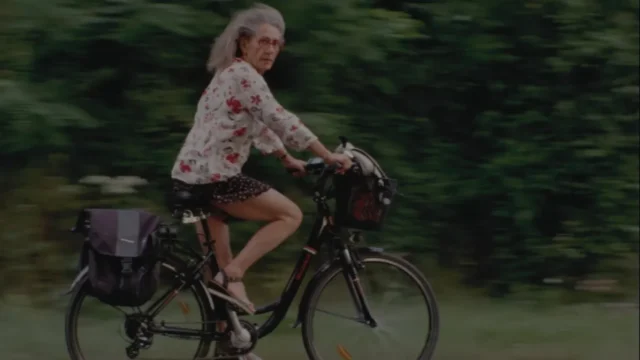
“I realize how much I hated the man my father was, and how hard it was to love him. And that I preferred the woman she had become,” he says. “When I close my eyes, a single image continues to beat under my eyelids: Lilou speeding along on her bike, hair in the wind. Then, I feel my smile forming again. Without knowing it, Lilou showed us the way.”