The Israeli targeted killing of Fatma Hassona, a photojournalist in Gaza, just one day after the selection of Sepideh Farsi’s documentary about her for the ACID sidebar was announced, has cast a dark shadow over the Cannes Film Festival. The powerful and minimalist film has become an international cause célèbre.
Rarely has one film had such an impact at the Cannes Film Festival. Remarkably, Sepideh Farsi’s Put Your Soul on Your Hand and Walk was selected by the smallest sidebar, which is curated by the Association du Cinéma Indépendant pour sa Diffusion (ACID) and usually largely ignored by attending journalists. Whether other competitions had previously rejected the film, I do not know.
Iranian director Sepideh Farsi wrote a statement for the ACID website to accompany her documentary, which I believe is worth quoting in full (with only a few typos corrected).
“Put your Soul on your Hand and Walk was my response as a filmmaker to the ongoing massacre of the Palestinians. My personal way not to lose my sanity. A miracle happened when I met Fatem through a Palestinian friend. Ever since, she became my eyes in Gaza, while surviving under the bombs and documenting the war. And I became her connection to the outside world, from her Gaza prison, as she puts it. We kept this line of life going for more than 200 days. The bits of pixels and sounds that we exchanged constitute the film that you see. Fatem’s assassination on April 16, 2025, following an Israeli attack on her home, has forever changed its meaning.”
Fatma Hassona – ‘Fatem’ – was a 25-year-old Palestinian photojournalist who was one of the few journalists documenting the war in Gaza after Israel banned foreign reporters. Montage sequences of her work are interspersed throughout Farsi’s documentary, sometimes accompanied by Hassona’s own singing. She only recorded this for personal use, but shared it with the director.
It demonstrates the personal connection Farsi and Hassona developed, with Hassona smiling brightly every time Farsi manages to video call her through the faltering internet connection. Although there is no escaping the horrors of the ongoing genocide of the Palestinian people, it is this welcoming, completely disarming smile that pulls the viewer through. But even Hassona’s smile slowly loses some of its lustre as war, death and hunger take their toll during the months she and Farsi kept in touch, starting on April 24, 2024.
During the opening night of the festival, jury president Juliette Binoche concluded her speech by acknowledging Hassona’s plight. “On April 16 at dawn, in Gaza,” she said, “25-year-old photojournalist Fatima Hassouna [an alternative transcription of her name; KD] and ten of her loved ones were killed by a missile that struck their home. She had written: ‘Death passed through me. The shooter’s bullet pierced me, and I became an angel.’ The day before her death, she learned that the film she appeared in had been selected here, at the Festival de Cannes. Fatima should have been with us tonight.”
Note how, similar to the declaration the festival had published earlier, the mention of Israel was avoided on the opening night. This was contrary to the open letter Variety published ‘For Fatma, for all those who die in indifference’, which was signed by more than more than 370 actors and filmmakers including Joaquin Phoenix, Guillermo Del Toro and Rooney Mara, and contrary to the statement on the ACID website, which said that “an Israeli missile had targeted her home, killing Fatem and several members of her family” and denouncing the “politics of genocide (…) for which the Israeli far-right government must be held responsible.”
Nevertheless, the acknowledgement at the opening ceremony, which was broadcast nationally, undoubtedly helped to raise the profile of Farsi’s documentary, leading to more published reviews and articles than would have been the case if Binoche had remained silent – or if Hassona hadn’t died.
But Put Your Soul on Your Hand and Walk is not only a phenomenon, it’s also a film. And artistically, Farsi’s documentary is worthy of all the attention. The director made a bold choice for simplicity: some eighty percent of the film consists of shots she made with a mobile phone of another mobile phone, clipped in a holder, on which Hassona appears on unstable video calls, smiling from ear to ear every time she connects, through Farsi, to the outside world. Farsi combines these scenes with fragments of TV news stories on Gaza, or images of her cat interrupting the conversation. And Hassona’s photographs provide impressive moments of reflection on the destructive realities of war in Gaza – as they were intended to do.
But the image which remains and which burns itself into the screen is that of Hassona’s face, talking enthusiastically, smiling broadly, and then slowly, during the many months of filming, fading away through fear, hunger and exhaustion.
Interestingly and somewhat surprisingly, the frustration caused by a faltering connection gradually becomes part of the film’s aesthetic. This is, I believe, because it is so intimately connected to its essence: the attempt to reach those who are hard to reach, who are out of reach for aid convoys, and for almost anyone outside Gaza, a place which Hassona didn’t get to leave even once in her lifetime. Although her eyes light up when she tells Farsi about her wish to visit Tehran, Rome – or Cannes, after Farsi tells her their film has been selected and asks her if she’s heard of the festival. “Yes, yes, I know it!”, Hassona says leaning forward, her eyes opened wide, beaming with light. Farsi asks: “Do you want to come?” Hassona: “Of course!” It is the 15th of April, 2025.
An interesting contrast emerges between Farsi, who is unable to return to her homeland of Iran, and Hassona, who is unable to leave hers –both for political reasons. Still, there is something almost cruel when Farsi, a frequent traveller, mentions all the places she is calling from: Cairo, Paris, Montreal, Annecy, Zagreb, Athens. But Hassona only laughs: “This life! I want this life! You fly everywhere!” Above all, talking to Farsi makes her feel less alone: “You’re here beside me and that’s enough.”
Most of their conversations focus on everyday life during wartime, from the lack of food and clean drinking water, moving from one location to another (whichever appears safer or has better internet connection), and the loss of friends, family and neighbours or visits from those still alive. And the importance of still being able to make a cup of coffee: “It’s the only thing that you can drink and imagine that life makes sense.”
But Hassona’s answers to Farsi’s more directly political questions will no doubt face scrutiny from those invested in the debate. When asked by Farsi about her memories of October 7, Hassona first expresses her uncertainty about what to think or feel about that day, before acknowledging it did give her a sense of resistance. But we don’t get to hear Hassona’s thoughts on the civilian casualties of Hamas’s attack or the hostages they took – perhaps because Farsi didn’t ask her about it, or the material ended up on the cutting room floor.
Farsi does include a news item about the child hostages still in Hamas custody and personally compares Hamas to the Iranian regime and even to Netanyahu, because “they want war”. Hassona herself speaks openly about her disdain for Hamas’s new leader, Yahya Sinwar: “I think it’s like a joke. Lots of people here don’t like this. They didn’t like this election. So they’re refusing Sinwar.”
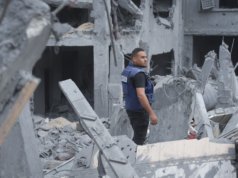
Everything, however, has forever changed after ‘a missile struck’ Hassona’s house. The multidisciplinary investigators of research agency Forensic Architecture established that the Israeli military specifically targeted the floor on which Hassona and her family were living. As always, the official reaction was that the target was a ‘Hamas operative’.
According to Reporters Without Borders, almost 200 journalists have been killed in Gaza to date, with Palestine becoming the world’s most dangerous state for journalists.
France/Palestine/Iran, 2025, 110 minutes
Director Sepideh Farsi
Production Rêves d’eau productions
Producers Javad Djavahery, Sepideh Farsi
International sales Cercamon World Sales
Cinematography Sepideh Farsi
Editing Sepideh Farsi
Sound design Pierre Carrasco
Sound Léo Boisson
Music Cinna Peyghamy
With Fatma Hassona, Sepideh Farsi