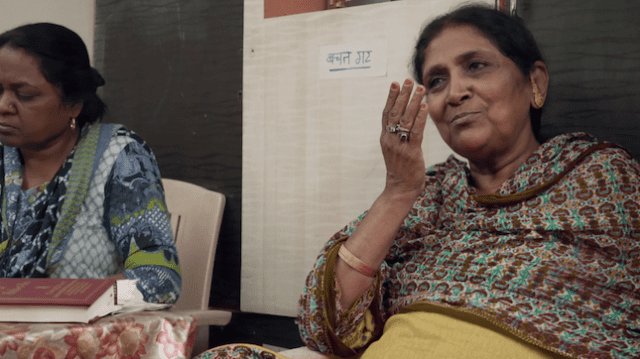
This truly eye-opening film observes the proceedings in India’s first women-led Islamic court, highlighting the (still) astonishingly unequal status of women in India, but also the powerful and unstoppable way in which women are striving to secure justice.
Documentary maker Sophie Schrago’s camera scarcely leaves the intimate setting of the unconventional courtroom – a small storefront situated directly on a busy street in Mumbai. The table in the centre serves as both the dock and the bench, and the judge and her deputy sit on plastic garden chairs, just like the defendant and the complainant. There is no space for an audience – parents who have accompanied their children stand or sit directly behind their sons or daughters.
This does not make the hearings any less valid legally, nor any less serious or impactful. The central figure is Khatoon Zubeda Shaikh, who from the outset reveals herself to be an intelligent, astute, just and extremely humane judge. Although, as someone who speaks from personal experience (in the film she recounts her own unpleasant experiences of marriage) she has a keen eye for the women’s interests, she gives the men a fair hearing and does everything in her power to save the relationships, especially when children are involved.
As a viewer, you are given ample time to feel part of what is unfolding in this seemingly insignificant space, where history is indeed being made. You empathise with the women’s stories, which bear many similarities – they are humiliated and physically and mentally abused both by their husbands and their husbands’ parents. These are not surprising stories, but what is unique to this film and this court is that the men are called to account. You sense their discomfort as they try to explain why they beat, verbally abuse or publicly humiliate their wives. Arguments that light hitting is not abuse or that they are entitled to be waited on hand and foot by their spouses are skilfully refuted by the female judge.
At the same time, the men are not merely portrayed as perpetrators; they are also having to navigate changing circumstances and are dealing with the demands of both their old-fashioned parents and their wives who are trying to discover their own needs and rights.
The film takes a moving, personal turn when the filmmaker, from behind her camera, hesitantly begins to speak of her own experiences – prompted by something Khatoon had said earlier. The camera carefully observes all the emotions stirring within the judge as she listens to Schrago’s account and then praises her for her courage. “Only when we speak up can we change things,” she says – thereby touching on the very heart of the film. A poster on the wall showing how many cases were initiated by women versus men, and how many ended in divorce (which is significantly less than the marriages saved), speaks volumes about a tentative shift in gender relations in India.
This documentary is an important record of the process of women’s emancipation, across the world, within Islamic society and in deeply misogynistic India in particular. It dismantles clichés about Muslim women as defenceless victims and Islam as a misogynistic religion. For these women are, in fact, taking religious law into their own hands as a powerful weapon against male dominance. Their decisions are based on what is written in the Quran and demonstrate what a different interpretation can achieve. But ultimately it is also about love, as is stated in the song accompanying the credits at the end: “I would have no complaints about a life / And yet a life without you is no life at all.”
France, South Korea, Switzerland, US, 2026, 77 minutes
Director, screenplay, cinematography Sophie Schrag
Production Pauline Tran Van Lieu, Lucie Rego (Hutong Productions), Heejung Oh, Sarah Kang (Seesaw Pictures)
Editor Isidore Bethel
Sound Romaine Ozanne, Pierre George
Music R.D. Burman