Let me begin with this: ‘It’s time to play the music. It’s time to light the lights. It’s time to meet…’ Or wait, let’s start with: ‘It’s time to put on makeup. It’s time to dress up right. It’s time to raise the curtain on…’
…on Jim Henson. And hopefully you will now have the opening tune of The Muppet Show playing in your head as you read the rest of this review of Ron Howard’s posthumous portrait, Jim Henson Idea Man. Just as I have not been able to get it out of my head since seeing the film.
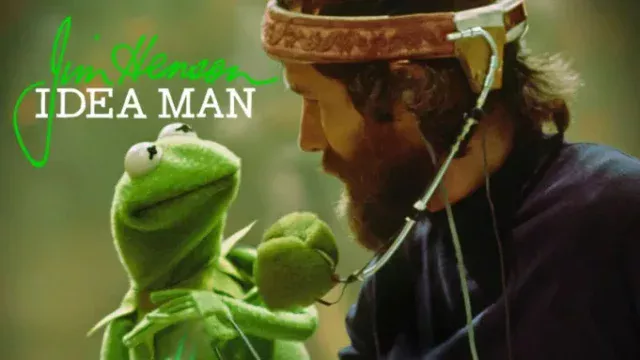
Jim Henson Idea Man, named after Henson’s experimental 1966 short film, was made with the co-operation of the Henson family, and is as overflowing with ideas, anecdotes and entertainment as the most famous puppeteer of all time was himself. It’s a eulogy, as one would expect, reminding us of the unsurprising fact that Henson was a workaholic and not home quite as often as his family would have liked. But I know of no controversies or scandals which should have otherwise been mentioned, and this is one case where the ‘eulogy’ feels truly deserved.
I’m not objective, however. I grew up with the Muppets and I identified with characters such as Sesame Street’s Ernie and The Muppet Show’s Rowlf, Kermit and – a favourite background character – Beauregard, to the point of greatly embarrassing my younger brother. Part of me is a Muppet – I don’t know how else to put it. Which makes watching Jim Henson Idea Man both an eye-opening insight into his background, delivering anecdotes which may not be new (but are new to me) and propelling me on a nostalgic trip down memory lane.
It’s all the more nostalgic because I’m about to turn 53, the age at which Jim Henson (1936-1990) left this world, plus the ones he created, far too soon. But although this is a portrait made 34 years after his death, Henson himself is omnipresent. Unsurprisingly, he has been filmed (the behind-the-scenes footage is a big part of this documentary’s appeal) and interviewed enough times to tell much of his too-brief life story himself.
Interviewed by Orson Welles, for example, who in archival television footage rightly declares Henson a ‘genius’, with all the Wellesian gravitas such a statement deserves, and seems shocked to learn Henson never played with puppets as a child, and that he only started because he saw an ad from a local TV station looking for a puppeteer. Because that’s what he wanted: to work in television.
Clearly, it was meant to be. Henson was to become the most famous puppet player in the United States. But twice it was Europe that put American on the right track. It was a trip to Europe, with its many traditions of puppetry, that definitively convinced Henson that marionettes and puppets – in short, Muppets – were a medium with great artistic potential. Years later, after Sesame Street (which launched in 1969) had proved a gigantic hit in the United States, it was in the United Kingdom that Henson finally found financing for The Muppet Show (1976-81) – having failed to persuade any of the American networks to take on a puppet show for adults. The historical success of The Muppet Show – which continues to this day with reruns and merchandise – proved them wrong and Henson right.
After five years, however, he pulled the plug on The Muppet Show, believing it would inevitably become repetitive. Instead, he and his team gave the world yet more fantastical wonders, including the films The Dark Crystal (1982) and Labyrinth (1986, and featuring the David Bowie hairdo to end all hairdos), the TV series Fraggle Rock (1983-87) and The Storyteller (1988).
There is much to admire about all these shows. There is the technical skill and inventiveness in creating the puppets, which led to the Jim Henson’s Creature Shop also producing puppets for other parties. There is the technique of puppetry itself – it’s easy to forget that in order to move a Muppet like Fozzie Bear, who has two human-like hands, you need two puppeteers, one for the mouth and one hand, the other for the other hand, standing very close to each other and holding their hands above their heads while looking at a monitor to keep their Muppet in the frame, acting as their own synchronised cinematographers. These are behind-the-scenes revelations, which are wonderful to discover. Especially because the Muppeteers seem to be having so much fun within this ‘affectionate anarchy’, as one of them aptly puts it.
One detail that the documentary doesn’t specifically address is the importance of music. We don’t learn anything about the theme tunes of Sesame Street and The Muppet Show (which I hope you’re still hearing in your head) to the evergreen ditties It’s Not Easy Being Green and The Rainbow Connection, to the definitive version of Mahna Mahna – although we do get to hear them all.
But of all aspects, it’s the way the Muppets move which I identify with most. It’s what most gets under my skin. I am sure – and people who know me can testify to this – part of my way of moving, my physical way of expressing myself, comes from the Muppets.
And watching Jim Henson Idea Man, it becomes clear how much of this actually stems from Henson himself. He invented most of what we think of as typical Muppet behaviour. He chose colleagues who were on the same wavelength – Frank Oz (also the director of The Dark Crystal) foremost among them. And he expressed himself through his own creations, most clearly through Kermit, a home-made puppet who was there from the very beginning. Not a frog at first, but a man, cut from Henson’s mother’s old green coat with two halves of a ping-pong ball for eyes. He’s the simplest of all Muppets – you can more or less see Henson’s hand inside his face, crumpling and distorting Kermit’s features to express different emotions.
It’s touching to see how much of what I’ve loved and identified with since I was a kid came so directly from Jim Henson himself. Which makes Ron Howard’s documentary, in my eyes, a tribute truly deserved.
Disney+ will release Jim Henson Idea Man as Video on Demand on May 31, 2024 worldwide.
United States, 2024, 111 minutes
Director Ron Howard
Production Imagine Documentaries
Producers Brian Grazer, Ron Howard, Sara Bernstein, Margaret Bodde, Justin Wilkes, Mark Monroe, Christopher St. John
Script Mark Monroe
Cinematography Vanja Cernjul, John Chater, Igor Martinovic, Jenni Morello
Editing Paul Crowder, Sierra Neal
Sound design Jeremy S. Bloom
Sound Daniel Timmons
Music David Fleming
With Jim Henson, Frank Oz, Rita Moreno, Jennifer Connelly