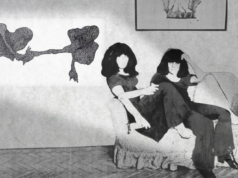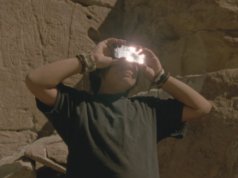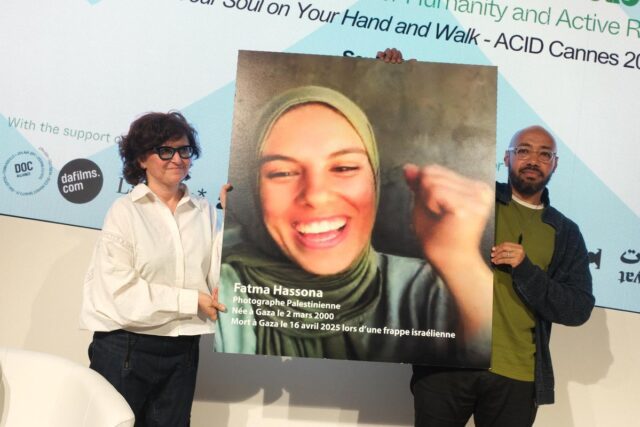
At the beginning of Iranian director Sepideh Farsi’s conversation with culture writer, critic and film curator Murtada Elfadl, she tearfully read out a poem that Fatma Hassona (Fatem), the subject of her Cannes ACID film Put Your Soul on Your Hand and Walk, wrote a year ago. A year before her murder by a targeted Israeli missile, which struck the day after the announcement of the film’s Cannes selection. The poem reads as follows:
Today or tomorrow or the day after, I will fall to the sky.
Just as my friends fell, we would take each others’ hands, row upon row to an eternal gate.
We will know the answer to all these questions, because something makes everything [we] see and hear unreasonable.
At that time, everything will become reasonable. And it will become.
Questions are just ashes.
Tomorrow or the day after tomorrow I will actually become a past person in the category of ‘was.’
‘She had dreams and she loved life even though it was hard on her.
She was talented, she wanted to live and she was.’
And she was.
“It’s as though she was predicting her own death,” Sepideh reflected on the poem.
The genesis of the feature documentary lay in the director’s desire to give voice to the people of Gaza after the October 7 attack and the subsequent destruction of their country. “I felt very needy of understanding what was going on for the people stuck in Gaza and I wasn’t getting my answers [in] the media,” said the director. “We had points of view of other people about them, but they were practically never asked to express themselves.”
Sepideh went to Egypt but was denied entry to neighbouring Gaza. All the while she was speaking to refugees who were escaping the bombardment. One of them told her about this girl Fatem living in northern Gaza, “an amazing photographer and a very wonderful person.”
“I [called] Fatem explaining what I was trying to do, which is the beginning of the film, more or less, that first call. And she said, ‘yes, yes, yes’ to all of my demands and questions and something just happened. It’s the magic of human encounters and the magic of cinema…this was really the moment I realized she was the heart of the film to be. That’s how it started.”
“Perhaps because I’m Iranian, I dunno, but I’m used to subversive filmmaking and instability of connections and political landscape and changes. I somehow felt that every moment was unique. So I really told her I’m going to film this…flip the phone and start filming. That was really very quickly the idea that this was the core of the film.”
Sepideh and Fatem soon formed a tight bond via their mobile conversations, despite the distance between them. “There was a kind of sorority very quickly that shaped between us despite, or maybe because of, the age difference. She was my daughter’s age,” said Sepideh.
“I think this is one of the beauties of the documentary filmmaking, meeting people and when it clicks, when it happens right, you really get into their lives. I mean, of course they have to accept to open up to you and you have to [accept]. It is like an offering…I would say, when it happens correctly. That’s the beauty of it. And this time it happened very deeply with her.”
Their means of mobile communication, and its unreliability, became an essential, meaningful component in telling the story, all the time mirroring the fragility of the wider situation. They spoke on cell phone and a third phone was used to record the image of Fatem on Sepideh’s primary phone.
“I have a feeling when I see the film on a big screen now, I feel that this added layer, which paradoxically brings it closer to something more grainy, like film, whereas usually the digital image is too sharp and too clean…the heart is going away,” she says.
For Sepideh, it was essential that Fatem’s photos were part of the film as well. She knew this as soon as Fatem showed them to her during one of their first conversations. “They were bright, colourful photos and she had some thousand followers or so. Now she has reached 40,000 or more. This is a tribute…[the director sighed]…she paid with her life, but her work is great and she has something very systematic in her eye as a photographer. Very precise, uncompromising.”
Sepideh also promised Fatem that she would arrange an exhibition of her works during Cannes, which she did at the Majestic. “I promised her that and I hope she’s watching this somewhere. She believed in God, so I hope she’s seeing this.”
Their last conversation, of an hour’s duration, was on April 15, the day of the Cannes announcement and the day before Fatem’s death. Sepideh met Fatem’s sister and Fatem expressed her own wish to have children.
“I knew a few days prior…but I wanted to wait for the public announcement before telling her. And then I also wanted her on camera. So I asked her to connect. It took her a couple of hours to walk to a place to get a connection. This was always the thing because she had never an immediate connection. She had to do an hour of walking to reach a place with stable internet. And so she connects and I tell her the good news and she was so delighted. It was such a joy to watch her.”
“She was so much into this thing of becoming a mother, becoming an aunt…I think it’s part of the Palestinian resistance, a way of resilience to, in a way, keep going. This was really in her. She sent me her passport [details]. I said I’d immediately start the visa processing, and then, the day after, I learned that she’s gone.”
“She will always live with this film,” concluded Elfadl, before the room rose to applaud Sepideh, her film and her exceedingly brave subject.