

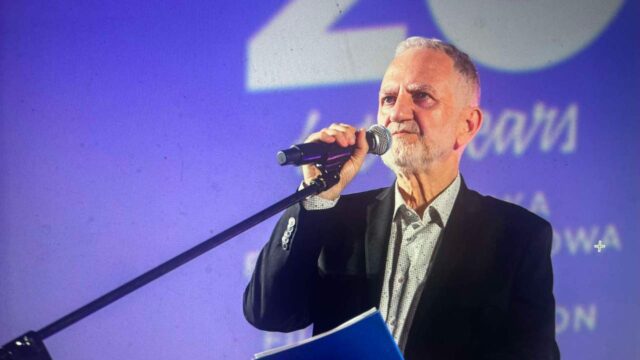
On the eve of the 65th Krakow Film Festival, outgoing director Krzysztof Gierat and Krakow Film Foundation president Barbara Orlicz-Szczypuła sat down with Business Doc Europe to preview this year’s event and reflect on Gierat’s 25 years at the helm.
The 65th Krakow Film Festival opens 25 May, heralding eight days of frenzied doc activity in the historic city of Cracow. The festival presents fours competitive sections: the Oscar-qualifying International Documentary Competition; the National Competition of Polish feature-length and short documentary films, short animations and fictions; the Short Film Competition, the festival’s oldest competitive section, and the international DocFilmMusic Competition.
Elsewhere, The Dragon of Dragons Award, given for contributions to the development of world cinema, will be presented to the legendary animator Jean-François Laguionie, winner of the Palme d’Or in Cannes, the French César, and both the Silver and Golden Dragon at the Kraków Film Festival. (Krakow FF is also focused squarely on animation).
Ireland is the guest country in 2025, whose cinematographic output will be celebrated. The Polish Documentary Panorama presents a review of the most interesting Polish documentary films from the past year, with a special showcase films produced in Krakow. The Kids&Youth Fest is a special programme for young audiences combining screenings of documentary, animated and feature films with the Q&As and workshops. The documentary programme is created in cooperation with European festivals within the Docs4Teens network.
Other sections determine that the KFF programme covers the widest possible spectrum of interests. DOCS+Science screens the most interesting documentaries from around the world, blending art of film and science, while the Sound of Music sidebar presents open-air screenings of films on music, as well as VR and shorts. KFF Talks is a series of meetings and discussions “at the intersection of philosophy, the exact sciences, natural sciences, and the humanities about the state of the world and humanity’s place in contemporary reality.”
Outgoing director Krzysztof Gierat has seen seismic change across the sector over his 25 years in charge.“Documentary filmmaking has changed radically, so much so that my own perception of it has changed,” he tells BDE.
“When I was a student, I was taught that documentary film meant following a character, patiently observing, getting them used to the camera, accompanying them through life — often for years. Classic films of this kind are still being made; there are filmmakers who continue to work this way, such as Helena Třeštíková. But documentary cinema doesn’t end there. There was a time when the idea of creative intervention in a documentary outraged me. Today, it certainly doesn’t disqualify a film in my eyes. I’ve come to understand that even the masters used it. Marcel Łoziński (89 mm from Europe; Anything Can Happen) has often spoken about ‘condensing reality.’ Marcin Koszałka reminds us that simply placing a camera, framing a shot at a specific time and place, is already an act of creation.”
“I remember that fifteen years ago, we organized a festival debate titled: Is this still a documentary, or already fiction?” Gierat continues. “Today, we no longer even ask that question — as long as the story the film presents is not the director’s invention, and the protagonist is not merely an “actor” performing someone else’s vision. The question is: Does the creative approach serve the truth? Does it clarify the subject? What does it bring to the film?”
To commemorate Gierat’s 25 years of dedicated service, the festival will publish a book titled ‘Skazany na kino’ (Polish-language), in which the outgoing director will reflect on many matters. including some of the esteemed guests of the festival over this period. Which of these stand out, and why?
“I’ll certainly never forget the visit of Paul Mazursky (Bob & Carol & Ted & Alice) and his fantastic sense of humour, as well as the recipients of the Dragon of Dragons award,” Gierat recalls. “Jonas Mekas delivered a passionate manifesto declaring that films should be shown on the medium they were originally created on. Luckily, just before his visit, we found a huge 16mm projector in the basement of the Kijów cinema and managed to restore it. Albert Maysles’s visit was also unforgettable — throughout the entire festival, crowds of students followed him everywhere. And of course, Andrzej Wajda was an incredibly important figure for us. He supported the festival during visits from distinguished guests, often taking on the role of a host.”
And if Gierat were to recall some of the key films within this period what would they be? “I vividly remember the debut, 25 years ago, of this year’s chairman of the documentary competition jury, Marcin Koszałka, because it was also the first edition of the festival under my leadership,” he answers. “His film Such a Beautiful Son I Gave Birth To caused a huge scandal. Our classic filmmaker, Marcel Łoziński, accused the young director of disgracing his parents. It took years before he came to believe in the filmmaker’s sincerity.”
“I still carry in my mind the powerful films by Talal Derki, The Return to Homs and Of Fathers and Sons, which offered an intimate look into the tragedy of the Syrian people from within. And I will never forget the extraordinary success of three Polish female directors who swept the podium in 2015. The winning film, Call Me Marianna by Karolina Bielawska, was the first to boldly address the subject of gender transition. Sadly, during the entire period of right-wing rule, the film — despite being a TVP production — was never broadcast.”
Gierat further underlines the structural changes the festival has undergone over the past quarter century which have bolstered its influence and importance to the Polish and international doc communities alike.
“I took over the festival during a deep crisis in the 1990s. We managed to revive it and expand it significantly. In addition to the two existing competitions — the Polish and the short film competitions — we introduced two new ones: the Documentary Competition and DocFilmMusic, along with numerous accompanying sections,” he says.
“We began showcasing many more films, across ten screens. But most importantly, alongside the audience segment, we created a space for professionals — KFF Industry — featuring project presentations in development and work-in-progress stages, as well as a dedicated market. We were among the first in the world to have a fully digitized video library, now accessible online. Every year, we welcome over 10,000 guests, a third of whom come from abroad. Six of our award-winning films have qualified for the Oscar shortlisting process. During the pandemic, we were the first festival in Poland to go fully online. Since then, the festival has taken place both in cinemas and on the internet.”
Likewise, the Polish doc industry has evolved over this time, all the time with KFF acting as a hub and a place for debate, cogitation and inspiration. “I witnessed the birth of new talents, and debutants becoming established classics. A generational shift took place — even within families — with the symbolic example being the remarkable career of Paweł Łoziński (The Balcony Movie), the son of Marcel Łoziński,” Gierat tells BDE.
“We observed various trends, some of them long-lasting — such as the tendency of Polish documentary filmmakers to avoid addressing our own political and social realities,” he continues. “On the other hand, making a documentary has become technically much easier, which has led many to seek stories abroad, often in distant or exotic countries. During the years of right-wing rule, this trend raised concerns. We even held a panel discussion to explore whether this was a case of self-censorship, opportunism, or the result of real barriers imposed by decision-makers.”
“Fortunately, the situation has significantly improved, though now it sometimes results in an overabundance of films about the Belarus border or the war in Ukraine. We’re still waiting for films that tackle the polarization of Polish society and the internal ‘Polish-Polish war.’ Taking a different path is the recent debutant Tomasz Wolski, who for several years has been delving into archives to craft his own highly original, auteur-driven vision of contemporary Polish history.”
Writing before the 65th edition of Krakow FF, Barbara Orlicz-Szczypuła, President of the Krakow Film Foundation, acknowledged the enormous debt the Polish doc sector owes to Gierat.
“Krzysztof ushered the festival into the 21st century. He reimagined it, shaped it into a unique and original event that reintroduced Polish audiences to documentary and short film – while also transforming the festival into a recognisable and respected international brand,” she underlines. “Simplifying the festival’s name, establishing the Documentary Competition and DocFilmMusic, and creating the open-air Kino pod Wawelem are true milestones in the festival’s rich history. Thanks to his passion for cinema, which he so generously shared with us, we are now able to carry on the festival’s legacy with a strong team, united by the values of collaboration, openness, and tolerance.”
Looking to the future, Orlicz-Szczypuła outlines to BDE a future for the festival that is characterised both by optimism and a mild degree of uncertainty.
“On the one hand, the future of the festival looks very promising. Over the past few years, we have successfully rebuilt our audience and introduced new activities for viewers. Our strong fan community is still growing, which motivates us greatly. We have presented a lot of amazing films in previous years, and there are still many great documentaries and short films that should be screened and presented to our audiences,” she says. “Therefore, I’m feeling very confident that the programme selection will be still very good.”
“On the other hand, when we consider the current political, social and environmental changes, the future is uncertain. However, this could also provide a good point for the festival, as it will encourage us to emphasise the festival’s educational role by showcasing stories from various regions around the globe. We will continue to organise the KFF Industry event, inviting professionals from around the world to meet producers and talent from CEE countries. We still believe that there are compelling stories from filmmakers in our part of Europe that should be shared with professionals and decision-makers in Western Europe and beyond,” Orlicz-Szczypuła signs off.





