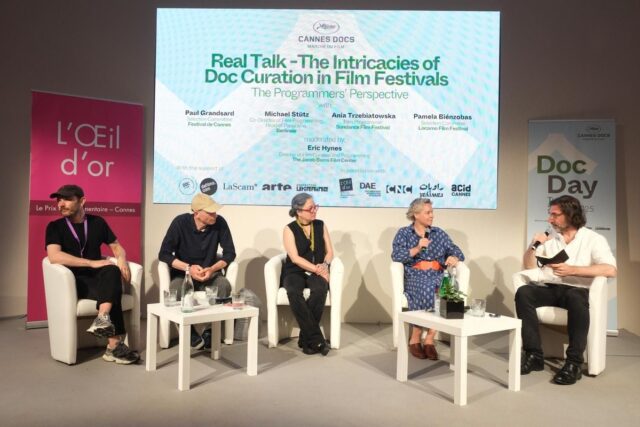
In an industry saturated with submissions and shifting audience behaviours, programming documentaries for major film festivals remains an intricate craft — a fact that emerged during the “Real Talk” panel organised by this year’s Cannes Docs.
Held on the Plage du CNC, the conversation featured insights from some of the world’s leading curators: Pamela Biénzobas (Locarno Film Festival), Paul Grandsard (Festival de Cannes), Michael Stütz (Berlinale), and Ania Trzebiatowska (Sundance Film Festival), under the moderation of Eric Hynes, Director of Film Curation and Programming at the Jacob Burns Film Center.
Each speaker had a unique background, often shaped by transitions from film criticism, filmmaking, or acquisitions into programming. For Trzebiatowska, who spent twelve years as the Artistic Director of Krakow’s Off Camera International Festival before joining Sundance, programming became an unexpected vocation. “I realised watching five films a day was my happy place,” she shared with a smile. Before Sundance, she also worked in acquisitions “to get better at curation” and to better understand the audiences she was programming for. At Sundance, she now forms part of a ten-person team working under a programming director, with each member actively involved in deep, often daily conversations around submissions.
The collaborative nature of programming was a recurring theme. “We work in subgroups, talk to those watching works-in-progress, and bring the projects we’re most excited about,” explained Trzebiatowska. Despite the pandemic shifting much of their viewing online, in-person discussions remain central. “We still struggle with Zoom — it’s hard to disagree in a way that doesn’t escalate — so we find ways to meet and talk outside, even for hours.”
Pamela Biénzobas, a Chilean critic-turned-programmer based in Europe for over two decades, offered a pan-European perspective shaped by her work with Berlinale Forum and IFFR. “Programming happened naturally,” she said modestly. At Locarno, where she works closely with development funds and assesses works-in-progress, the structure is lean. “We’re split into just two committees — shorts and features — and our team is very small.” The selection work is intensive, often with the support of pre-selectors. “I don’t like the word ‘filter,’” she clarified, preferring to describe her colleagues as “really experienced people helping with the submission volumes.”
Biénzobas underlined how programming is shaped by a complex interplay of factors: territorial knowledge, collaboration with other festivals, venue sizes, and ultimately the desire to foster dialogue with audiences. At Locarno, the towering Piazza Grande and FEVI venues cannot be ignored. “It’s not about selling tickets, but establishing a two-way dialogue,” she said. “The audience is there for the festival, and we build it together.”
Locarno’s approach to non-fiction remains open-ended. “Of course, documentaries can take many different forms, but there aren’t that many that would really fit Locarno’s style. And having a friendly festival like Visions du Réel in Nyon [April], naturally we’re not going to venture into the same territory as the films they tend to programme,” she added.
For Michael Stütz, now Co-Director of Film Programming and Head of the Panorama section at Berlinale, this openness is also structural. “We don’t have a specific section just for docs — we have them across all sections.” From the Forum and Generation to Berlinale Shorts, nonfiction finds space and visibility throughout the festival. In Panorama, the Dokumente subsection typically hosts 10–12 of the 30 selected titles. The Panorama Audience Award, originally given to a single film, is now split between fiction and non-fiction — “because docs were almost winning every year,” he laughed. Not to mention two of the most recent Golden Bear wins – Mati Diop’s Dahomey and Nicholas Philibert’s On the Adamant.
Stütz’s journey from intern to programmer illustrates the value of institutional memory. “It took me an enormous amount of time to understand the organisation, and that’s been hugely helpful,” he said. Moreover, Berlin’s critical and outspoken audiences also shape programming decisions. “They give us lots of freedom — it doesn’t limit us, it pushes us to find new voices.”
Paul Grandsard, a long-time member of Cannes’ selection committee, came to programming from a more circuitous path — through directing, photography, and even tour guiding. “I tried for ten years to make films,” he shared, “but I couldn’t make a living.” A recommendation based on one of his short films landed him a programming job at the Festival Premiers Plans d’Angers. That eventually led him to Cannes, thanks in part to a crucial encounter with a scout in Munich. “I never imagined he’d ask me one day to give a hand at Cannes.”
He now watches thousands of films annually, with an emphasis on fiction. “Selection here is very centralised — the director is in charge,” he stressed. The Cannes selection ecosystem is split across several independent teams: shorts, Cinéfondation, international films and French films. “We’re quite divided — I don’t know most of my colleagues. We work from home, the films are uploaded to the server. One-third are watched in screening rooms with others, but it’s a complex organisation.”
Cannes’ lack of a dedicated documentary section remains a limitation. “We don’t scout for them, and none of us specialise in docs,” he admitted. Despite this, the festival has occasionally showcased major nonfiction works from established auteurs, often made in between larger efforts. Still, the odds are daunting: “For documentaries, it’s about a 2% success rate.”
According to Grandsard, the qualities sought in documentaries for Cannes are specific and rare. “We look for originality, relevance to contemporary history, and a global perspective,” he said. Sending in a television documentary is “a waste of money,” he warned, citing Cannes’ formal exclusion of TV content from its main competition and hinting at the traditional tension between television funding and festival ideals.
As the session drew to a close, Grandsard circled back to a key point: Cannes values the cinematic experience, looking for titles which have the potential for a solid theatrical run. This focus, he admitted, may exclude films that are “too radical” or unconventional in form. “Cannes works with this idea of cinema first,” he concluded — a guiding principle that shapes both the scope and the limitations of what makes it into one of world’s most prestigious gatherings.