

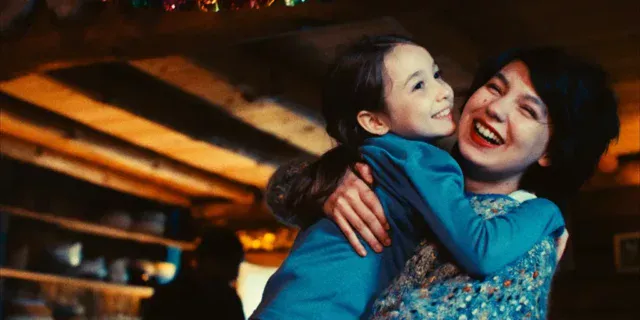
Romane Bohringer is well known as a César award-winning actress. She has worked on very high-profile movies like Savage Nights, Colonel Chabert and Mina Tannenbaum. Seven years ago, she wrote and directed her first feature behind the camera as well as in front of it, the autobiographical “sentimental comedy” (in her own words) L’Amour Flou (2018), in which she co-starred opposite her partner, Philippe Rebbot. This was about a couple separating – but still living together for the sake of the kids. Now, she has made her first feature documentary Tell Her I Love Her (sold by Kinilogy and presented as a Special Screening in Cannes this week).
It’s a hybrid affair, inspired by the book that popular French politician and MP Clémentine Autain wrote about her mother, the troubled French movie star Dominique Laffin. Over a decade between 1975 and 1985, Dominique had enjoyed a meteoric rise, appearing in a series of films with many of the best-known actors and directors in French cinema. She was a troubling and mesmerising screen presence with raw talent in abundance. Her daughter describes her as the “symbol of the liberated woman.” But then she died very suddenly aged 33, supposedly from a massive stroke while having a bath. Clémentine at the time was 12 years old.
Laffin was a reckless, free-spirited woman. She certainly wasn’t a model mother. Autain wrote very frankly about their relationship. The book struck an immediate chord with Bohringer who was abandoned by her own mother at a very young age – and Bohringer was only 14 when her mother died.
In the film, Autain and Bohringer’s stories become intertwined. “It has been a long travel, a long trip to understand what film it would become,” Bohringer says of a project which combines several different storytelling styles. It has interviews, dramatic reconstructions, pieces of archive footage, startling family revelations and even its own very young family detective.
As a cinema lover, Bohringer has often found herself profoundly moved by movies about painful and difficult childhoods – possibly because she endured such a childhood herself. She cites films like March Pialat’s Naked Childhood, the story of a boy left by his mother and put into the care system or Jacques Doillon’s Ponette, which features a grief-stricken girl trying to cope after the death of her mother in a car crash.
Such movies, Bohringer says, “always broke my heart…”
Autain’s book had precisely the same effect. “Everything was in it, the way she was writing about feeling so insecure, her anger, her shame. Every little piece of her writing reminded me of my childhood.”
Bohringer felt that by adapting the book, she could tell her own story too. At first, she planned a conventional fictional adaptation. However, during the writing process, she kept on hearing her own story “knocking at the door.”
The film she eventually made is “something between our two stories….I really wanted to mix fiction and documentary. I didn’t want to make a film just about my story. That was too lonely.”
Early on in the film, Bohringer and Autain are shown talking together over coffee. Both are now mothers themselves and live in “constant fear of messing up.”
“When you don’t have your mother, I have to admit, you spend years thinking maybe you’re unable to become one,” Bohringer admits. “If you don’t have a mother, you are never very sure that you are real.”
Bohringer’s daughter is now 16. Almost every day when she was growing up, the director would ask herself if she was parenting properly.
Making the film was a way for the director to try to “make peace” with her many painful memories of her mother. She originally met Autain in usual circumstances. She was working on the script for her previous romantic comedy film, and asked her partner and co-star Philippe Rebbot “who would you like to fall in love with.” He responded immediately ‘Clémentine Autain.’
“I was surprised that this was Philippe’s fantasy and I asked him why.”
Philippe explained that Autain was left wing, clever and beautiful – and that she was the daughter of Dominique Laffin.
Bohringer therefore called Autain and asked her to play a cameo in the movie – as herself. Autain agreed. “She was great!”
That was six or seven years ago. Autain mentioned then that she was planning a book about her mother. Little did Bohringer realise that the book would be the basis of her next film.
Politicians are generally very guarded about their private lives. They’re always aware that the media can turn their words and actions against them. Autain, though, has supported the movie project every step of the way.
“When I told her ‘Clémentine, your story is mine, and that I wanted to make a film, she said ‘yes’ at the first minute. She never asked me what I would do with it or who would play her mother. She saw my first film and she knows my style. She told me I know you are going to do something very personal.”
At that stage, the idea was still to do a drama, without Autain’s involvement. When Bohringer decided to introduce documentary elements, she called Autain and told her: “Clémentine, I won’t be able to do the film without you – who apart from you could read what you wrote?” Again, Autain was completely supportive. Bohringer marvels at the politician’s independence, fearlessness and sense of freedom.
Ask the director whether she regards her film as fiction or documentary and she simply says she was looking to be truthful. She also points out that recent documentaries like Laura Poitras’ All The Beauty And The Bloodshed, about artist Nan Goldin, her troubled family background and her battle with opioids, have been as powerful as the most emotionally wrenching fiction films. “It completely broke my heart. It was like watching a drama.” Her hope is her own movie will have the same impact.
The director sees the selection in Cannes s a vindication of her approach. “When you write something so personal, you dream that it can join other stories. That was my dream. Otherwise, I wouldn’t do films. When I heard it was selected for Cannes, I was like – wow! My heart was full up.”
Tell Her I Love Her, which was produced through Escazal Films, will be released in France in December.





