

As doors opened once more on the world’s biggest film festival, Cannes Docs boss Pierre-Alexis Chevit underlined to Business Doc Europe both the raison d’être and objectives of his programme, running May 16 to May 23 but peaking May 22 during the annual Cannes Docs Day.
Yes, a major goal is to provide a networking and business platform for doc filmmakers and producers, “but then there’s the whole reflective and analytic component,” he underlines. “The whole philosophy of Cannes Docs is all about going beyond a strict industry approach, to advocate for creative, author-driven, arthouse documentary cinema, and for all kinds of forward-thinking political values that I feel our community always has at heart to champion.”
Once again this year, Cannes Docs will host a Palestinian Showcase of Docs-in-Progress. Twice in past years, Palestinian filmmaker Lina Soualem received top Docs-in-Progress awards, for her films Their Algeria and Bye Bye Tiberias. “Of course, this year, this Showcase takes on a very particular signification and resonance. We at Cannes Docs fully and consciously endorse this visibility and symbolical support that we can bring to Palestinian filmmakers and the Palestinian people. Just like we also try to repeat and confirm our support to Ukraine, by showcasing three docs from Arte’s ‘Generation Ukraine’ collection: A Bit of a Stranger, by Svitlana Lishchynska; The Basement, by Roman Blazhan, and Intercepted, by Oksana Karpovych.”
Additionally, on May 18 Cannes Docs will present two major new Ukrainian projects: Cuba&Alaska by Yegor Troyanovsky, about two female paramedics treating the casualties of the war against Russia, and Frontline by Alisa Kovalenko, which comprises a cinematic letter from a woman at war to her four-year old son. These are presented within the context of the East Doc Platform Showcase of projects from CEE. Other Showcases will present new projects from the Nordic countries, Scotland, Switzerland, Asia (via the Docs by the Sea presentation) and the CIRCLE Women Doc Accelerator.
Cannes Docs will be taking on important Industry concerns as well during a series of panel discussions. “[These enable] us to tackle many fundamental contemporary issues – which I think is a vital element to bring to a sometimes otherwise relatively institutional Cannes context,” says Chevit. “Thanks to the very stimulating programming collaboration of DAE – Documentary Association of Europe, we’ll be talking about: Festival Programming Today; Filmmakers Collectives Rising Up in Eastern Europe; Redefining Success on Our Own Terms Panel (by Chicken & Egg); and Dismantling Borders for Greater Equity in Documentary (in partnership with American Documentary and Film Comment). All of these panels will be bringing together amazingly inspiring speakers, eager to talk loud and clear about all of these pressing issues.”
Chevit’s documentary sidebar also presents a space (and a rather large one, at that) where doc folk can gather away from the hustle and bustle elsewhere on the Croisette. “Yes, we try to make Cannes Docs a bit of a unique thing – a welcoming, nurturing, protective home for doc makers and professionals, inside an otherwise quite overwhelming, hectic, fiction-oriented market and festival. Essentially, we’re really just trying to bring together a maximum of interesting, well-intentioned, passionate people from the (doc) film community worldwide, mix them all together and let it all bloom and operate nicely for a few days. And it works. There’s a sense of community, togetherness and proximity within the program which enables a smooth, favourable, easy-to-navigate networking environment for all participants.”
Doc Day on May 21, described as an all-day celebration and exploration of the documentary cinema, represents the culmination of the festival’s doc activity and interest.
The day will include the traditional conversation with the President of the Oeil d’or jury – this year French director Nicolas Philibert, recently awarded with the 2023 Golden Bear for On the Adamant. Together with film programmer and producer Madeline Robert, he’ll be discussing his work in the world of psychiatry, and how his documentary practice is more and more guided by “quote unquote ‘improvisation as an ethical necessity,’” says Chevit.
“Then we’re presenting Doc Society’s ‘Soapbox for the Future of Independent Documentary Film’ format, which has been traveling around multiple festivals these past months,” he continues. “With a collective, participatory approach, the audience will be invited to discuss on the future we all need and deserve for the doc world at large.” The Soapbox presentation will include special keynotes by Inti Cordera (DocsMX, Mexico), Susan Mbogo (Docubox, Kenya), Shamira Raphaëla (New Dawn Fund, Netherlands), and Mandisa Zitha (Encounters, South Africa).
“In the afternoon, we’re expanding the scope to news reporting and how it critically informs us on the state of world, hand in hand with documentary film practices,” Chevit continues. “We are honored to be welcoming Lina Attalah, journalist and founding editor of Mada Masr, a Cairo-based news media and one of the rare independent voices in Egypt. Featured as one of Time Magazine’s most influential people of 2020, she’ll be reflecting on the burden of mediation, and on the beaming lights that uncover different possibilities of perceptions of reality, in dialogue with the one-and-only Rasha Salti, commissioning editor of Arte France’s La Lucarne, the last remaining slot for bold, unformatted, creative filmic narratives on French television (and beyond).”
The Doc Day panels will be rounded off by an “exceptional conversation” between doc luminary Raoul Peck (in Official Selection this year with Ernest Cole: Lost and Found), and director, curator and educator Dominic Asmall Willsdon, recently appointed as Executive Director of IDA – International Documentary Association. Moderated by Eurodoc’s Nora Philippe, and with a common ground of championing Ernest Cole’s ‘key legacy’, “they will expand on serving the common good through filmmaking, curatorial work, advocacy organizations – in a time of critical destabilization,” says Chevit.
Doc Day will also include the presentation of the Docs-In-Progress prizes.
“The first obvious goal [for Cannes Docs] is to be as useful as possible for doc filmmakers and doc professionals, from a pure industry/networking/project development perspective,” underlines Chevit of his programme, adding how “we also, at heart, have to open up other type of spaces – typically, our ‘Morning Boost’ sessions, conceived as sharing circles to start off the day in a protective, good-hearted, positive atmosphere.” Each day, guests from the documentary and wider film scene will be sharing inspirational & motivational contributions. “All the participants around the circle can freely exchange views about working with docs, about the Cannes jungle, the film industry & festival circuit never-stopping roller-coaster – or just about life and the world in general, how to cope with all of it, and keep forging on relentlessly, whatever happens…”
Chevit further posits to BDE what will constitute a satisfactory take-away when doors close on Cannes 2024. “Naturally, we’ll be happy if everyone’s happy with their Cannes Docs experience, and if the whole program continues to be perceived as being meaningful, beneficial, and worth the trip (and the insane Cannes expenses),” he says. “But also hopefully [be perceived] as a somewhat singular, different, special program. We’ll also be happy if the Palestinian Showcase of Docs-in-Progress has contributed, even extremely modestly, to help raise awareness on the ongoing massacre in Gaza, and on the urgent necessity of an immediate ceasefire and liberation of all hostages.”
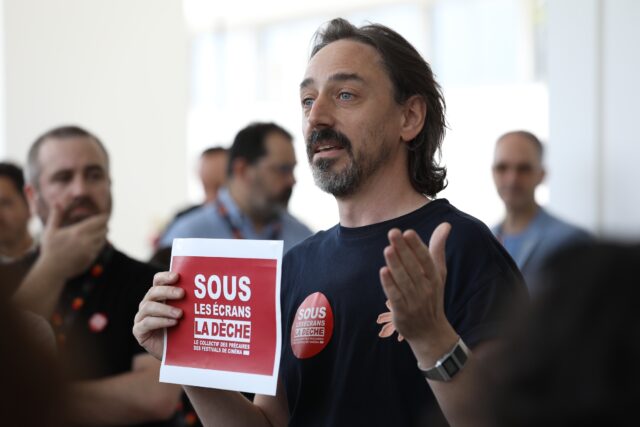
The Cannes Docs boss highlights a side issue (but nevertheless one of great social and cultural importance), how right now in France warnings about the precariousness of short-term contract festival workers and their ongoing livelihoods seem to go unheeded by both the CNC and the Department of Labour alike, a situation that places the festival sector in jeopardy (see souslesecransladeche.wordpress.com).
“Obviously, we’ll also be extremely proud and satisfied if the current festival workers’ movement in France has reached its demands regarding the catastrophic, destructive unemployment benefits reforms aggressively engaged by the French government,” says Chevit. “If we don’t obtain what we demand, it’ll be literally impossible for thousands of film festival workers to keep doing what we do, because of the absolute impossibility of making ends meet in-between contracts. Consequently, festivals won’t find anyone to hire, and I wonder how they will actually be able to simply take place.”





