

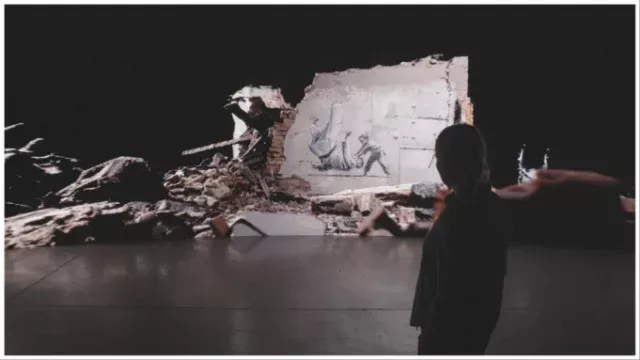
Despite its intricacy and its precision (as well as the gobsmacking effect it had on at least one viewer who got to experience it before Cannes) Murals is, in many ways, an oddity, albeit a beautiful, heart-breaking and highly thought-provoking one.
The work, directed by Ukrainian Artem Ivanenko and US artists Alex Topaller & Daniel Shapiro (Aggressive, USA),captures 3D scans of the stencils that Banksy, in November 2022, sprayed onto buildings in and around Kyiv that had been destroyed by Putin’s artillery. With the further application of light and sound effects, onscreen text and state of the art Unreal Engine 3D technology, the stories of many of Ukraine’s innocent dead are told, all emanating from the images cast onto the shattered walls of their former domiciles, apartment blocks, offices or kindergartens.
Murals is a labour both of love and duty, and is strictly non-profit with all revenues, if any, going to Ukrainian charities. World-premiering at Cannes Next on May 18, the work will be screened on a 30ft curved LED screen for audiences of up to no more than 20 people, although the directors concede that the work can be adapted for other forms of exhibition.
As the installation notes say, the work “confronts viewers with the devastating war of aggression and aims at showing the reality of conflict, while preserving Ukrainian cultural heritage.” It also serves as pin-sharp evidence of war crimes, should Ukrainian artist and filmmaker Ivanenko, who initiated the work, ever be called on to provide it.
The Banksy artworks may be ephemeral, subject to removal either for profit or for safekeeping, and indeed still prone to destruction by more Russian bombs, but their digital recording is permanent. “Our goal is to create a digital record of our country, history, and culture. Bombs cannot damage digital records,” says Ivanenko. “The highly detailed, real 3D models will be used as scientific, educational, social and legal evidence of Russia’s crimes in Ukraine. Truth is here to stay.”
The work is produced by Radosława Bardes (ATM Virtual, Poland), Maciej Żemojcin (PixelRace, Poland), and Maxim Dudko (Mriya, Ukraine).
US-based co-directors Topaller and Shapiro were approached by Polish producer Bardes after she was shown Ivanenko’s scans of the Bansky artworks. “The second she contacted us and said they were thinking about doing this thing, we said ‘we’re in,’” says Topaller. “Let’s just make it happen. Because we felt like it was very important. And it could be something tremendous. We [thought] we have to do something.”
“It was complicated though, because obviously you’re not just walking into making the film purely for the creative of it. There’s a lot to be carried, and there’s a lot that has to be carried delicately,” he adds of the sensitivity that each member of the production applied to the project.
Shapiro explains the choice of Unreal Engine 5 to work its magic on Ivanenko’s scans. “It is a real-time graphics engine. It’s what is used now in films like The Mandalorian… What was really great is even when we’re putting the storyboards together, we used Unreal to actually sketch out the scenes…you can literally move it [the image] around. You can light it the way you want…the creative story can come out very quickly using a real-time tool like this.”
“And Artem gave us very high fidelity scans,” Shapiro adds. “That’s one thing that was really special, when you open one of these up on your computer and you go in even down to the smallest piece of debris or garbage, the texture, the strokes of paint there on the buildings. In the kindergarten it was hard because there’s a stroller there, there’s a ladder that’s leaning against the building in many colours. I think that’s one of the things that was important for us – to keep the preservation of the original scans as much as possible because these are transplanted sections of reality.”
Ivanenko stresses how the work serves to help retain cherished memories of his country and underline the heroism of its people, but also to illustrate, in no uncertain terms, “the horror in which the people of Ukraine are being forced to live today.”
“Now we have faithful scans and capture a certain point in time,” adds Topaller. “Even Banksy’s artwork aside, these [are] homes that were destroyed. We know what it was like during that point in time…It provides evidence for the war crimes. It provides context culturally. It preserves exactly what happened.”
Of course, it was Banksy’s stencils that set the whole project in motion, but the film is more about astonishing bravery and resilience in the face of Russian aggression, and a chronicle of a people remaining steadfast within a world turned upside down.
That said, when pushed by me, Topaller recognises the similarities between the Murals team and Banksy himself. “I feel like the vector of our thoughts and feelings is similar to Banksy. It’s a non-commercial enterprise. Nobody’s making money off it. I know that when he came to Ukraine, he wanted to make a difference, to make an impact with whichever tools he has. And I feel we’re trying to make an impact with whatever tools that we have. So I feel like we’re aligned.”
The last word goes to Ukrainian Ivanenko, a resident of what he calls the “tragically famous” city of Irpin, the site of a month-long battle in February and March 2022 when Russian armed forces were resisted and ultimately repelled
“My country is at war. Every day we lose lives, our homes, our cities, and our future…Ukrainian heroes are going through the unimaginable on the front line to preserve our culture, history, and heritage. Our team is serving the same purpose in the rear. Our heavy weapons are creation and imagination used to preserve our architectural heritage, which is being targeted by the Russian rockets daily. We document the destruction caused by Russia as well as the contemporary art that is emerging despite and in the face of this destruction, knowing that it may vanish in flames.”





