

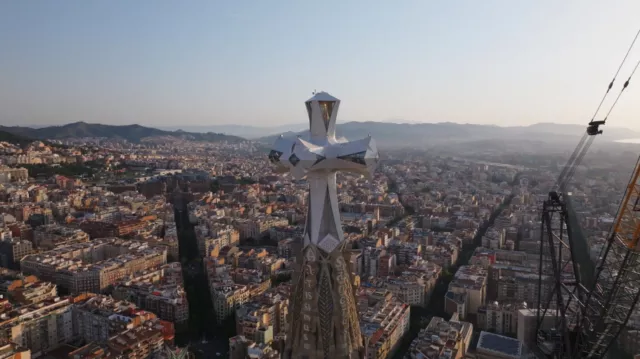
One of the cornerstones of Japanese broadcaster NHK’s offer at Sunny Side 2026 will be its new documentary on the completion of the Tower of Jesus on Antoni Gaudi’s spectacular Sagrada Familia cathedral in Barcelona. The documentary, exec-produced by NHK’s Masumi Hoshino (Sagrada Familia Project, Content Production Department, NHK) will premiere in Japan on June 28 before its international roll-out.
After years of building “mutual trust with the Sagrada Família,” NHK was granted permission to film on site from 2010, documenting the construction of the central towers since then. During this time, NHK has produced a series of programs, providing a continuous record of the construction’s progress. The programs captured key milestones, including the ultimate completion of the Nativity Façade in 2015, the Tower of the Virgin Mary in 2023, and now the Tower of Jesus in 2026. This extensive footage represents a historically significant record of the basilica’s construction, say NHK.
On June 9 the Pope officially blessed the newly completed tower.
“The greatest challenge was how to capture the full scale of the construction of the Tower of Jesus, which rises to a height of 172.5 meters,” the documentary’s executive producer Masumi Hoshino told BDE on the eve of SSD 2026.
“The sheer magnitude of the construction project required us to carefully consider how best to film it in its entirety,” he added. “To capture the lifting of the cross components, we used ultra-telephoto lenses. For the extremely confined worksite at a height of 172.5 meters, we deployed ultra-compact cameras. We also asked the crane operator to help position a 360-degree camera inside the crane cabin. We explored every possible method to bring viewers a vivid sense of being there.”
“As a result, I believe we were able to capture truly gripping footage—an experience unlike anything seen elsewhere. So far, this project has been entirely filmed and produced by NHK’s team, but we hope there will be a chance to share it with the world.”
The project has a very personal undertow for exec-producer Hoshino. “When I was 21, I travelled around Europe as a backpacker and visited the Sagrada Família. At the time, only the Nativity Façade was completed. I was overwhelmed by its sheer presence—it felt almost like a living being, growing with a will of its own. I was completely captivated,” he says.
“I returned in 2010 as a director and closely followed Japanese sculptor Etsuro Sotoo, who was then working on the three doors of the Nativity Façade,” he adds. “Through this experience, I was able to engage deeply with Gaudí’s vision as interpreted by Sotoo. I was particularly fascinated by Gaudí’s wish for peace—shaped by an era of inequality and terrorism in which he lived—as well as by his architectural philosophy, inspired by the forms and principles of nature.”
Prior to the Sagrada Familia project, Hoshino had already established a strong track record while producing programs on World Heritage sites—such as series on the Roman Empire and Angkor Wat—which were also distributed internationally.
“With 30 years of experience in documentary filmmaking, I have spent the past 15 years filming the Sagrada Família using 4K and 8K cameras. Together with my team, we were the first to introduce 8K cameras to the construction site of the Sagrada Família and capture it in such high resolution. We are grateful that our work has been well received and reflects consistently high standards in both visual quality and storytelling,” he adds.
Director Yukina Tashiro shares how, as the only woman on the crew, she developed a strong connection with the Sagrada Família’s construction site manager, who was also female. Tashiro ultimately persuaded the manager to appear on camera, explaining that seeing a woman in a leadership role within such a male-dominated work environment could be inspiring.
Hoshino continues: The fact that we were granted exclusive access to film the Sagrada Família, and to document its construction continuously over such a long period of time, represents a major strength for NHK. While June marks an important milestone for the basilica—and was the occasion for a special program—NHK plans to continue its coverage and broadcast a definitive, comprehensive version, one that represents the culmination of the Sagrada Família project, later in the winter. We very much hope to share this content not only with audiences in Japan but with people around the world.”
Also at Sunny Side 2026, NHK Senior Producers Yuko Fukuyama and Shin Yasuda, and Exec Producer Hiroyuki Shirakawa, will sit on a June 22 panel (noon) panel to outline “the broadcaster’s vision and editorial strategy for international co-production through its role in bringing Asian stories to audiences around the world.” Through concrete case studies, this session explores how NHK “builds global connections and creates concrete opportunities — leveraging original storytelling, technological innovation, and creative partnerships with independent filmmakers to deliver high-value factual content for the international market.”
Yuko Fukuyama expands on NHK’s desire to share stories from Asia with audiences around the world via international co-pro.
“One example is Sky Tiger, a highly ambitious project. Although tigers are generally believed to inhabit lowland areas, they have been discovered in high-altitude regions of the Himalayas, attracting the interest of scientists worldwide,” she says. “This project aims to capture their behaviour on film for the first time. It is an international co-production with Bhutan’s public broadcaster BBS and the Indian production company RBS (Riverbank Studios). With the full cooperation of Bhutan, we are developing new cameras capable of recording the tigers’ movements 24 hours a day, in addition to deploying 4,000 camera traps.”
“NHK has a longstanding history of providing technical support to BBS, which has made it possible for us to gain exclusive access to film in this region. While respecting the perspectives of local creators, we hope to promote this project at Sunny Side and share these uniquely Asian stories with audiences around the world.”





