The term ‘guilty landscapes’ was introduced by Dutch artist and poet Armando in 1970 to describe places which hide historical atrocities behind peaceful present-day façades, such as a sunny forest, or indeed a beautiful city, where mass murder, dehumanisation and genocide took place. It is a powerful idea that recurs in Claude Lanzmann’s magnum opus Shoah (1985), in which he shows the sites of the Holocaust as they appeared at the time of filming – eschewing archive footage with its (in his view) false claim to accurately represent a horror so unimaginable it could not, and therefore should not, be represented.
In their four-hour documentary Occupied City, which recalls the Nazi occupation and the persecution of Jews in their home town of Amsterdam, director Steve McQueen (for whom this is his first feature-length documentary) and screenwriter Bianca Stigter – who based the screenplay on her 2019 book ‘Atlas of an Occupied City (Amsterdam 1940-1945)’ – similarly forego the use of archive footage. Which is all the more remarkable since Stigter’s own directorial debut, the impressive documentary Three Minutes – A Lengthening (2021) did just that, recalling pre-war Jewish life through the creative use of archival material. This time, however, they only film the city as it appears today. And unlike Shoah, they also refrain from interviewing survivors and eye witnesses.
Instead, we are guided through the film by a continual voice-over – Melanie Hyams’ delivery is measured and well-cast – itemizing what happened in the places that we see onscreen as they are now, including the current occupants and the passers-by all going about their daily lives unperturbed. Although, as McQueen has underlined elsewhere, “this could happen again quite easily.”
There are a few musical interludes when the audience can let the stories and atmosphere sink in, and there are a few moments of diegetic music and dance, scattered throughout the documentary, providing the film itself with a sense of rhythm.
But mostly we listen to the voice telling us, usually in only a few lines, what happened to whom in whichever particular place, interspersed with some more general stories about the politics, policies and practicalities of the Nazi occupation. Jews were hidden in basements, betrayed for money (7.50 guilders per Jew for the Dutch person revealing their whereabouts) and deported to concentration camps. Collaborators held meetings. Nazis were shadowed and shot. Dutch prisoners were executed in retaliation. Papers were forged, schools were closed, babies were sent to Auschwitz.
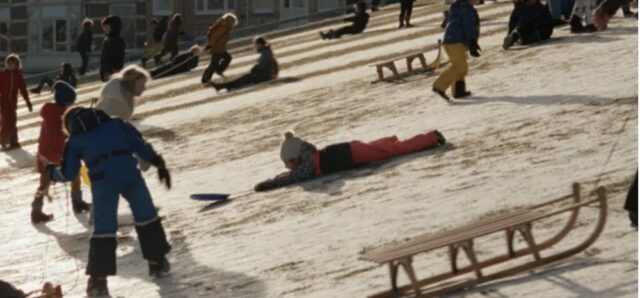
And all the time, we’re looking at these ‘guilty landscapes’. The beautiful canals of Amsterdam, the 21st century families living peacefully in their homes, the children playing and laughing in the streets. One might at first assume the filmmakers are drawing a polemical contrast between historical truth and modern indifference. There is indeed something jarring in juxtaposing these tragic stories with the lively energy of present-day Amsterdam. But the longer the documentary goes on – the four hour-plus running time is a necessity – the more layers begin to reveal themselves.
Because isn’t the reverse happening? Isn’t the celebration of life in these places of death the ultimate triumph? Isn’t this what the resistance fighters who appear in the stories were actually fighting for? Isn’t this what they themselves would have wanted to be doing? Seen this way, having a laugh or making music in a place where people were summarily executed is perhaps the best way of honouring them.
Then, a sense of haunting starts to permeate the film. Because not everybody we see is laughing and celebrating. Echoes of the war still linger in Amsterdam. The Day of Remembrance for the Netherlands’ war victims, which McQueen registers, is an obvious example. But the most dominant contemporary echo of occupation, state violence and resistance in Occupied City concerns the Covid pandemic, which not only provokes protests by anti-vaxxers opposing social distancing and other government policies, countered by a heavy police presence, but also leads to what we hear Dutch Prime Minister Rutte describe as the first evening curfew since the Second World War.
The empty streets of Amsterdam eerily fit the wartime stories, with their sinister sense of communal fear. But the demonstrations against the Covid measures are given too much screen time, becoming their own storyline within the film and, no doubt unintentionally, risking the false equivalence – made by many protestors at the time – between the government’s pandemic policies and Nazi repression.
But the anti-fascist struggles of the Second World War are also echoed by the modern activist in the film reminding his audience that their rights, including those of women, gay people, and people of colour, have literally been fought for. Meanwhile the voice-over notes how the Rijksmuseum very recently returned the last of the artworks it illegally acquired during the war to their rightful Jewish owners. And we see the opening, in the presence of the Dutch king, of the Holocaust Memorial in Amsterdam, as recently as 2021. As an Amsterdammer myself, I say: finally.
This monument bears the names of all known Jewish victims in Amsterdam. Such ‘name memorials,’ of which many exist around the world, are a way of countering dehumanisation by recognising each individual. Occupied City does something similar. Of course, the filmmakers cannot be as exhaustive. But over the course of the documentary’s four-hour running time, so many names are mentioned, often with their year and place of death, that they add up to a cumulative sense of those historical times. Here, history is made and remade through individuals instead of the other way round – an implicit, but powerful message in itself.
Which also relates this documentary to Gunter Demnig’s Stolpersteine, the ‘stumbling stones’ which are placed in front of houses from which Jewish occupants were deported, each stone bearing one name, birthdate and age of death, of which Occupied City shows four being installed in Amsterdam. Both the documentary and the Stolpersteine are about building a city from individual histories, one by one; about reclaiming history in these modern-day streets, squares, parks and houses; and about remembrance.
As with the laying of the Stolpersteine, and just like walking past the endless rows of names at the Holocaust Memorial, watching Occupied City has a sense of religious ritual. There is a sacred aspect to the act of remembrance, which lends itself to ritualistic repetition. The fact that my mind sometimes started to wander during these hours of individual stories, all recited in the same voice, is therefore not something negative per se. It felt similar to the way my mind used to wander during church services – and those were always precisely the moments when real reflection took place. There is an incantatory aspect to Occupied City, which fits very well with having all the stories spoken by a disembodied voice coming from somewhere outside this visible world.
Although the main focus is on the Holocaust, other related issues, such as the suffering of homosexuals and of the Roma and Sinti communities, appear throughout the film. And the film also shows the historical moment in 2021 when the Amsterdam mayor issues the first official apology for the city’s role in slavery, which has helped finance many of the fine buildings we see in the documentary, adding yet another layer to this historical X-ray of a ‘guilty cityscape’.
The Netherlands, United Kingdom, 2023, 262 minutes
Director Steve McQueen
Production Lammas Park, Family Affair Films, A24, New Regency, Film4
Producers Floor Onrust, Steve McQueen, Bianca Stigter, Anna Smith-Tenser
International sales A24
Script Bianca Stigter
Cinematography Lennert Hillege
Editing Xander Nijsten
Sound design Jan Schermer
Sound recording Jos ten Klooster
Music Oliver Coates