In 2011, German director Wim Wenders wowed the film world with his 3D documentary Pina, finally convincing a cynical arthouse crowd that yes, 3D technology could be put to the service of artistic expression.
In 2023, Wenders (whose fiction feature Perfect Days also plays in Cannes) returns to 3D documentary filmmaking with Anselm, a portrait of fellow German artist Anselm Kiefer. When presented alongside his fiction features Every Thing Will Be Fine (2015) and The Beautiful Days of Aranjuez (2016), as well as a number of shorter 3D films and installations, the work is further proof of how 77-year-old Wenders remains at the vanguard as one of the very few auteur directors to consistently explore cinema’s third dimension.
And again, he proves to be a master of the medium. Like Pina, this new documentary does not feel experimental at all, but fully accomplished. As if 3D documentaries weren’t the exception, but a well-established part of the arthouse mainstream.
In Pina, a portrait of famed choreographer Pina Bausch, the use of 3D was informed by dance. The 3D cinematography enhanced, clarified and even contributed to the spatial aspects of the art form. In Werner Herzog’s Cave of Forgotten Dreams, which premiered in 2010, 3D also fit the art form by echoing the spatial experience of exploring the prehistoric paintings in the Chauvet-Pont-d’Arc Cave in France.
With Anselm, shot in crisp 6K, I expected something similar to what Herzog did in Cave of Forgotten Dreams, when he filmed the paintings in close-up, showing how the rough surface of the cave informed the artistic choices of the prehistoric people who incorporated the shapes into their depictions of animals. Kiefer is an artist who also famously works with irregular surfaces in his gigantic paintings, with thick layers of not only paint, but also plaster, mud and clay, even lead, shellac and straw. But to my disappointment Wenders didn’t show the extreme 3D textural close-ups of Kiefer’s paintings on the large screen of Cannes’ main Lumière cinema I was hoping for.
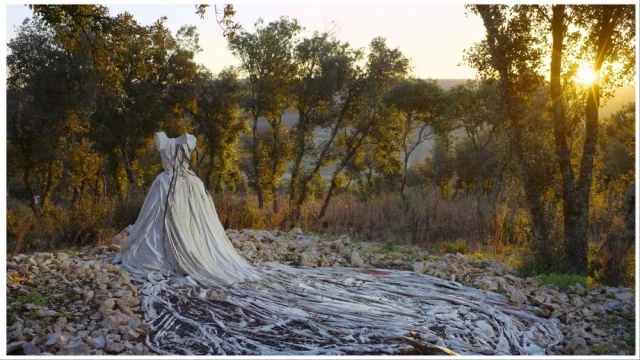
Aside from this, Wenders’ use of 3D is exemplary. He begins by showing some of Kiefer’s sculptural works (forgive me for not knowing their titles): white painted ball gowns, shaped as if worn, but without heads – or with their heads replaced by metal or other objects. Meanwhile, the names of famous women from history, handwritten on the surrounding walls, are whispered by disembodied voices, seemingly emanating from the artworks themselves or from some unseen angels circling them – one of a number of moments recalling Wenders’ 1987 masterpiece Der Himmel über Berlin.
Another such moment is when we hear Kiefer’s thoughts as he silently ponders – one of the ways Wenders includes the artist’s reflections without resorting to interviews. In this selective biography, which focuses less on Kiefer’s private life and more on his work, Wenders foregrounds Kiefer’s controversial take(s) on Germany’s Vergangenheitsbewältigung, ie the country’s reckoning with its dark past, especially during the Nazi era, and the condition of Germany’s collective soul.By creating a mythology which incorporates Nazi imagery and symbolism, Kiefer inevitably invited the accusation that he himself was a fascist. An ambiguity of intent which is of course essential to the work, and underlined by the use of Kiefer’s paintings by the Slovenian art band Laibach in their equally controversial toying with totalitarianism.
It is here that I feel that Wenders and Kiefer, both children of 1945, best find each other. Like Der Himmel über Berlin, much of Kiefer’s work is part of this reckoning with the past. If, like me, you are struck, impressed and even intimidated by the way Kiefer confronts the scorched earth of Germany’s horrific history, Wenders’ 3D rendering will do the same.
As Wenders’ camera pans across the landscape to stop at the entrance to one of Kiefer’s work places, he clearly demonstrates how 3D works especially well indoors, where the architectural physicality materialises in terms of size and distance. It was therefore an inspired choice to structure his biography around Kiefer’s successive ateliers. As Wenders said elsewhere: ‘Coming out of this film, you can say: “I was in Anselm’s world.”’
And these ateliers are huge. Anselm actually makes what could be called a ‘3D joke’, when we look down at rows and rows of massive paintings in Kiefer’s current studio, when the artist enters the frame – at least five times smaller than we’d imagined. Meaning these paintings are so much more gigantic than our minds even allow us to comprehend. I call this a ‘3D joke’, because I’m pretty sure the 3D settings were set to amplify this effect as much as possible.
3D also helps us explore and experience the remarkable 40-hectare world Kiefer has created at La Ribaute in Barjac, France, which includes crypts and tunnels that appear as natural formations. One shot in particular, in which Kiefer, seen from behind and wearing a long black coat, walks up a flight of stairs in the rain towards a field full of sloping and uneven towers, with empty black entrances on various unreachable levels, all built by Kiefer himself, strongly reminded me of Andrei Tarkovsky’s aesthetic – the closest I’ve come to 3D Tarkovsky!
The scenes with a younger Kiefer, played by his own son Daniel, and Kiefer as a child, played by Wenders grand-nephew Anton, are biographically functional but artistically less engaging. And by filming these scenes in 3D, Wenders undermines the conceptual clarity of his documentary, in which (just as he did in Pina) the present reality is filmed in 3D and archival material is shown in 2D – suggesting that the memories they represent are somewhat distant from reality, as memories inevitably are.
The three-dimensional scale of Kiefer’s works is also emphasised by watching him at work. Kiefer doesn’t place a canvas on an easel – he rides to his painting on an aerial platform cart. He doesn’t just pick up a brush – he uses a flamethrower to scorch and burn the landscapes he is creating, or pours molten metal over them with the help of a forklift. He builds brick towers, and lead planes and rockets close to life-size.
Kiefer creates worlds so immersive that, standing in front of one of his monumental paintings, one disappears in it. This is where the immersive qualities of 3D really come in. Being the meta filmmaker that he is, Wenders has used this medium to immerse us into the immersive and create a monument for the monumental.
Germany, France, Italy, 2023, 93 minutes
Director Wim Wenders
Production Road Movies
Producers Karsten Brünig
International sales Hanway Films
Script Wim Wenders
Cinematography Franz Lustig
Editing Maxine Goedicke
Sound Régis Muller
Music Leonard Küssner
With Anselm Kiefer, Daniel Kiefer, Anton Wenders