

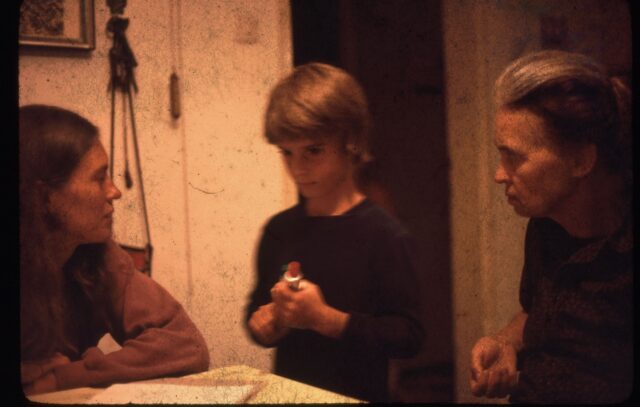
Director Jakob Krese, who grew up between the former Yugoslavia and Germany, explains the family history that informs his existential documentary essay About the End of the World.
“My grandmother, Staramama, fought as a partisan against fascism in the Second World War and in support of the revolution in Yugoslavia,” he writes. “After the war, she became part of the political elite and started a family. Her daughter, Mama, rebelled against that revolution and saw her country go up in flames. When war broke out, she rushed to the besieged city of Sarajevo to support her friends. Her son—me—is making a film about them, about a country that no longer exists, and about the hope that sustains all of us.”
The project, pitched at CineLink 2025, is produced by Ivana Naceva of Pótem (Slovenia). “What makes About the End of the World intriguing is its multi-generational narrative, linking together memories of the outside world to the intimate tone of home,” she tells Business Doc Europe. “It blends historical sources with the unique family heritage and personal texts of director Jakob’s family, conveying an intimate and authentic perspective across generations.”
From the beginning the production team have developed a specific cinematic language, “one that comes to life through the contrast and interplay between the individual and the collective,” Naceva stresses. “We experience intimate fragments from the lives of the grandmother and mother through their inner monologues, which we hear through voices from off-screen, while at the same time being confronted with the larger historical context through the archive material.”
“At the centre of the film are the lyrical texts of Jakob’s mother, Maruša Krese, published in her novel and short story books, as well as the unpublished diary writing of his grandmother, Ljudmila Krese – Maruša,” she adds.
“We follow their narrations through off-voices read by actresses in a neutral tone. The footage, and to a lesser extent photography, that accompanies their stories are archival documents gathered from almost all countries of former Yugoslavia, from public televisions, film archives (both state and private), cinematheques, museums and galleries, spanning from the 1940s onward. Films of various ideological, production, and stylistic backgrounds are woven together to reveal a largely unknown cinematic world.”
Naceva further points out how Krese’s films have always been politically engaged, addressing themes such as migration, the sense of belonging, and acts of collective resistance. “In About the End of the World he continues his exploration from a different perspective and in a new format. This time, he draws his inspiration from his own home and family, and tells a multi-layered political story about Yugoslavia, a country that no longer exists, but remains deeply embedded in the identity of those whose lives were intertwined with its history. We believe that he brings a bold vision to the project, one supported by a carefully chosen visual approach that allows him to contextualise the individual stories of his family within a broader political framework.”
About the End of the World is a four-way co-pro between Slovenia, Germany, Italy and Croatia. “The production teams create a rare synergy that goes beyond the usual industry practice,” Naceva opines. “What makes this collaboration even more inspiring is that it involves two younger, emerging production companies – Pótem and Zero Stress – working alongside more experienced players like Majmun Films and Restart. This dynamic creates an exciting space for innovation and fresh perspectives, while benefiting from the expertise and stability of the more seasoned partners.”
In Sarajevo, the producer is looking to garner sales, distributor, broadcast and festival interest ahead of a Summer 2026 release. “The film will be produced primarily for cinematic exploitation, with the goal of a strong theatrical run,” says Naceva. “Our wish is, of course, to secure a world premiere at an A-list festival. After the initial release, we will explore opportunities across other formats and platforms, including more alternative distribution channels. Planning for the film’s festival strategy and release is something the team is currently working on.”
“We believe this story has the power to resonate with both local and international audiences, drawing them into the universal experiences of loss, hardship, and destruction, while offering inspiration through a family’s hope and resilience,” she stresses the enduring at the heart of the story. “In 2025 we mark the anniversary of the Second World War with a troubling world where it seems nothing much has changed. By telling the story we want to shed a light on the enduring human spirit that persists amidst the scars of repeating history.”





