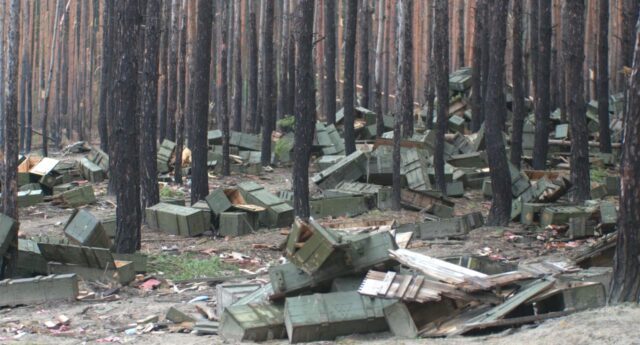
The feature documentary Divia (named after the Slavic goddess of water, rivers and lakes), reveals Ukraine’s harrowing journey through unprecedented Russian aggression and its haunting aftermath: forests reduced to ash, fields damaged by explosions, and the lingering presence of abandoned military wreckage within treacherous minefields.
Amidst this desolation, nature stands as a silent witness, absorbing and beginning to heal from the scars of conflict, the project synopsis reads.
“This is an observational meditative journey which contains neither dialogue nor a vocalized narration: its tone is set by the juxtaposition of images, music and sound design,” producer Polina Herman of the Ukrainian UP UA Studio tells Business Doc Europe. “A slow moving camera leads the viewer from harmonious nature to war, its consequences and nature’s attempt to recover. Through music and sound design, the viewer should feel the presence of the nature goddess Divia.”
Herman points out that the project is very important not only for Ukraine but also for Europe as a whole, since war destroys the nature and ecology far beyond Ukrainian borders. “Using Ukraine as an example, this can happen everywhere. Our project is very universal, since our film is without dialogue and there is no language barrier. Our cinema is a universal cinematic language that will be understandable to everyone” she says.
The meditative narrative, without any dialogues, follows de-miners, body searchers, environmentalists, and animal activists who navigate the wreckage, striving to quantify the tragedy’s impact and restore Ukraine’s fragile ecosystems, the project synopsis further reads.
“As for partners, yes, the topic of ecology is of interest to many European countries, including America,” Herman tells BDE. “We already have many partners [the co-pro countries are Ukraine, Poland and the Netherlands], but we are also open to new ones. We need additional funding for an editing director, since the process of editing such a film has turned out to be more complicated than we initially thought and requires more time. We are also looking for sales agents and distributors and, of course, a platform for the world premiere.”
She underlines why this is an important project for investors and audiences alike. “The destruction of nature is a significant part of the cost we Ukrainians pay for our freedom from Russia, which views nature and the world around it merely as resources for exploitation and expansion. Documenting the Russian military’s eco-crimes and the destruction of natural landscapes and ecosystems is crucial. Understanding the scope of these issues is the first step toward solving them. While environmental concerns might not be a priority for Ukrainians amidst pressing issues, neglecting them could threaten our lives more than anticipated.”
Polina met director Dmytro Hreshko in the Carpathian forest when she was location scouting there in 2019. They have worked together ever since, their friendship reinforced after recently surviving a massive shelling operation by the Russian military. “Now we trust each other completely,” she says.
“I think his ideas for films are brilliant and their implementation is very deep and meaningful,” Polina adds of her director. “His qualities are deep-thinking, sensitive to the world around him, brave, responsible and logical. He knows what he wants.”