“Like a regret that this film has us share…this interlocutive filmic work engages in painful and invigorating questions about culture, as the notion is now widely shared even as far as the Amazon.” So said the jury when they awarded the Cultural Intangible Heritage Award 2025 to Monikondee (Money Land) at Cinéma du réel this weekend in Paris.
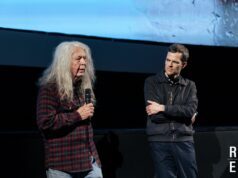
BDE caught up with Dutch artists and filmmakers Lonnie van Brummelen & Siebren de Haan, along with Surinamese writer, theatre maker, and performer Tolin Alexander, the film’s three directors to find out more.
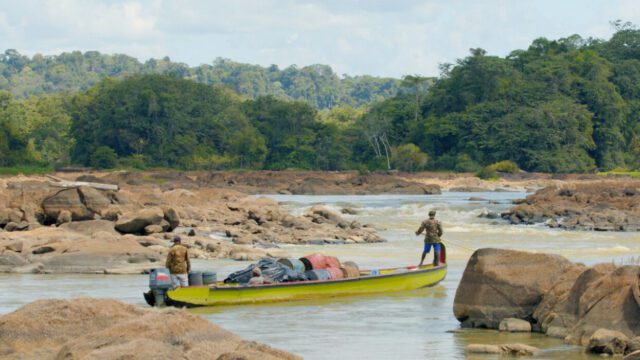
Produced by Vriza Productions and world-premiering at the leading French documentary festival, Monikondeefollows a boatman, Boogie, who delivers cargo to remote indigenous and Maroon communities along the river bordering Suriname and French Guyana. His winding journey offers an insight into the complex challenges of maintaining local customs in the face of rampant gold mining, multinational corporations and a changing climate.
When Boogie is summoned by his clan leaders to attend his nephew’s trial, the demands of his money-driven work begin to conflict with his traditional duties.
Van Brummelen, de Haan and Alexander, a Maroon who hails from eastern Suriname, first met whilst filming Stones Have Laws (2018). This led to discussions on how gold mining has affected the former Dutch colony.
Whilst this mining has been going on since the 19th century, bringing with it a money-centred, largely western culture, many of the tribes are relatively isolated, and even those that aren’t have maintained their own way of living and organising themselves.
It’s a culture partly based on traditional African systems which, Alexander suggests, have survived robustly in Suriname. This culture, and that of the indigenous peoples, is still a huge source of strength and wisdom for the Surinamese tribes.
“If we look at the way our chiefs rule – cultural-wise, tradition-wise – we see that it’s a sort of consensus model. That means that community meetings continue until a collective decision has been made to which all agree. When we freed ourselves from slavery – because we talk about freeing ourselves, not running away – the Sweli obia led us through the forest. Sweli was the magic source that led us to where we are…. and Sweli is still one of the important oracles that the gaaman, the head of the chiefs of the Ndyuka community consults when we have a decision to make.”
It’s a culture that is deeply spiritual and lives in harmony with the land, a fact which is communicated eloquently in Monikondee through sweeping landscapes, participatory storytelling and traditional music.
The three filmmakers worked with five different Maroon and Indigenous groups to help present what is important to them as they confront new realities. How did they do this?
Siebren de Haan tells us that the chiefs consulted their own communities, before deciding on the major issues and coming to the filmmakers to articulate their points. Gold mining, climate change and commerce mean that bartering is less possible, money is needed to buy goods and food because climate change is preventing them from growing their own, and resistance to these new ways of life make it difficult when they are forced to trade.
Monikondee’s core protagonist, the boatman Boogie, exemplifies these issues as we follow him on his arduous trip upriver, determinedly fighting the currents, a metaphor for the tide they’re all pushing against.
His main cargo is oil and food, which he takes to the miners and the tribes in turn as he criss-crosses the water. We are shown how he is derided by the tribes for dealing with the miners, and berated for the high price of his food, but still they trade with him and accept him. Boogie himself is from two Maroon tribes – the Ndyuka and the Pamaka – and needs to make a living from a fragile, storm-damaged boat which makes slower and slower progress up the river which is dangerously low due to climate change.
The resulting cultural exchanges, and the tribes’ cultures and storytelling traditions, inform the cinematic approach for the film. Van Brummelen explains to BDE how, “there’s actually a Maroon storytelling tradition called mato that one person is telling a story and then people sit around, but they can always intervene and bring a song or another story… We worked with this inclusive concept of mato storytelling. That’s why the film has a main narrator, but then you lose him occasionally, and others can tell their own stories.”
“Besides the storyteller, and those interrupting, the mato also has a pikiman. We were really fascinated by this pikiman figure because this person is repeating all the important words and confirming what is being said.”
“In this way, it kind of guides the viewer and keeps the viewer focused,” van Brummelen continues. “And we thought, that’s actually what the cinema apparatus is also doing. The camera is contributing to the story, for example by focussing on the water, or by following a certain person or a thing for a moment.
“Like this, the audience is more inclined to listen,” adds De Haan. “The film is a kind of immersive experience, and you can do that with the sound, with the camera movements, and also with the performances of the (non)actors.”
The crew faced many challenges during the 55 days they spent travelling on the river, battling the heat, the limited space in the boat, and at one point being stuck in the forest for two days with no food or water.
“We asked for help from the local indigenous village and they cooked some soup for us,” says van Brummelen. “I think for all of us, it was quite a powerful experience, a life changing moment.”
Working on the film changed Boogie the boatman. Van Brummelen, de Haan and Tolin relate a conversation they had (during Cinéma du réel) with Boogie about his experience.
“He met all these different river-communities. Boogie is from two peoples himself, but he also met the fierce Aluku women who complained about the state of the water – the Wayana people also. He really got what pollution is doing and that really set him thinking. He also said yesterday that he wanted to find a way out, to not work for gold miners anymore.”
Van Brummelen adds: “One of the nice things from this film was that all these remote groups were connected once again. It’s too soon to say if it’s changed anything, but at least the contact is made.”
In fact, de Haan tells us, a special moment was when the Indigenous chief of the Wayana people travelled from the deepest rainforest to a preview screening and gave a speech to the gathered tribes about the importance of collaboration. “We need to stand together,” he said.
And what of the wider impact the filmmakers are looking to deliver with Monikondee? “We felt that it was very important to make a film that could transport people in this reality to see how these communities survive and what they’re faced with. And then I think we need to be more responsible in the west to also take these remote communities into account with all our plans… we are also very happy to have a world premiere in France, because French Guyana borders Suriname. These countries would need to collaborate more to maintain the rainforest in that area,” van Brummelen stresses.
Tolin Alexander sums up the urgency for us all. “We need to cry out. I think that’s what the world needs now, to look at people who can live in a responsible manner with nature, because we are all part of the ecosystem,” he ends.